
5 Best RFP Software for SaaS Companies (2026 Reviewed)
Compare best RFP software for SaaS companies. Get AI-powered platforms that automate proposals, security questionnaires, and DDQs.

Technical Account Manager, AutoRFP.ai··18 min read
The best RFP software for SaaS companies helps revenue teams answer RFPs, security questionnaires, and DDQs without relying on stale content or repeatedly chasing subject matter experts.
This guide breaks down five of the best RFP software platforms for SaaS teams, including key features, strengths, weaknesses, real customer reviews, who each platform is best suited for, and how to choose the right tool for your sales and proposal workflow.
Best RFP Software Solutions for SaaS Companies: At a Glance
| Name | Best for | Standout feature | Price starting point |
|---|---|---|---|
| AutoRFP.ai | B2B SaaS teams needing defensible RFP, security questionnaire, and DDQ responses | Source-grounded answers with citations, content age, and a Trust Score | $899/month |
| Loopio | Established proposal teams with dedicated content managers | Structured content library with Close the Loop updates and review cycles | $20,000/year |
| Responsive | Large enterprises needing complex proposal operations and reporting | Deep project management, analytics, and Trust Center capabilities | Contact sales |
| Arphie | Growing SaaS teams wanting cited drafting, competitive research, and narrative support | Citation-forward responses with transparent sourcing and competitive intelligence | Indicative pricing of $36,000-$60,000+ per year |
| Qvidian | Document-heavy enterprise teams using Microsoft Word-based proposal workflows | Word-centric proposal management with enterprise governance and reporting | Contact sales |
1. AutoRFP.ai: Best for Defensible RFP Response Automation for B2B SaaS Teams
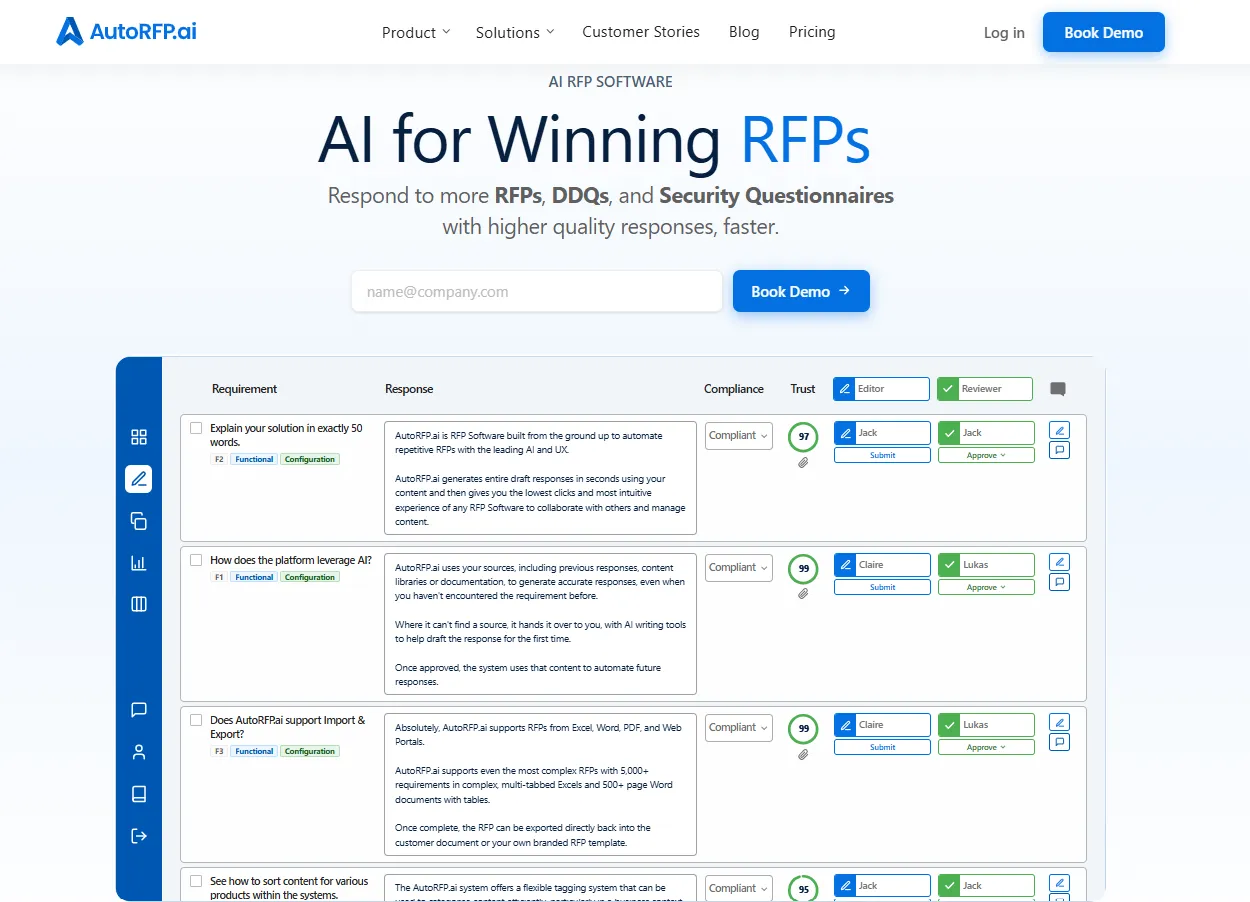
AutoRFP.ai is the best RFP software for B2B SaaS companies that need accurate, defensible answers across RFPs, security questionnaires, and due diligence questionnaires. It is the accuracy-first AI platform for high-stakes responses, with every answer source-grounded and citable, plus zero library maintenance.
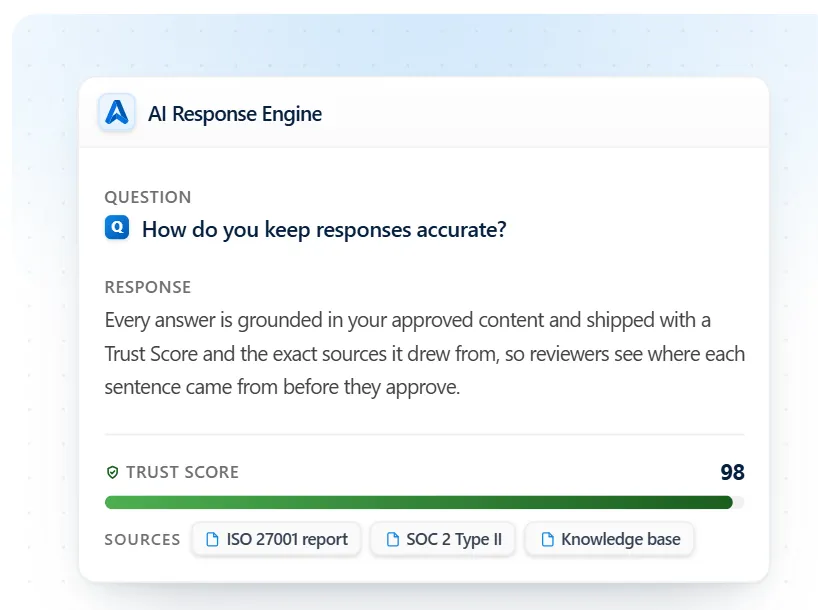
Its defining capability is zero hallucination by design. AutoRFP.ai only drafts from content your team has approved. Each answer displays its sources and a Trust Score, while unsupported questions are flagged and routed to a person for review instead of being filled with an AI-generated guess. A multi-model pipeline handles retrieval, re-ranking, drafting, redrafting, and checking behind the scenes.
This approach is particularly valuable for SaaS companies selling to enterprise buyers. RFP managers, sales engineers, and security teams often handle RFPs, security questionnaires, and DDQs simultaneously. AutoRFP.ai brings that blended response workload into one governed platform while connecting to the content and communication tools the team already uses.
Key Features
1. Response Generation
AutoRFP.ai generates submission-ready responses from approved company content rather than generic internet knowledge. Every answer includes source citations and a Trust Score, helping reviewers identify which responses are well supported and which need closer attention.
The platform can match the company’s existing terminology, tone, and response structure, apply win themes across multiple answers, and adjust response length to suit the question.
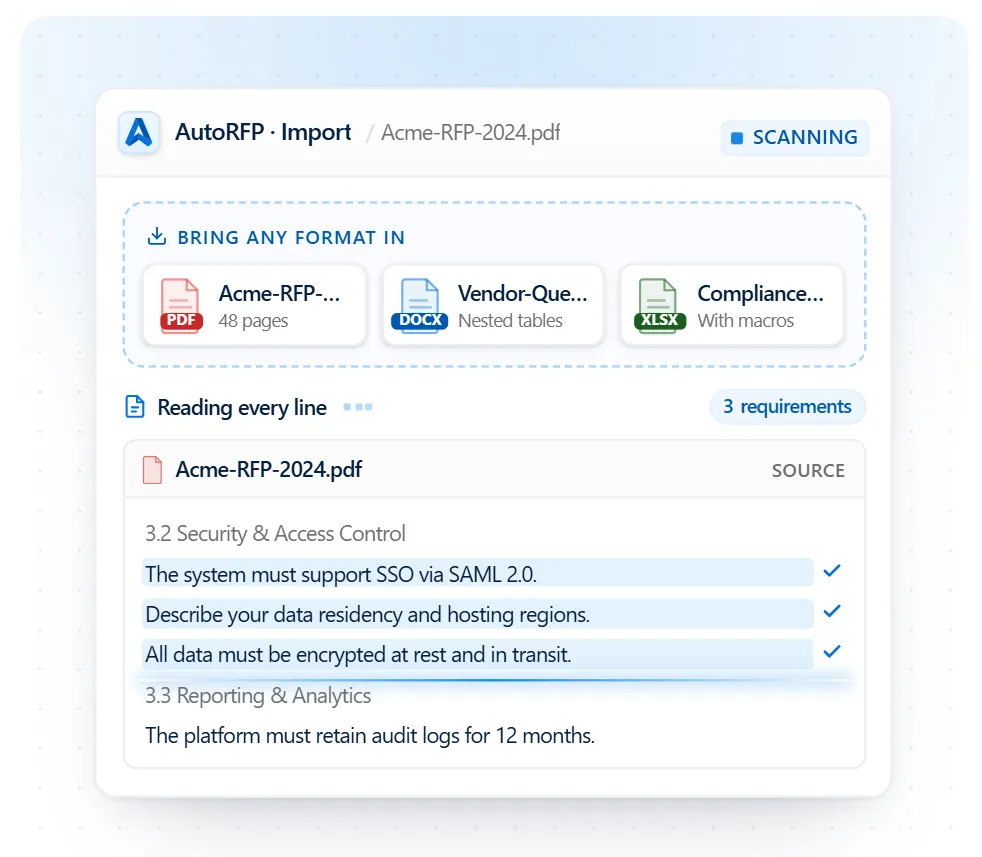
When approved evidence is missing, it flags the question and routes it to a person rather than inventing information. Teams can also import complex RFPs from Word, PDF, and Excel files, including workbooks with multiple tabs and macros.
2. Content Management
AutoRFP.ai replaces the traditional content-library maintenance model with a self-building system that learns from every approved response. New answers are automatically categorized and made available for future projects without requiring teams to continuously organize snippets, folders, tags, and taxonomies.
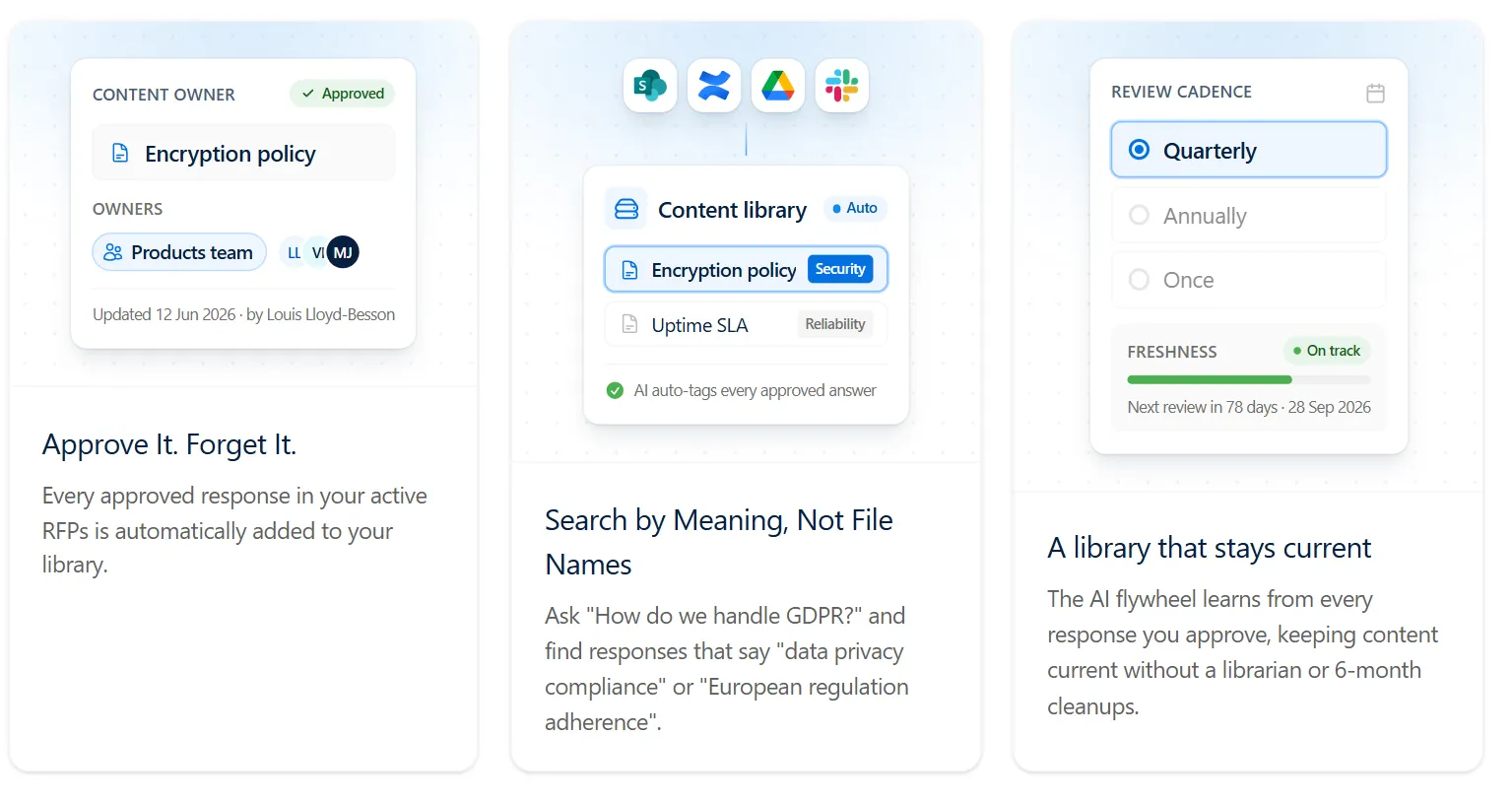
Semantic search finds relevant information by meaning rather than relying only on matching keywords.
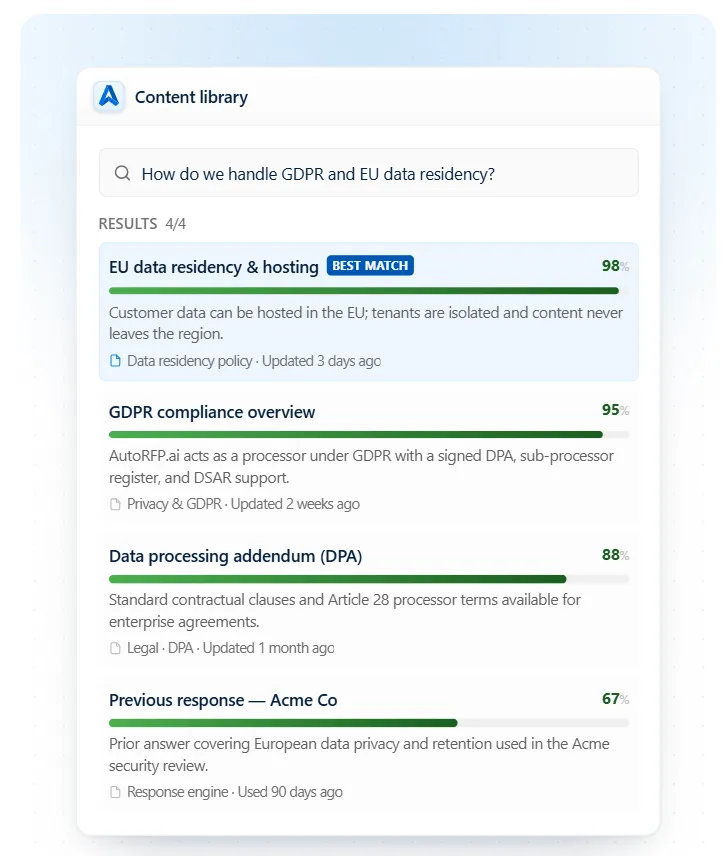
Teams can connect sources such as SharePoint, Confluence, Google Drive, OneDrive, Notion, Box, Intercom, and Zendesk. Content owners, renewal schedules, approval controls, freshness signals, and source-conflict detection help keep the information current and governed.
3. Collaboration
AutoRFP.ai provides a shared workspace where bid managers can assign editors and reviewers, track project progress, leave requirement-level comments, and manage approvals without relying on separate spreadsheets and email chains.
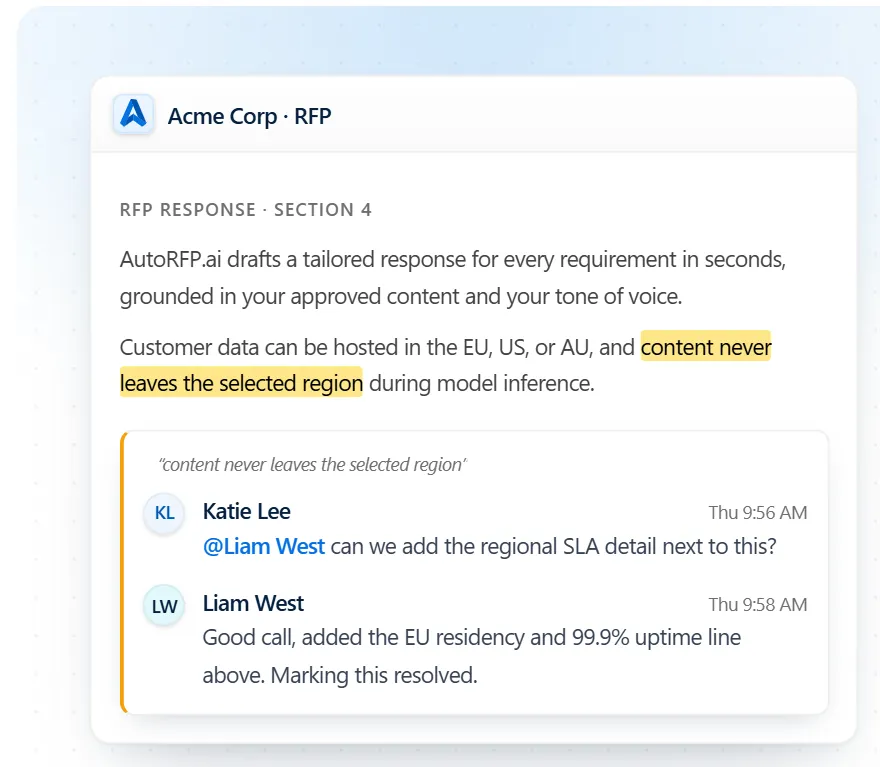
Subject matter experts can receive assignments and reminders through Slack, Microsoft Teams, or email. They can also retrieve approved, sourced answers directly within Slack or Teams. Real-time editing, sequential reviews, approval histories, role-based permissions, and audit trails make it suitable for responses involving sales, pre-sales, security, legal, and product teams.
In fact, 94% of high-win teams used either joint collaboration or a proposal-team-led model in which SMEs reviewed responses. Only 6% relied on SMEs to produce the first draft before proposal-team review.
4. Integrations
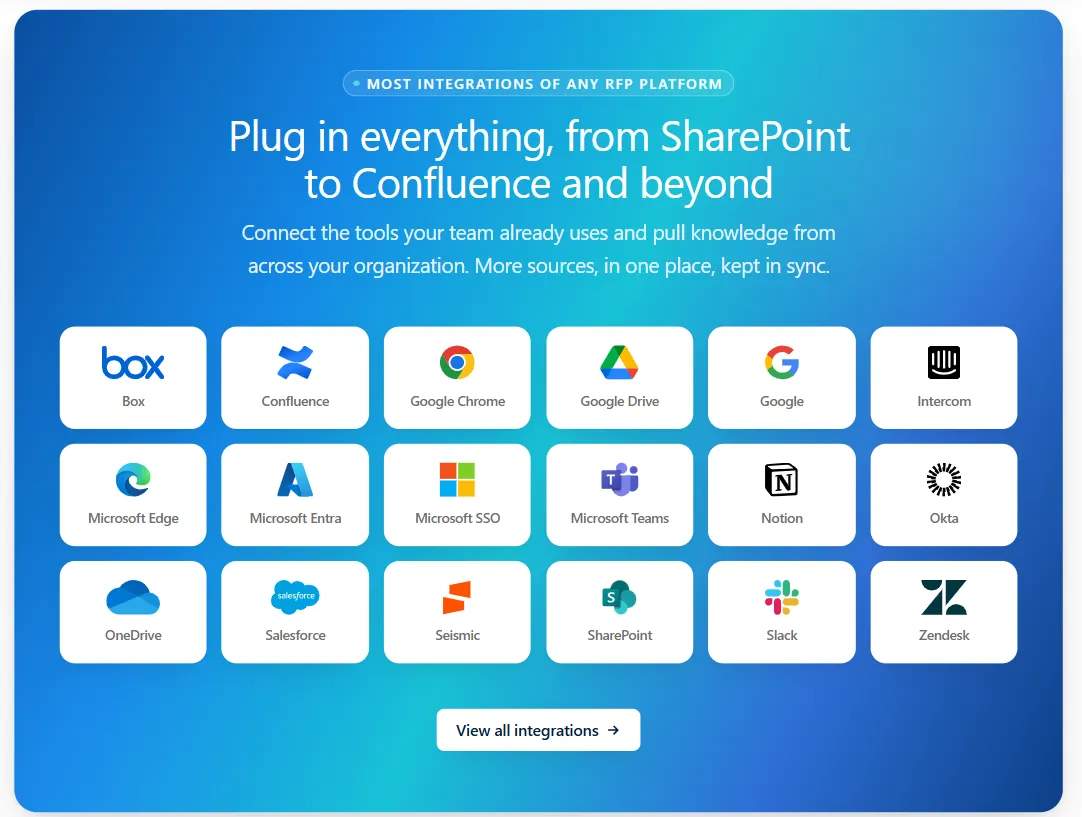
AutoRFP.ai connects response workflows with Salesforce, Slack, Microsoft Teams, SharePoint, Confluence, Google Drive, OneDrive, Notion, Seismic, Box, Intercom, and Zendesk. Identity and access integrations include Okta, Microsoft Entra, Microsoft SSO, and Google Workspace.
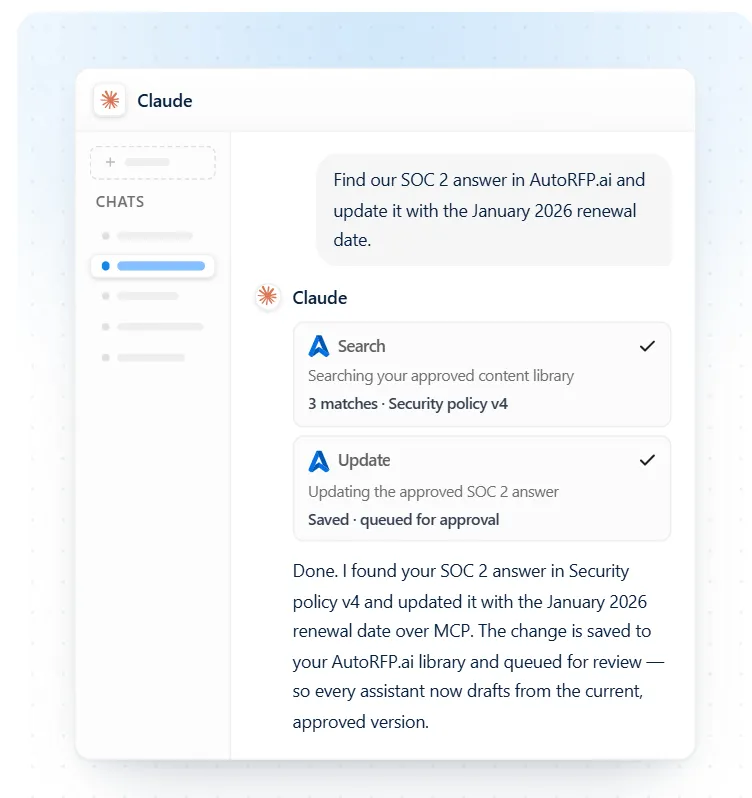
Its Model Context Protocol server also lets approved knowledge be accessed through AI assistants such as ChatGPT, Claude, Microsoft Copilot, and Google Gemini.
Pricing
| Plan | Price | Key Inclusions |
|---|---|---|
| Scale | $899/month (paid yearly) | 24 projects per year, unlimited AI, unlimited content, unlimited users, all features, SSO (Google & Microsoft), 18+ integrations, ISO 27001:2022 and SOC 2, unlimited support, online training |
| Accelerate | $1,299/month (paid yearly) | 50 projects per year, unlimited AI, unlimited content, unlimited users, all features, SSO (Google & Microsoft), 18+ integrations, ISO 27001:2022 and SOC 2, unlimited support, online training |
| Enterprise | Flexible pricing that scales with your business | Scalable projects per year, unlimited AI, unlimited content, unlimited users, all features, SSO (Google & Microsoft), 18+ integrations, ISO 27001:2022 and SOC 2, unlimited support, bespoke implementation, bespoke terms |
Note: AutoRFP.ai offers a 30-day money-back guarantee, and we would rather show you than tell you: run a two-week proof of concept on your own RFPs and measure the no-edit rate yourself.
Where AutoRFP.ai Shines
- Defensible answer generation: Every response is linked to approved sources and accompanied by a Trust Score, making it easier for reviewers to understand why the answer was generated.
- Zero library maintenance: Approved responses improve future drafts without forcing teams to constantly curate snippets, tags, folders, and content-library taxonomies.
- Built for the full SaaS response workload: RFPs, security questionnaires, RFIs, and DDQs can be managed through one governed system instead of separate point solutions.
- Strong fit with the SaaS stack: Salesforce, Slack, Teams, SharePoint, Confluence, Google Drive, SSO, browser extensions, and MCP connections reduce workflow disruption.
- Enterprise security and governance: AutoRFP.ai is ISO 27001 certified and SOC 2 Type II audited annually, and never trains on customer data.
- Format and portal coverage: Teams can work with complex Word, PDF, and Excel documents, respond inside online portals, and return completed answers in the customer’s original format.
Where AutoRFP.ai Falls Short
- Not designed for buyer-side procurement: AutoRFP.ai helps vendors respond to RFPs. It is not an RFP creation, vendor-selection, or procurement-management platform.
- Not built primarily for narrative-heavy proposals: Teams whose main requirement is long-form persuasive proposal writing, desktop publishing, or design-heavy tender documents may prefer a specialized proposal-authoring platform.
- Not positioned as the lowest-cost entry option: Very small or low-volume teams seeking basic drafting assistance may prefer a lighter tool, while AutoRFP.ai is designed around governed, repeatable enterprise response workflows.
Customer Reviews
Scott M., Account Executive, said, “AutoRFP.ai has dramatically reduced the time our team spends responding to RFPs, due diligence questionnaires and security assessments. The AI is fast, accurate and reliably pulls from our approved library of past responses. Where we historically spent hours filling out monotonous questionnaires on repeat, we can now comfortably meet deadlines for these questionnaires and focus on the more important work of getting our product in front of prospects.”
Kristen C., Marketing Manager, said, “We are new to AutoRFP, but so far, we are really enjoying it and can see the value it will bring to our company. Setting up new projects and working through them is so much easier and more controlled than working from spreadsheet versions. Assigning tasks, adding comments and attaching documentation to each question have been so helpful. I am looking forward to wrapping up our first project.”
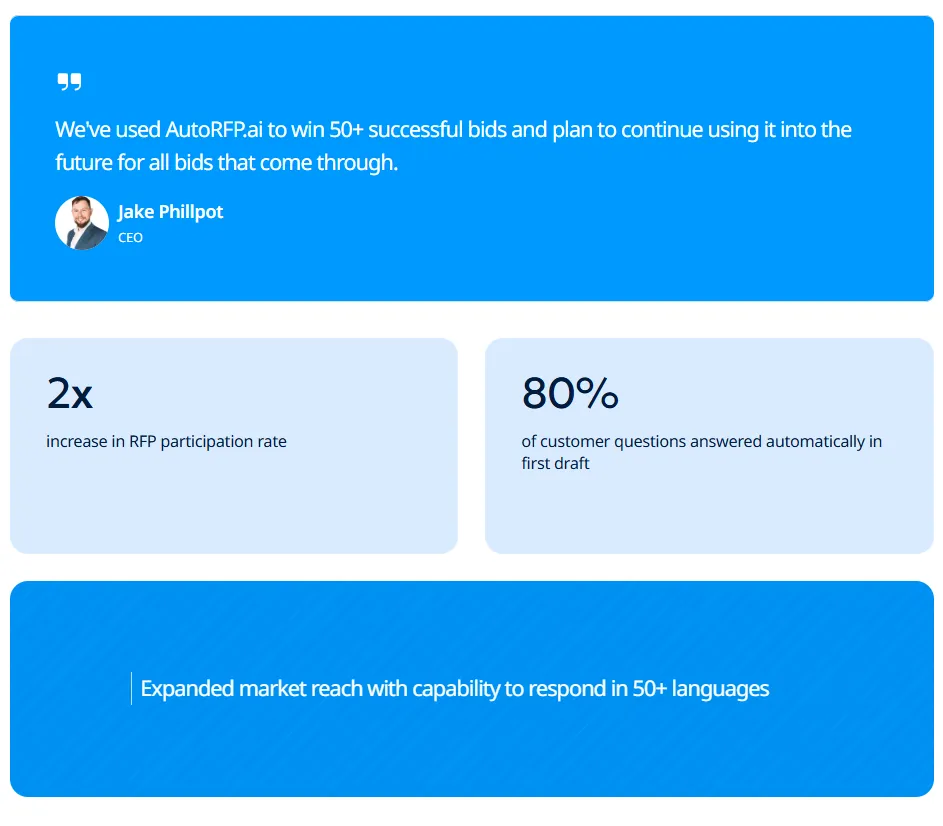
Jake Phillpot, CEO, said, “We have used AutoRFP.ai to win more than 50 successful bids and plan to continue using it for all future bids.”
Who AutoRFP.ai Is Best For
AutoRFP.ai is best suited to B2B SaaS companies with approximately 100 to 5,000 employees that sell software to enterprise or institutional buyers. It is particularly relevant when a meaningful share of revenue depends on competitive RFPs and customer security reviews.
The strongest-fit users include:
- RFP managers and bid writers responsible for coordinating repeatable response work
- Pre-sales and solutions engineering leaders managing limited SME capacity
- Sales engineers, security specialists, and product experts who should review answers rather than write every response from scratch
- Enterprise sales teams handling recurring RFPs, security questionnaires, RFIs, and DDQs
- SaaS companies replacing a library-heavy legacy platform or evaluating whether to build an internal RFP assistant with ChatGPT or Claude
- SaaS fintechs selling into banks or payment networks that need the RFP tools for fintech teams shortlist, which weights security-questionnaire automation more heavily


Video transcript
Did you know the average RFP can take thirty-two hours of manual grueling work? Now, in this video, in under ten minutes, I'm gonna show you how you can use AI RFP automation to drastically reduce the amount of time it takes to get to a first draft for your RFP, DDQ or security questionnaire using AutoRFP.ai. Sick. Let's jump into it. So at AutoRFP, we're an AI RFP software automation platform, across the globe with hundreds of customers using our software every day, battle-tested AI to help you automate RFPs. First, what's the problem? So an RFP or request for proposal or due diligence questionnaire or security questionnaire is a pain felt across all industries, whether it's construction, software, technology, finance, healthcare, anyone selling
to government or private businesses. And these glorified question and answers take hours and hours for people to complete, for them to win new business. It's a crucial part for your business to win enterprise and government contracts, which really help you grow sustainably and quickly. But when you go to bid on one, you are met with the RFP. Average response times are thirty to forty hours, usually involve five to eight people, seventy percent of content is reused but hard to find, and the average win rate across all industries is only forty-three percent. So you're spending hours with uncertainty that you may win, which is where efficiency and writing better responses, leveraging AI helps you win more faster. Now, looking into RFP automation, you have a number of options.
You can pick up a legacy RFP software. They've been around since the late nineties. They brought software to the RFP problem. Effectively, a glorified question and answer bank, like a database. You upload Q&A pairs, and then they try to use keyword matching to find the most relevant to then help you answer questions that you get in your new RFPs and tenders. You can also do AI builds yourself. So you might use ChatGPT or Claude, and you can see our other videos about how you can potentially use them. But effectively, you hit a ceiling where it's hallucinating, it's taking more time now to fix things than it should, and just doesn't have enough context to find the right answer most of the time. Or you can choose an actual AI native leader like AutoRFP.ai. Built from AI from the get go and have built the engine around zero
hallucination, multimodal architecture to leverage the latest models across all your major providers, library-less approach, so it doesn't take a lot of time to maintain the system, really high automation rates and enterprise security built in from day dot. So why do teams choose AutoRFP.ai? The reason is your knowledge is always current. We integrate with over twenty different systems, and we pull in from all your various file management and different software to make sure that your data is always up to date, and you don't have to maintain it across multiple different places. We're most accurate in the category because we leverage the different models, including specialized re-ranker models, embedding models, search models, and your large language models where they're best. And our team of over fifteen software engineers and AI engineers make sure that this is battle-tested, evals are correct, and it produces the correct answer based off your source context. And it's one platform for every stage of the RFP journey, from intake to new RFP
to AI-powered go/no-go to drafting to reviewing and using agents to review and update your RFP response, translation to collaboration across SMEs and different team members, ensuring that they can easily collaborate in an easy-to-use platform, and then exporting as well. Let's start with the AI native auto library. This is the core of the platform where your different content sources and past projects and up- and web scraping all live in the one place and- Any question that comes up, whether it's in an RFP or a team member asking the question, can be automatically answered with trust-based scores, specific semantic search, and ensures that the correct answer is found and used to then answer and generate an appropriate response. Then effectively, you upload a blank RFP.
The AI-powered response engine then automatically generates responses, translates it and everything to have the correct answers. Then your team can very easily edit, review, integrates with Slack and Teams, and everyone's notified on project deadlines. Now, I've spoken enough. Let's jump into the actual product, and you can see AI RFP automation from the start. We start by creating a project, which is a new RFP. We've got our portal agent that can scrape your requirements from web portals like SAP, Ariba and others, automatically ingesting those answers into your AutoRFP.ai instance, and then automatically drafting responses for you to easily enter back into the portal. Or you can upload a zip that contains a PDF, Excel, Word doc of your RFP and import that into the platform.
First we have our AI go, no-go. This ask different questions of your RFP based on your company context to ensure that should we actually bid on this RFP before we start it. It'll automatically grab out key details and link it to our CRM via our integration with Salesforce and so on. And here it's answered each question, and you can see it has confidence levels, it has trust built in, and you can then look back and see where the original source and what, for instance, table or other information. Our AI importer automatically selects every requirement, child requirements, dropdown pick lists response cells, everything else that's required for that RFP. We can manually change it if needed, but it automatically pulls that in. Then we can choose what content from our library or just choose every content, and our intelligent tagging and hierarchy system will make sure that the most relevant content is used for that response. And then I can create my project.
Next, the AI response engine then automatically starts sourcing the correct content from your auto library, re-ranking and finding the most relevant information, using that to then draft, redraft, and edit responses vi- with AI, and then provide those responses back to you in matter of seconds. And you can see here my thirty or so requirements automatically being filled out across the entire project. It's chosen the relevant pick lists, and each one of these have trust scores that I can understand further where this came from. It also has our AI-powered feedback score, and this is where AutoRFP is different to other systems. We don't wanna just help you source the correct answers. We wanna help you write better responses. And this goes into our feedback loop, where as you use the platform and write better responses, the AutoRFP system learns from those responses, and continually, your responses get better to help you win more faster.
Here we can do inline comments, so I can notify my team and so they can jump in, get notifications. I can submit, approve, add attachments, and everything else I can do in this platform. Finally, we have our project overview, which is our project management HQ for this particular RFP, making sure everyone understands deadlines. You can send reminders out to team members and just know when something needs to be completed by and when completed by and who is completing it, making sure that your RFP response is submitted on time and you're not faced with five PM Friday deadlines, calling someone to make sure you can get the correct answer to the correct question that's our short introduction to AutoRFP.ai. There's a lot more in RFP automation and AI RFP software that you can learn but feel free to reach out to our team. We'd love to provide a detailed demonstration to you so you can understand if this is a good fit for your business Already, AutoRFP.ai is in forty-four-plus countries across the globe with hundreds
of customers across different industries like technology, finance, and healthcare, and our customers are winning more faster. One of our customers like Shana Sweeney from SugarCRM won fifteen of their top twenty-five enterprise customers using AutoRFP.ai. They're using AI RFP automation to win more today, and it's a competitive advantage for their businesses. Our pricing is incredibly transparent. You can find more information on our website, to get in touch with our team, head over to our website, AutoRFP.ai. Book in a demo today and learn more and see if we can help you win more faster.
2. Loopio: Best for Structured Content-Library Management for Established Proposal Teams
Loopio is best for SaaS companies that already have a mature proposal process and want a central system for storing, reviewing, and reusing approved RFP content.
The platform’s main strength is its polished content-library workflow. Proposal teams can organize previous answers, search for reusable content, and set review schedules to keep frequently used responses current. Its clean interface, stable product experience, and established user community make it a dependable choice for formal bid teams.
Loopio still requires teams to manage the library behind the responses. The quality of its search and suggestions depends on how well content has been categorized, written, and maintained. SaaS teams that want approved answers to stay current without ongoing library curation may find AutoRFP.ai better aligned with their workflow.
Key Features
- Centralized content library: Stores approved answers, supporting documents, and reusable proposal content in one location.
- Content search: Helps writers locate previous answers based on the wording and organization of stored content.
- Review cycles: Allows teams to schedule content reviews and identify responses that may need updating.
- Freshness reminders: Notifies content owners when commonly used answers are due for review.
- Closed-loop content updates: Gives teams a process for adding approved responses from completed projects back into the library.
- Team collaboration: Supports assignments, reviews, and shared proposal workflows across contributors.
Pricing
| Plan | Cost |
|---|---|
| Foundations | $20,000/year |
| Enhanced | Contact sales |
| Enterprise | Contact sales |
Where Loopio Shines
- User experience: Provides a clean and intuitive interface that is easy for proposal teams to navigate.
- Product maturity: Offers a stable platform with an established presence in the RFP software market.
- Library organization: Gives teams a structured way to manage large collections of approved answers.
- Community support: Has an active user community and a broad base of experienced customers.
- Formal content governance: Works well when a dedicated owner is responsible for maintaining proposal content.
- Repeatable response workflows: Helps teams reuse approved material across recurring RFPs and questionnaires.
Where Loopio Falls Short
- Library setup: Teams may need to spend significant time creating folders, categories, tags, and content structures before the system performs well.
- Search dependency: Content discovery can depend on how previous responses were worded and categorized.
- Ongoing maintenance: Review schedules and freshness reminders reduce some work but do not remove the need to maintain the library.
- Content ownership: Libraries can become outdated when no dedicated person is responsible for reviewing and updating them.
- Lean-team fit: Smaller proposal teams may struggle to balance active RFP work with content-library upkeep.
- Source verification: SaaS teams that need a visible confidence score and exact supporting sources for each generated answer may prefer AutoRFP.ai.
Customer Reviews
Brian F., Senior Proposal Manager, shared on Capterra, “I love the ‘Close the Loop’ functionality because it makes adding to your library much easier. It is easy to categorize content, add alternative questions, and update existing content with better material from a recent response. Their customer support team is fantastic, and I could not ask for more from them. They are fast, creative, and always make you feel supported. The pricing is also very competitive and offers great value.”
A Finance Associate said, “Project Building function does work well at all. Its functions are a bit critical. Issue of mistakenly deleted content: At times, it has happened that I mistakenly deleted the content, however there is no feature to recycle it back.”
Who Loopio Is Best For
- Established proposal teams: Companies with defined bid processes and a substantial collection of reusable content.
- Dedicated content owners: Organizations with someone responsible for reviewing, organizing, and updating the response library.
- Mid-market and enterprise SaaS companies: Businesses with enough proposal volume to justify a formal content-management system.
- Teams prioritizing familiarity: Buyers that prefer a mature and widely adopted platform over a newer response workflow.
- Companies with an existing taxonomy: Teams that already know how they want answers, products, and subject areas organized.
3. Responsive: Best for Enterprise Proposal Operations, Reporting, and Complex Project Management
Responsive is best for large SaaS enterprises that need extensive project management, reporting, analytics, and professional-services support across a complex proposal operation.
Formerly known as RFPIO, Responsive covers more than RFP response drafting. It supports proposal coordination, content management, operational reporting, Trust Center workflows, and wider procurement use cases. This breadth makes it suitable for organizations with large bid teams, formal governance structures, and detailed leadership-reporting requirements.
Its extensive feature set can require more setup, administration, and training than a lean SaaS team needs. Companies mainly looking to complete RFPs, security questionnaires, and due diligence questionnaires with governed, source-backed answers may prefer a more focused platform.
Key Features
- Proposal project management: Coordinates contributors, assignments, deadlines, reviews, and approvals across complex projects.
- Advanced reporting: Tracks proposal workloads, completion data, team activity, and operational performance.
- Leadership analytics: Gives proposal directors and senior stakeholders greater visibility into the response function.
- Content library: Stores approved answers and reusable proposal material for future responses.
- Trust Center: Supports the sharing of approved security and compliance information with prospective buyers.
- Procurement workflows: Extends into buyer-side processes, RFQs, and quote-driven procurement use cases.
- Professional services: Provides implementation and operational support for larger enterprise deployments.
Pricing
| Plan | Monthly Cost |
|---|---|
| Lite Edition | Contact sales |
| Emerging Edition | Contact sales |
| Growth Edition | Contact sales |
| Enterprise Edition | Contact sales |
Where Responsive Shines
- Project-management depth: Supports complex assignments, workflows, deadlines, and approval structures.
- Reporting capabilities: Gives enterprise teams detailed visibility into proposal operations and performance.
- Leadership visibility: Provides analytics suited to proposal directors and senior management.
- Enterprise scale: Accommodates large, distributed teams with formal response processes.
- Professional-services support: Helps organizations plan and manage more involved implementations.
- Broader procurement coverage: Supports RFQ, quote-driven, and buyer-side workflows that fall outside AutoRFP.ai’s main focus.
- Trust Center functionality: Gives companies a dedicated way to share security and compliance documentation.
Where Responsive Falls Short
- Implementation requirements: Its broad feature set can require a more involved rollout and configuration process.
- Administrative workload: Large organizations may need dedicated administrators to manage the platform effectively.
- Feature complexity: Smaller SaaS teams may pay for or manage capabilities they rarely use.
- Library maintenance: Its content-management workflow still requires teams to organize and update stored answers.
- Lean-team suitability: A smaller proposal function may find the system heavier than needed for recurring questionnaires.
- Response verification: Teams prioritizing approved-source generation, visible confidence indicators, and less library upkeep may find AutoRFP.ai more suitable.
- Workflow focus: SaaS companies that do not need buy-side procurement or RFQ functionality may prefer a narrower response platform.
Customer Reviews
Brian Z., Sr. RFP Manager, shared on Capterra, “Hundreds of hours were saved in responding to questionnaires and RFPs. Responsive offers very competitive cost savings compared with most larger RFP software providers. It delivers the same functionality at a fraction of the cost of the bigger players. Customer support is top-notch, and all questions or requests for help are addressed within the same day, or within 24 hours at most. The management team provides great, direct support, with no call centers or outsourced product support. You get assistance from the people who helped build the product.”
Christian F., Proposal Writer, shared, “Ease of use could be improved. I want more hotkey customizability so I can move around the software with fewer clicks and rely more on the keyboard instead of the mouse. More features should also be available through right-click and open in a new window. The ribbon in the commenting area should be adjustable so different tabs can sit next to each other. For example, I want Comments, Activity, and Recommendations next to each other because they are the features I use most, but it is annoying when they are far apart and require multiple clicks to switch back and forth.”
Who Responsive Is Best For
- Large enterprise proposal teams: Organizations with multiple contributors, reviewers, managers, and business units.
- Proposal operations leaders: Teams that need detailed analytics, reporting, and workload visibility.
- Companies with complex governance: Enterprises with formal approval chains and structured response processes.
- Organizations needing professional services: Buyers that want additional support during implementation and rollout.
- Teams managing wider procurement workflows: Companies that need RFQ, quote-driven, Trust Center, or buyer-side capabilities alongside proposal management.
- Businesses prioritizing operational breadth: Enterprises that want one extensive platform for a wide range of proposal and procurement activities.
4. Arphie: Best for Modern Response Drafting With Citations, Competitive Research, and Narrative Support
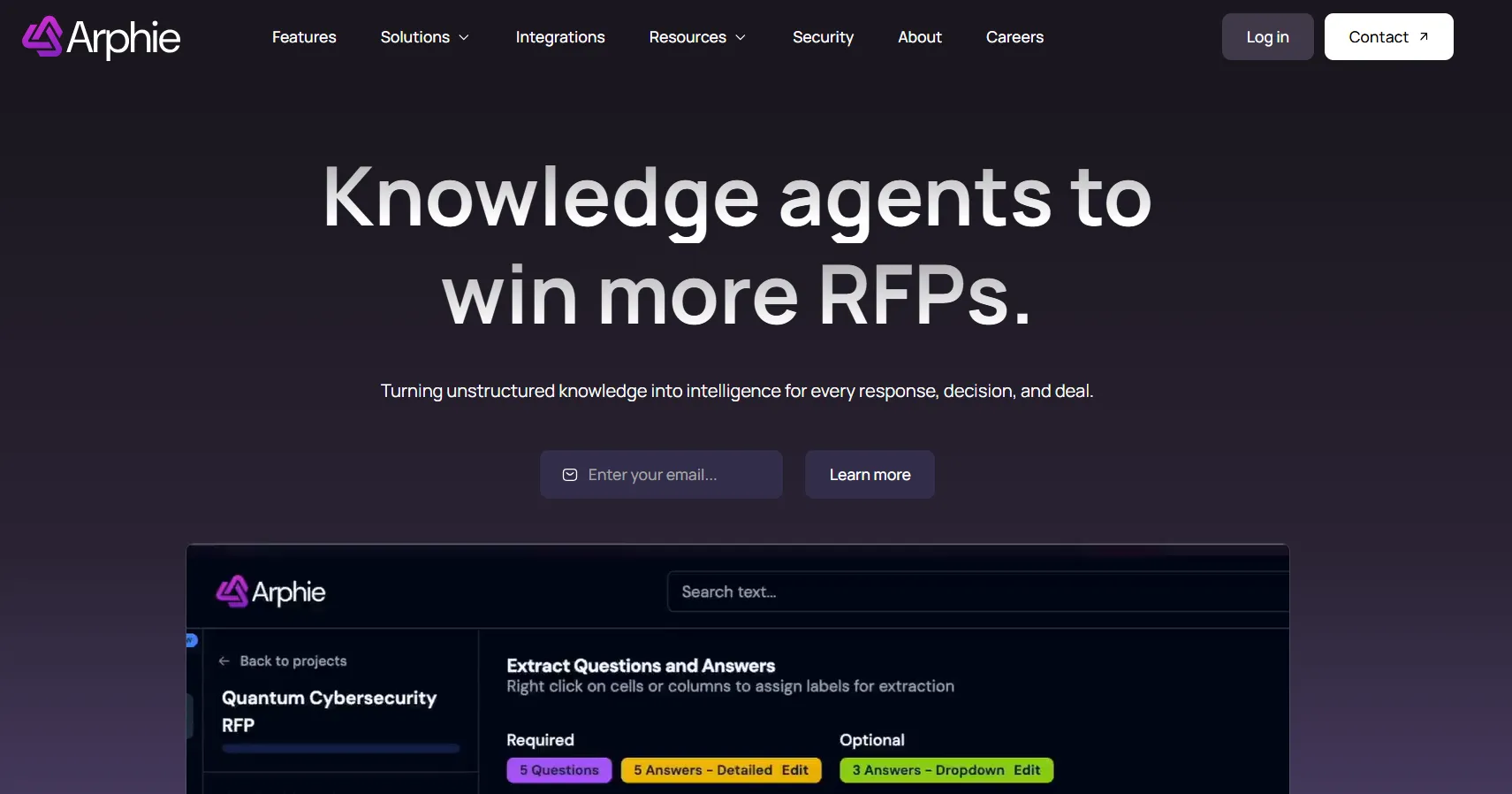
Arphie is best for growing SaaS companies that want a modern RFP response platform with cited answers, competitive research, transparent reasoning, and support for broader proposal writing.
The platform combines structured questionnaire responses with tools for narrative proposals and competitive positioning. It is one of the closer alternatives to AutoRFP.ai for teams that want approved-content grounding and greater visibility into the information supporting a draft. Its modern interface and unlimited-seat positioning may also appeal to collaborative mid-market teams.
AutoRFP.ai is the stronger fit when the buying criteria include explicit abstention when evidence is missing, deeper private-capital DDQ workflows, pre-bid qualification, broader portal coverage, and consolidated management of RFPs, security questionnaires, and DDQs.
Key Features
- Approved-content drafting: Generates responses using the organization’s existing content and knowledge sources.
- Source citations: Shows supporting materials so reviewers can inspect where information came from.
- Transparent reasoning: Gives users visibility into how the platform selected or developed a response.
- Competitive research: Helps teams incorporate competitor information and positioning into proposal work.
- Specialized workflows: Uses dedicated capabilities to support different stages of the response process.
- Narrative proposal support: Helps writers develop broader and more persuasive proposal sections.
- Security questionnaire workflows: Supports recurring questionnaires from enterprise SaaS buyers.
- Unlimited-seat positioning: Allows wider participation without restricting collaboration to a small number of contributors.
Pricing
There is no publicly available pricing tier for Arphie AI. Instead of offering fixed, self-service subscription plans, Arphie uses a quote-based, “contact us” pricing model. This means pricing is tailored to your team’s RFP volume, workflow complexity, and implementation requirements.
Arphie has shared indicative pricing ranges for its services, even though full plans are not publicly listed.
| Annual cost range | Pricing model | Key features | Implementation cost |
|---|---|---|---|
| $36,000–$60,000+ | Concurrent projects | Advanced AI, transparent sourcing, rapid implementation | White-glove included |
Where Arphie Shines
- Modern interface: Provides a clean and current user experience for proposal and pre-sales teams.
- Citation visibility: Makes supporting source information available during the response-review process.
- Competitive intelligence: Helps teams bring competitor positioning into proposals and bids.
- Narrative breadth: Supports longer-form proposal content alongside structured questionnaire answers.
- Transparent response process: Gives reviewers more visibility into how answers were developed.
Where Arphie Falls Short
- Abstention controls: Teams should verify how Arphie handles questions when approved evidence is insufficient, including whether unsupported answers are left unresolved for human review.
- DDQ specialization: Teams with substantial private-capital or regulated due diligence workloads should compare Arphie’s DDQ capabilities with platforms built more specifically around those workflows.
- Security consolidation: AutoRFP.ai is better suited to teams managing RFPs, security questionnaires, and DDQs as one combined workload.
- Pre-bid qualification: Go/No-Go analysis is not presented as one of Arphie’s primary strengths.
- Portal coverage: Teams completing questionnaires directly inside procurement and security portals may need to assess whether Arphie supports their full portal workload.
Customer Reviews
A Director at a software company said, “We did a side-by-side test with Arphie with a few other vendors. Arphie was the strongest by far in answer quality, depth, and transparency.”
A Senior Associate mentioned on Gartner, “Sometimes there are minor interface bugs but the team fixes them in a matter of hours, if not minutes.”
Who Arphie Is Best For
- Growing SaaS companies: Mid-market businesses that want a modern platform for RFPs and security questionnaires.
- Pre-sales teams: Contributors who need help drafting structured answers and broader proposal content.
- Collaborative response teams: Organizations that want to involve more contributors without limiting access to a small core group.
- Teams using competitive research: Companies that want competitor context included in proposal development.
- Narrative-focused proposal teams: Writers who need support beyond short questionnaire answers.
- Buyers prioritizing transparency: Teams that want greater visibility into the sources and reasoning behind generated responses.
5. Qvidian: Best for Word-Centric Proposal Management for Document-Heavy Enterprise Teams
Qvidian is best for large SaaS enterprises that manage complex proposal documents and need established governance, reporting, and Microsoft Word-based workflows.
The platform has a long history in enterprise proposal management. It is designed for formal bid operations where multiple contributors work across detailed documents, structured review processes, and management reporting. This makes it a credible option for organizations that value mature proposal controls and established workflows.
Qvidian is less suited to lean SaaS teams that want a modern response workflow with less content maintenance. Companies prioritizing source-backed answers, easier administration, and one system for RFPs, security questionnaires, and DDQs may find AutoRFP.ai better aligned with their needs.
Key Features
- Word-centric workflows: Supports proposal teams that create and manage substantial response documents in Microsoft Word.
- Enterprise governance: Provides structured controls for managing contributors, reviews, and proposal content.
- Proposal reporting: Gives managers visibility into proposal activity and operational performance.
- Document-heavy response management: Fits complex submissions that involve large files and detailed proposal sections.
- Established enterprise platform: Offers the experience and longevity of a long-standing proposal-management product.
- Formal proposal processes: Supports organizations with defined bid stages, responsibilities, and review requirements.
Pricing
- Qvidian’s pricing isn’t publicly listed, so you’ll need to contact Upland’s sales team for a quote.
Where Qvidian Shines
- Document workflow depth: Works well for enterprises that produce detailed and highly structured proposal documents.
- Microsoft Word fit: Suits teams that rely heavily on Word throughout the bid-writing and submission process.
- Governance capabilities: Supports formal review processes and clearly controlled proposal workflows.
- Reporting depth: Gives proposal leaders operational information about the response function.
- Product longevity: Appeals to organizations that prefer a long-established enterprise software provider.
- Large-team suitability: Supports formal proposal departments with multiple contributors and reviewers.
Where Qvidian Falls Short
- User experience: Teams accustomed to newer software may find the workflow less modern and more complex to navigate.
- Content maintenance: Stored proposal content may require continued organization, review, and updating by the team.
- Administrative effort: Larger implementations may require dedicated ownership and ongoing platform management.
- Pricing visibility: Buyers may need to contact the vendor to understand the full cost and configuration required.
- Lean-team fit: Smaller SaaS proposal teams may not need the depth of its enterprise document workflows.
- Combined workload coverage: Teams managing RFPs, security questionnaires, and DDQs together may prefer a platform designed around that complete response workload.
- Answer verification: Companies that need source citations, visible confidence signals, and clear gaps when evidence is missing may find AutoRFP.ai more suitable.
Customer Reviews
A verified reviewer shared, “The search function in the library is amazing. Qvidian Advanced Search makes it very easy and efficient to find specific content for specific products for our RFPs.”
Kartikk M., Senior Manager, Sales Operations, shared, “A lot of human intervention is needed to fully utilize all the features and functionality of this tool.”
Who Qvidian Is Best For
- Large enterprise proposal teams: Organizations with formal bid departments and multiple levels of review.
- Word-first teams: Proposal writers who complete most of their work inside Microsoft Word.
- Document-heavy SaaS companies: Businesses responding to complex opportunities with substantial narrative and supporting documentation.
- Governance-focused organizations: Companies that need controlled proposal processes and structured oversight.
- Proposal operations leaders: Managers who require reporting and visibility across enterprise bid activity.
- Established bid functions: Teams with the resources to manage implementation, administration, and proposal-content maintenance.
How to Choose the Right RFP Software for Your SaaS Company
The right RFP software should match your response workload, team structure, content-governance needs, and existing technology stack. Start by identifying where your current process breaks down, then test shortlisted platforms on a live RFP rather than relying only on feature lists or demos. SaaS teams leaving a newer AI drafting tool can also use a Steerlab replacement shortlist alongside this vertical guide. Here is what to evaluate:
1. Start With Your Actual Response Workload
Choose software based on the documents your SaaS company receives and the people involved in completing them. A platform built mainly for proposal documents may not be the best choice when most of your workload consists of structured RFPs and security questionnaires.
Assess these areas before creating a shortlist:
- Document types: Identify whether your team handles RFPs, requests for information, security questionnaires, due diligence questionnaires, or long-form proposals.
- Response volume: Calculate how many projects your team completes and how often deadlines overlap.
- Team structure: Consider how many sales engineers, security specialists, legal reviewers, and subject matter experts contribute to each response.
- Buyer requirements: Check whether customers send Excel workbooks, Word documents, PDFs, or portal-based questionnaires.
- Current bottlenecks: Determine whether the main problem is drafting, finding approved information, coordinating reviewers, maintaining content, or tracking deadlines.
This prevents teams from selecting an extensive proposal suite when they only need focused questionnaire automation, or choosing a lightweight drafting tool that cannot support enterprise review requirements.
2. Evaluate How the Software Verifies Its Answers
For high-stakes SaaS responses, answer quality should be judged by how easily reviewers can verify each claim. Look for source citations, confidence indicators, approval controls, and a clear process for handling questions that are not supported by existing evidence.
AutoRFP.ai is a strong choice when security, compliance, and technical accuracy are central to the evaluation. It gives each answer a Trust Score indicating how well the approved source material supports it, so reviewers with a question about a claim can open the passage it came from instead of hunting through folders.
And when the AI cannot support an answer from approved content, it says so and routes the question to a person; an unsupported answer is flagged, never invented. It also includes one-click AI edits, so users can shorten, simplify, rewrite, or polish responses before submission.
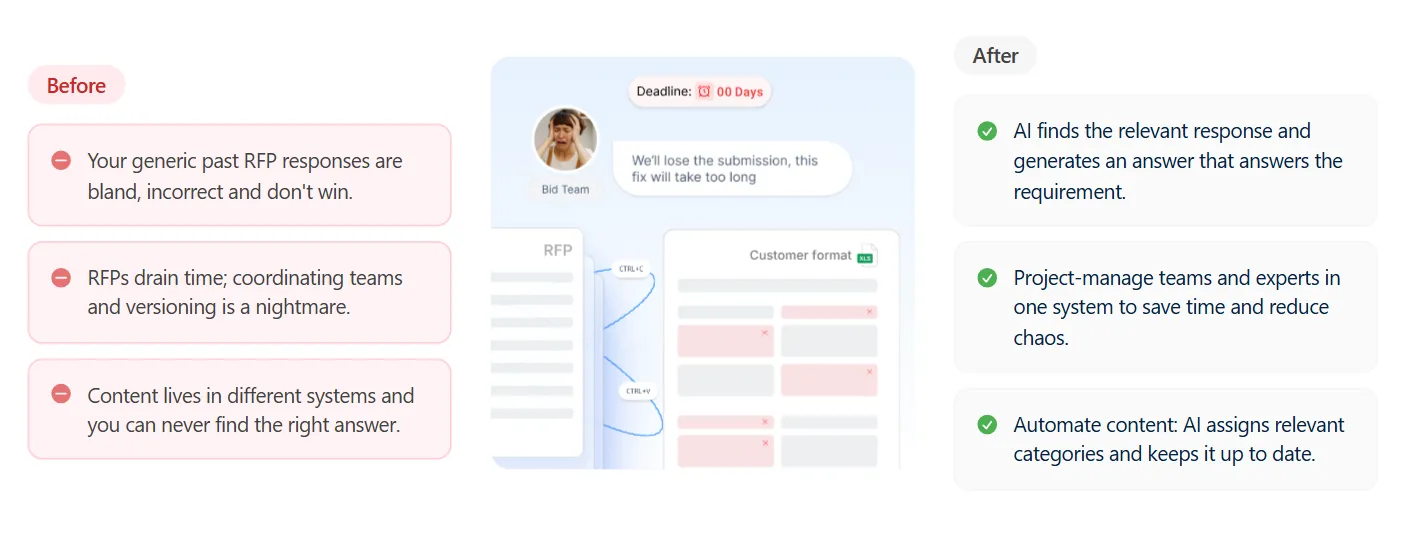
If output quality is your deciding criterion, measure it directly in a trial: track the percentage of AI answers you submit without edits. AutoRFP.ai reports 63% of AI-generated answers requiring no edits, and that number is visible per project in its automation reporting rather than taken on faith.
3. Decide How Much Content Maintenance Your Team Can Support
Content-library software works best when someone has the time and responsibility to organize, review, and update reusable answers. Without clear ownership, even a well-structured library can become difficult to search and filled with outdated information.
Loopio is a suitable option for established proposal teams that want a polished library workflow and already have a dedicated content owner. Its review cycles and freshness reminders help teams manage approved responses, but the organization still needs to maintain the categories, snippets, and review schedules behind the library.
4. Match Collaboration and Reporting Depth To Your Team
Large proposal departments may need detailed assignment controls, operational reporting, formal approval chains, and management dashboards. Smaller SaaS teams may value simpler coordination that keeps subject matter experts involved without requiring extensive administration.
Responsive provides deep project-management, analytics, Trust Center, and professional-services capabilities for large enterprise proposal operations.
Qvidian is better aligned with document-heavy organizations that rely on Microsoft Word workflows, established governance, and formal reporting. These platforms can be valuable when operational depth matters more than a lightweight implementation.
5. Test the Full Workflow on a Live RFP
A product demonstration cannot show how well the software performs with your content, document formats, and reviewers. Run a proof of concept using an actual RFP and measure the full process from qualification to final export.
Check whether the platform can identify deal-breakers, retrieve approved answers, coordinate contributors, preserve the buyer’s document format, and show where human input is still required.
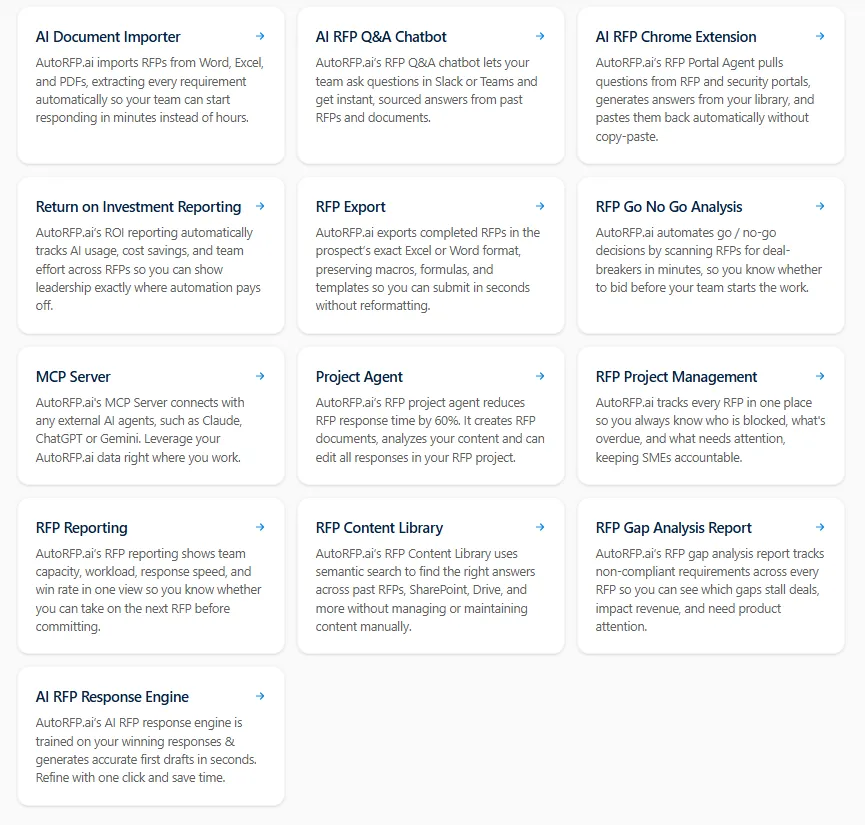
AutoRFP.ai supports this broader workflow through Go/No-Go Analysis, the Project Agent, the Q&A Agent, project management, and export back into the customer’s original format.
Choose an RFP Software You Can Defend
Your final RFP software decision should come down to whether reviewers can verify, govern, and approve every answer with confidence.
AutoRFP.ai is built to pass this review: ISO 27001 certified and SOC 2 Type II audited, customer data never used to train public machine-learning models and only used at runtime, with data sovereignty commitments and 48-hour breach notification. It brings RFPs, security questionnaires, and DDQs into one source-grounded workflow with Trust Scores, citations, approvals, and audit trails.
We would rather show you than tell you: prove it on your own bids in a two-week proof of concept. If you sell into hospitals or clinical buyers, see our health tech RFP software guide. SaaS companies that also sell into institutional investors can cross-check our RFP software for asset-management teams.
About the author

Technical Account Manager
Technical Account Manager at AutoRFP.ai. Background in asset management completing institutional RFPs and DDQs; now implements AutoRFP.ai for some of the company's largest accounts.
LinkedInFrequently asked questions
Can AutoRFP.ai Export Responses Into Our Company’s Branded Templates?
Yes. AutoRFP.ai can export completed responses either back into the customer’s original Word or Excel format or into custom branded company templates. It also supports original-format export with Excel macros, dropdowns, and validations preserved.
What Should SaaS Teams Measure When Evaluating RFP Software?
SaaS teams should measure how much useful work the software removes rather than simply how much content it generates. Useful measures include how many responses require minimal editing, where manual work remains, whether reviewers can verify supporting sources, and whether the platform reduces bottlenecks across sales engineering, security, and other subject matter experts. The evaluation should use a live RFP or security questionnaire so the results reflect the company’s actual content and review process.
Can AutoRFP.ai Go/No-Go Analysis Be Customized to Our Deal-Breakers?
Yes. AutoRFP.ai lets teams define their own qualification criteria and screening questions. Go/No-Go Analysis can then assess an uploaded RFP against requirements such as geographic restrictions, certifications, deployment models, security requirements, or other factors that affect whether an opportunity is worth pursuing.
Can RFP Software Help SaaS Teams Respond Inside Procurement Portals?
Some platforms support browser-based procurement and security portals in addition to uploaded Word and Excel files. SaaS teams should check whether the software can capture questions, retrieve answers from approved content, support different portal field types, and move requirements into a full response project when necessary. AutoRFP.ai’s Portal Agent supports portal-based response workflows and can import requirements from a website into a project. Its documentation names portals including SAP Ariba, Workday Strategic Sourcing, Jaggaer, and Coupa.
Can AutoRFP.ai Gap Analysis Identify Recurring Product or Compliance Gaps?
Yes. AutoRFP.ai Gap Analysis identifies recurring requirements where the company is non-compliant or only partially compliant. Teams can use these patterns to distinguish one-off gaps from requirements that repeatedly affect RFPs and use that information to inform product, security, and compliance priorities.
Should SaaS Companies Use One Platform for RFPs and Security Questionnaires?
It depends on the response workload. SaaS companies selling to enterprise buyers often receive commercial RFPs and detailed security questionnaires as part of the same sales process, so consolidating them can reduce duplicated content management and disconnected review workflows. When evaluating a platform, check whether it supports both response types, source verification, security-team collaboration, buyer portals, approvals, and the document formats your customers actually send.
