
Best RFP Software for Fintech: 7 Tools Compared (2026)
The best RFP software for fintech includes AutoRFP.ai, Responsive, Loopio and Hey Iris, ranked on security questionnaire automation and DORA readiness.

Technical Account Manager, AutoRFP.ai·Updated ·31 min read
Fintech companies face a difficult mix of commercial RFPs, security questionnaires, and due diligence requests, often from banks, enterprise buyers, and regulated institutions. The challenge is not just answering quickly, but making sure every response is accurate, current, and defensible under security and compliance review.
The best RFP software for fintech combines source-grounded response generation, strong governance, enterprise security, and collaboration across sales, legal, compliance, and InfoSec. This guide compares seven leading platforms and where each fits best.
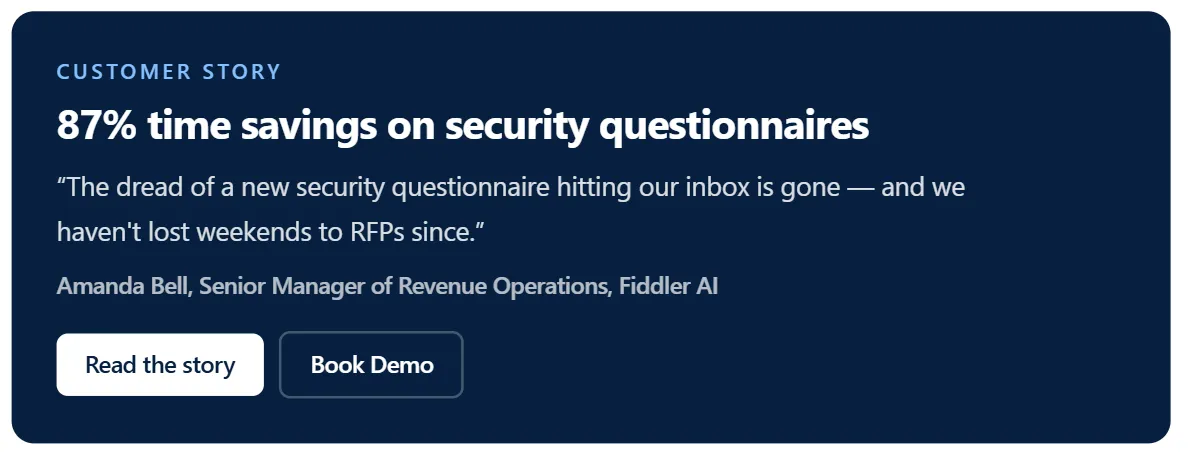
7 Best RFP Software for Fintech in 2026: At a Glance
We weighed five criteria: security-questionnaire handling (30%), data privacy and posture accuracy (25%), response accuracy and tailoring (20%), portal and integration support (15%), and pricing transparency (10%). Ratings reference G2/Capterra/Gartner where a vendor has at least 20 reviews. We do not assign our own star scores.
| Name | Best for | Standout feature | SQ automation | Portal support | Price starting point | G2 rating |
|---|---|---|---|---|---|---|
| AutoRFP.ai | Fintechs handling enterprise RFPs, security questionnaires, and DDQs | Source-grounded answers with Trust Scores, citations, abstention, and zero library maintenance | Yes | Yes | $899/month | 4.8/5 |
| Responsive | Larger fintechs with complex proposal operations | Deep project management, reporting, governance, and enterprise workflow controls | Yes | Yes | Contact sales | 4.5/5 |
| Loopio | Fintech teams with dedicated content managers | Structured content library with mature review and collaboration workflows | Partial | Partial | $20,000/year | 4.7/5 |
| Iris | Lean fintech teams handling high RFx, DDQ, and security-questionnaire volume | Compliance-focused AI drafting with unlimited submission credits on paid plans | Yes | Partial | Contact sales | 4.9/5 |
| Arphie | Small and mid-sized fintechs wanting modern AI drafting | Citation-forward responses, confidence indicators, and configurable writing controls | Partial | Partial | Contact sales | 5.0/5 |
| 1up | Sales, presales, and RevOps teams needing answers inside existing tools | AI answer layer across Slack, Teams, browser tools, and connected knowledge | Yes | Partial | Free plan; Starter $300/month | 4.9/5 |
| Conveyor | Security and GRC teams focused primarily on security questionnaires | Dedicated security-questionnaire automation combined with a Trust Center | Yes | Yes | Free plan with 10 Trust Credit | 4.8/5 |
For fintech teams, the biggest difference between these platforms is how they handle accuracy, security reviews, and ongoing content maintenance.
If your team manages both enterprise RFPs and recurring security questionnaires, AutoRFP.ai offers one governed workflow with source-grounded answers, Trust Scores, approvals, portal handling, and zero library maintenance.
Want to see how it performs on your own RFPs and security questionnaires? Book a demo with AutoRFP.ai.
1. AutoRFP.ai: Best for Defensible RFP, Security Questionnaire, and DDQ Response Automation for Fintech
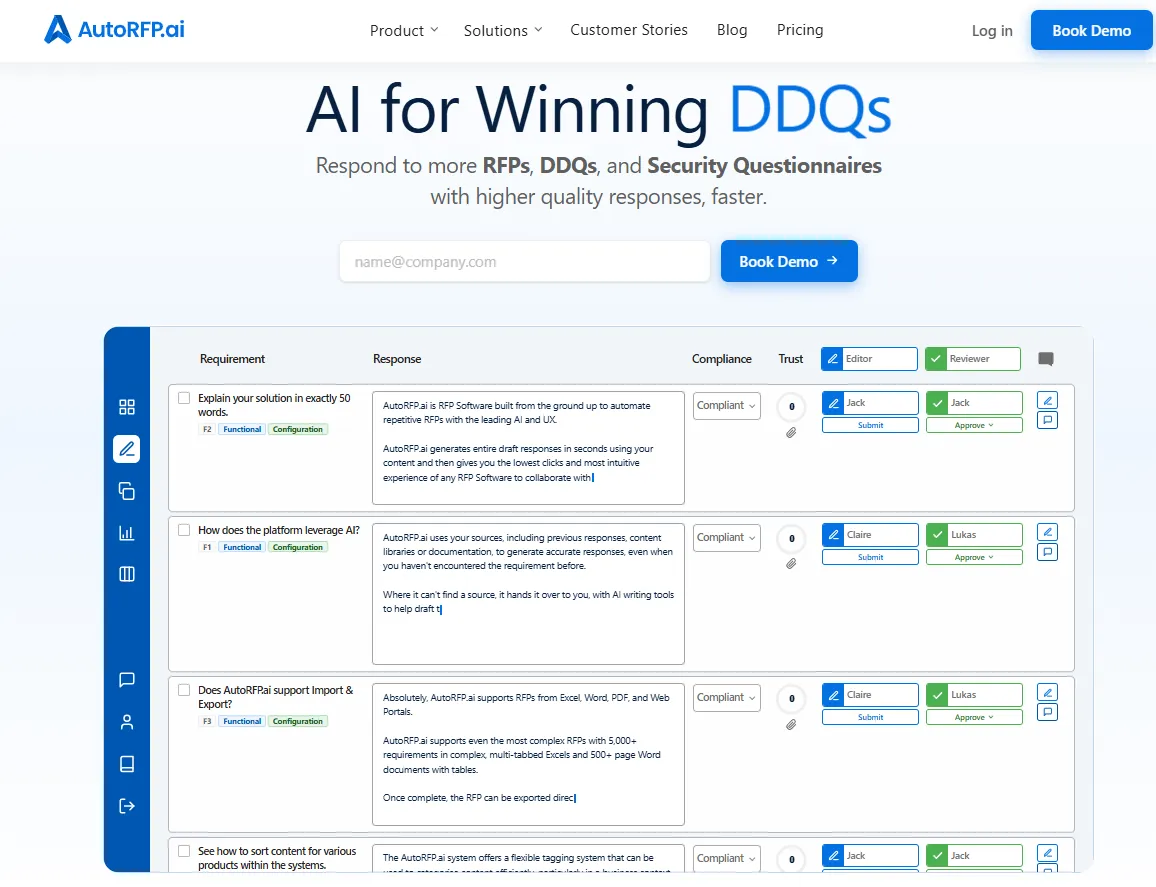
AutoRFP.ai is the accuracy-first AI platform for RFPs, security questionnaires, and DDQs: every answer is source-grounded and citable, with zero library maintenance.
That combination is particularly relevant to fintech companies. Selling into banks, insurers, payment providers, and large enterprises often means answering commercial RFPs alongside detailed questions about encryption, access controls, data residency, AI governance, business continuity, compliance, and third-party risk.
AutoRFP.ai brings those response workloads into the same governed system. Sales and bid teams can draft from approved product content, while security, legal, risk, and compliance reviewers can verify exactly where sensitive claims came from before approving them.
Key Features
1. Source-Grounded Response Generation
AutoRFP.ai drafts responses from approved company knowledge rather than relying on generic model knowledge. Its multi-model pipeline handles retrieval, re-ranking, drafting, redrafting, and checking before an answer reaches a reviewer. Every response shows its supporting sources, content age, and a Trust Score.
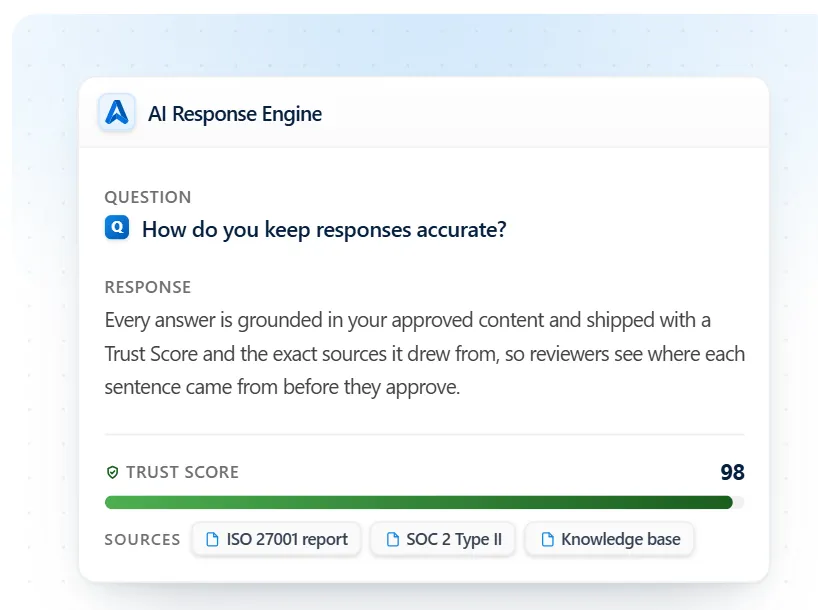
If the platform cannot find sufficient approved evidence, it flags the question and routes it to a person for review instead of guessing. For fintech teams answering questions about security controls or regulated processes, that makes uncertainty visible before submission.
2. Security Questionnaire and Portal Automation
Fintech security reviews rarely arrive in one convenient format. AutoRFP.ai can process complex Excel questionnaires and respond inside web-based procurement and security portals through its Portal Agent.
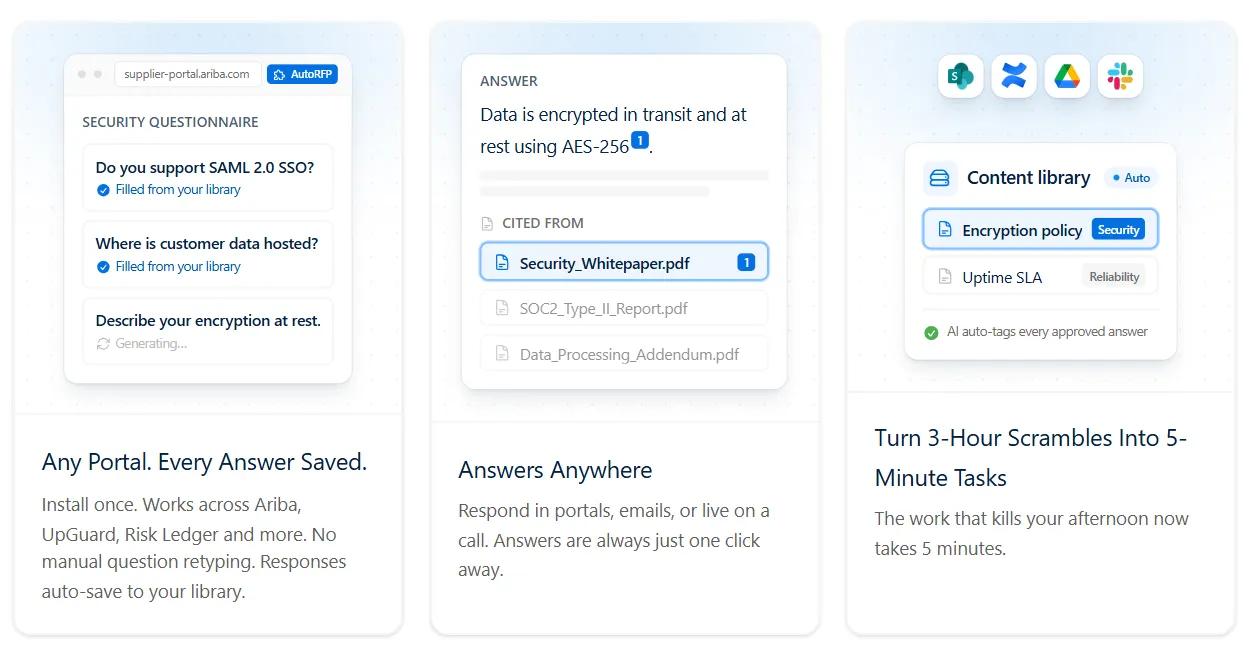
Teams can import questions, generate answers from approved security documentation, review them, and return responses in the required format. This helps when enterprise buyers repeatedly ask about SSO, encryption, data hosting, SOC 2, incident management, and other security controls.
3. Self-Maintaining Knowledge Governance
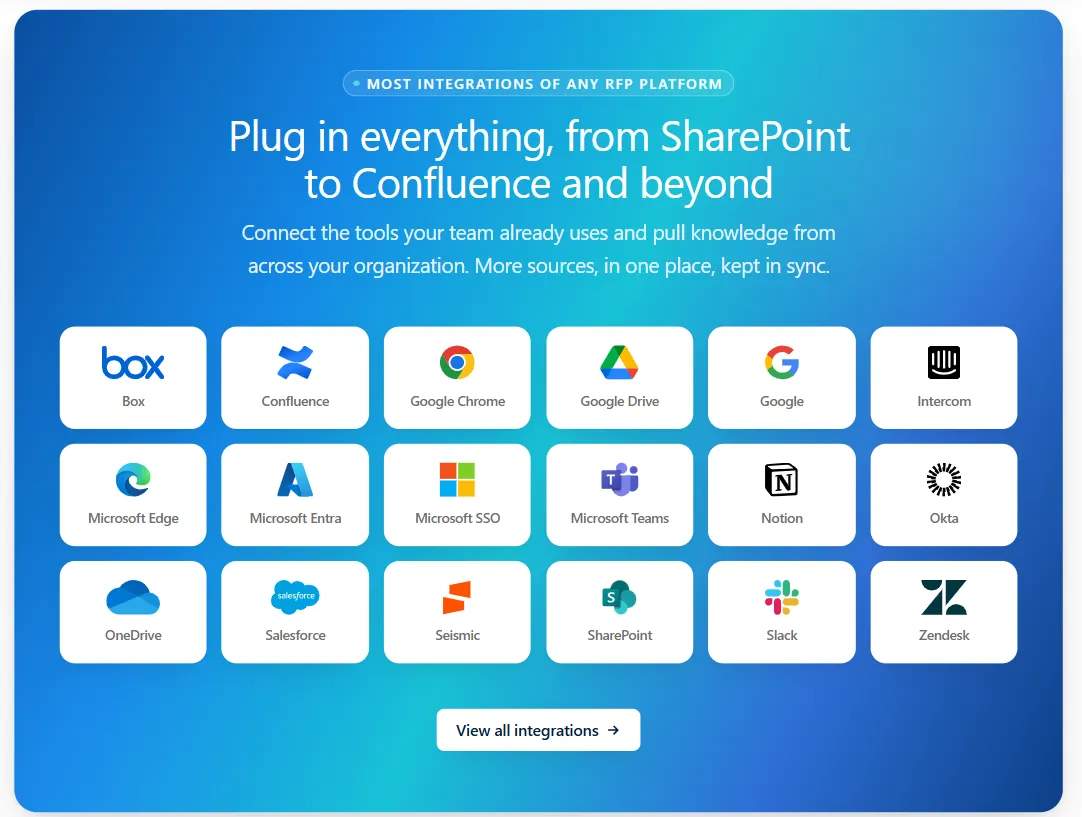
AutoRFP.ai connects content from 18+ connected sources such as SharePoint, Confluence, Google Drive, OneDrive, Notion, Box, Seismic, and other sources.
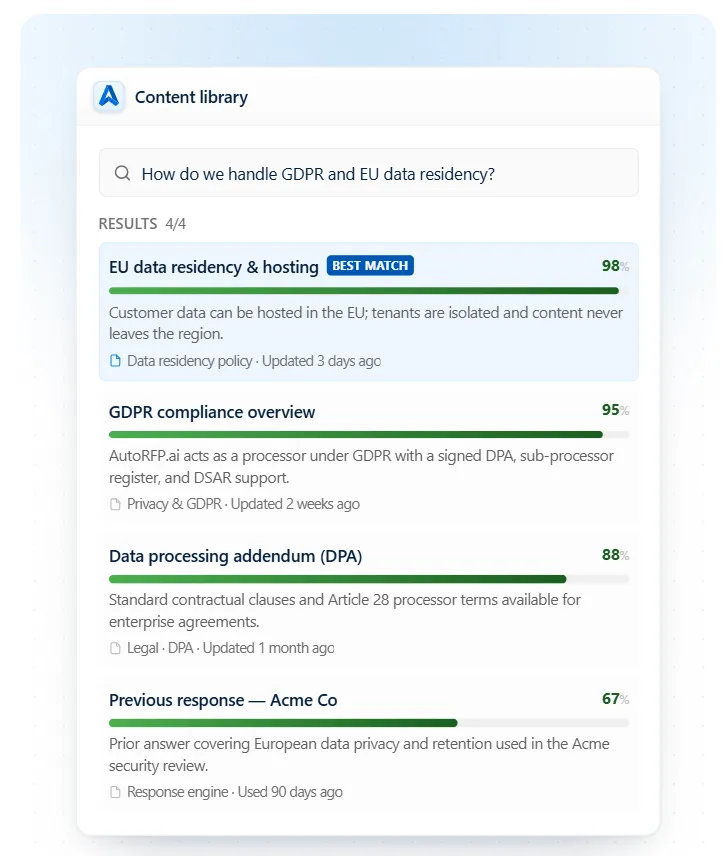
Semantic search finds information by meaning rather than depending only on exact keywords or manually maintained tags.
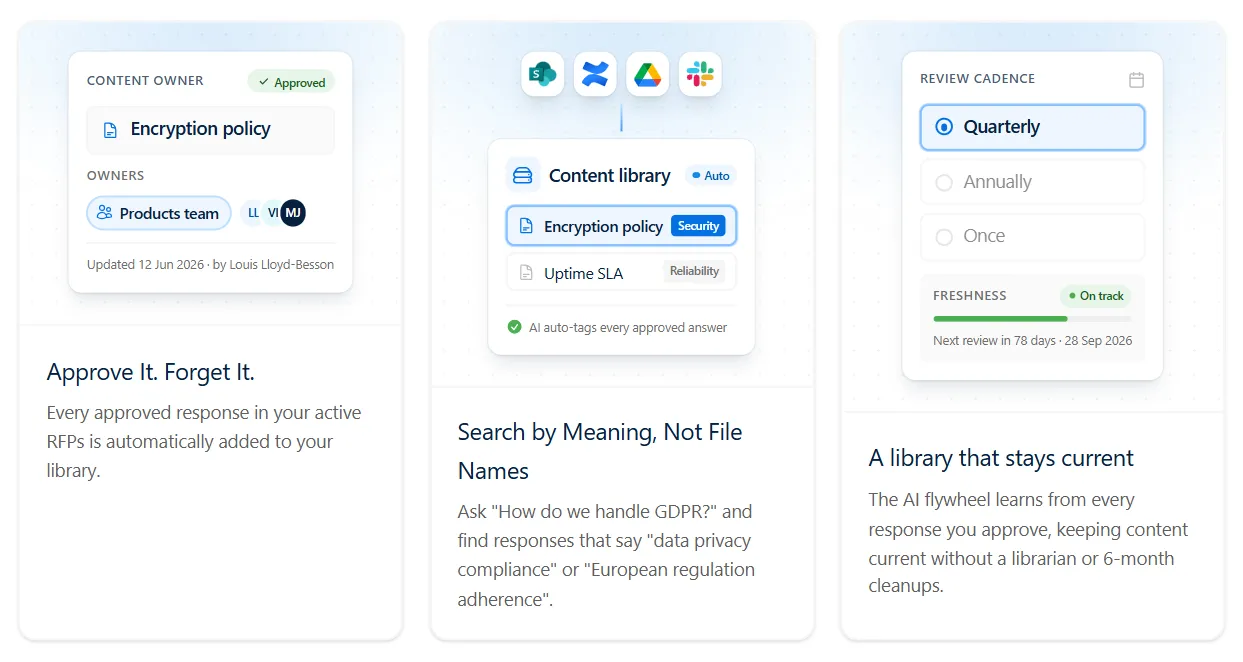
Approved responses automatically improve the knowledge available for future projects. Ownership, review schedules, freshness signals, and conflict resolution remain in place, but teams do not need to continuously develop a traditional snippet library.
4. Cross-Functional Reviews and Audit Trails
Fintech responses often require sales, solutions engineering, InfoSec, legal, compliance, and product teams to review different sections.
AutoRFP.ai supports section and requirement assignments, requirement-level comments, sequential approvals, version history, and audit trails.
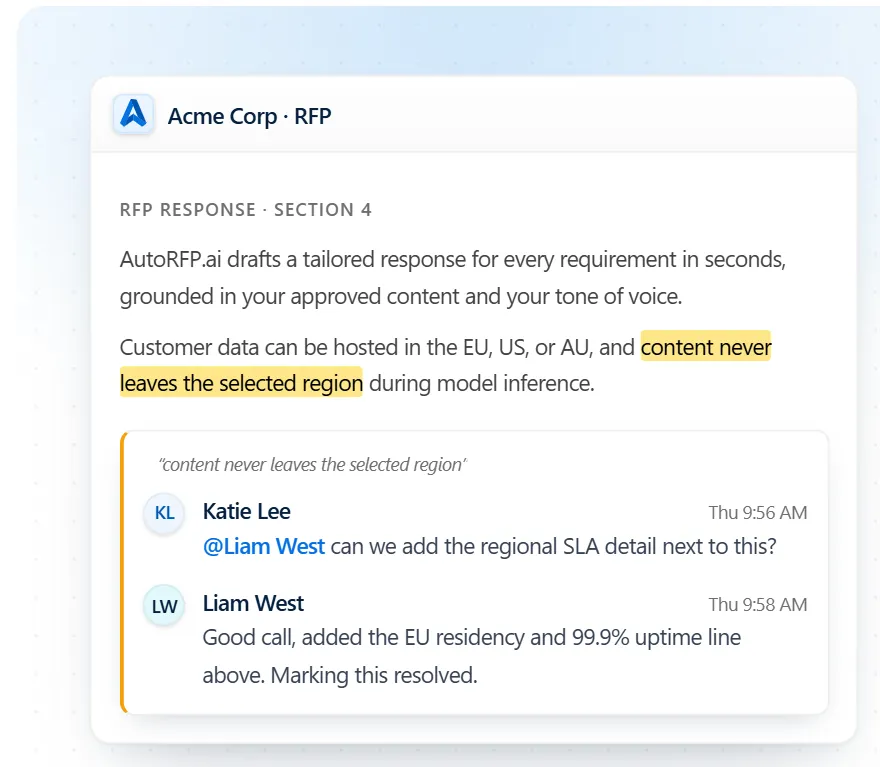
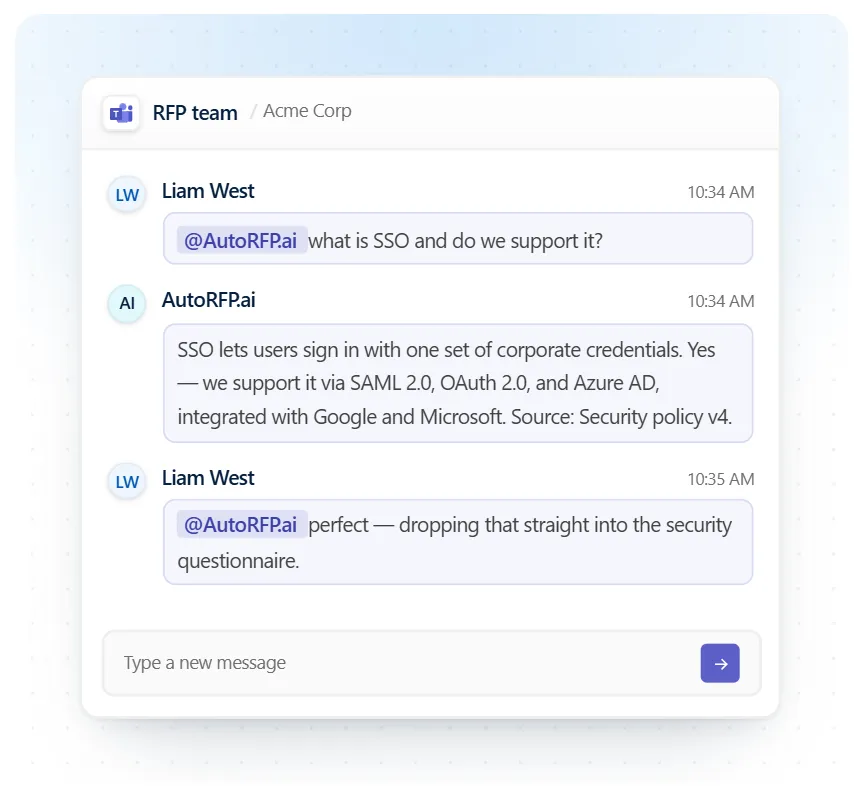
Contributors can also receive assignments and notifications through Slack, Microsoft Teams, and email, allowing specialists to review answers without turning the RFP process into a long email chain.
5. Fintech-Grade Security and Access Controls
AutoRFP.ai is ISO 27001 certified and SOC 2 Type II audited. Customer data is not used to train public AI models, and regional hosting options support organizations with data-residency requirements.
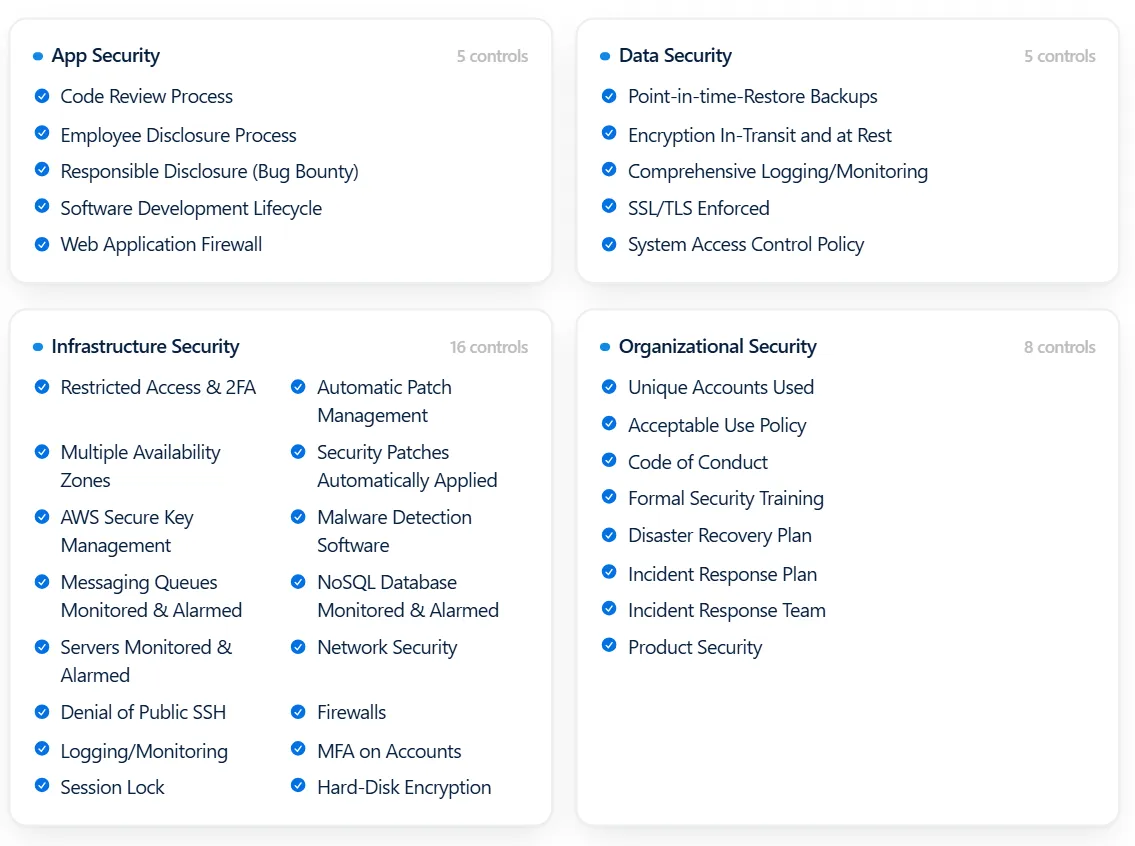
Identity and access capabilities include Okta, Microsoft Entra, SAML, and SCIM provisioning. These controls matter when a fintech’s own AI vendor must pass the same security scrutiny its customers apply to the fintech itself.
6. End-to-End RFP Workflow and Reporting
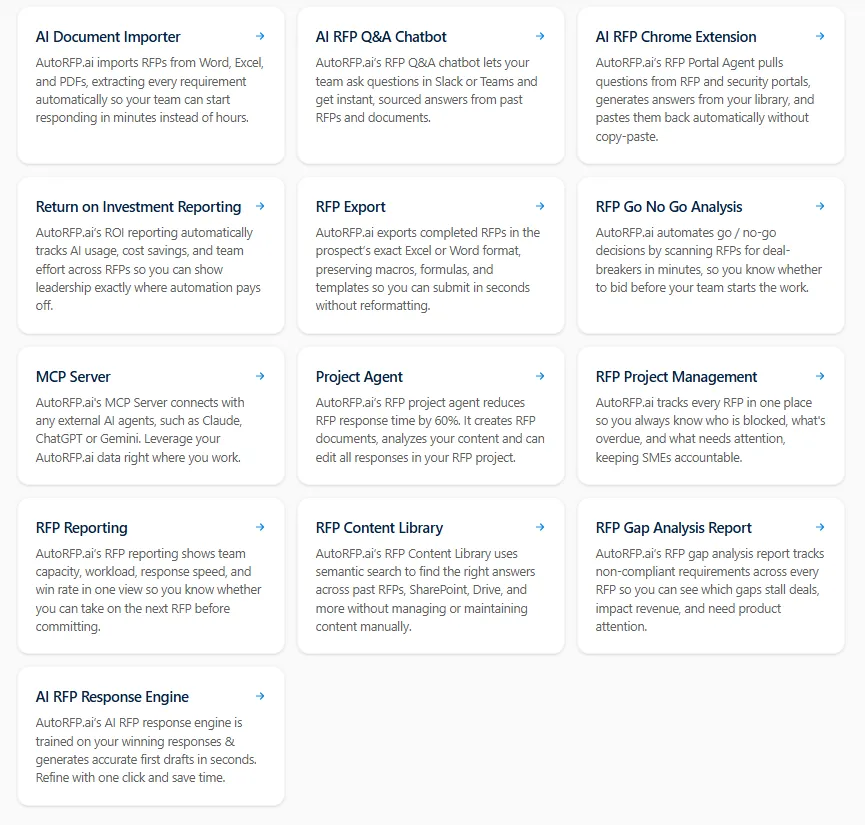
Beyond response generation, AutoRFP.ai supports Go/No-Go analysis, project management, Gap Analysis, original-format export, RFP reporting, and Automation Reporting. Fintech teams can manage the process from qualification through submission while seeing where requirements are missing, which responses need specialist input, and how much work is being automated.
Pricing
| Plan | Price | Key Inclusions |
|---|---|---|
| Scale | $899/month (paid yearly) | 24 projects per year, unlimited AI, unlimited content, unlimited users, all features, SSO (Google & Microsoft), 18+ integrations, ISO 27001:2022 and SOC 2, unlimited support, online training |
| Accelerate | $1,299/month (paid yearly) | 50 projects per year, unlimited AI, unlimited content, unlimited users, all features, SSO (Google & Microsoft), 18+ integrations, ISO 27001:2022 and SOC 2, unlimited support, online training |
| Enterprise | Flexible pricing that scales with your business | Scalable projects per year, unlimited AI, unlimited content, unlimited users, all features, SSO (Google & Microsoft), 18+ integrations, ISO 27001:2022 and SOC 2, unlimited support, bespoke implementation, bespoke terms |
Where AutoRFP.ai Shines
- Bank-ready defensibility: Reviewers can inspect the evidence behind sensitive product, security, privacy, and compliance statements before approving them.
- One response workload: Fintech teams can manage enterprise RFPs, security questionnaires, and DDQs without maintaining separate response tools.
- Reduced content-administration burden: Approved knowledge improves future responses without requiring constant snippet tagging, categorization, and library gardening.
- Cross-functional adoption: Unlimited-user positioning makes it easier to involve occasional security, compliance, product, and legal reviewers when required.
- Scales with buyer scrutiny: The same workflow can support an early enterprise RFP and the deeper security and governance review that follows later in the deal.
- Fits the existing fintech stack: Named integrations reduce the need for sales and security teams to move core knowledge into another isolated repository.
Where AutoRFP.ai Falls Short
- Narrative-heavy proposals: Teams primarily producing highly designed, long-form persuasive proposals may prefer specialist proposal-authoring software.
- Buyer-side procurement: AutoRFP.ai is built for companies responding to RFPs, not procurement teams creating sourcing events or evaluating vendors.
Customer Review
Sam B., Global Bid Manager, said that AutoRFP.ai offers “Fast search and collaboration to improve our entire bid management process,” adding, “I love being able to quickly search through our large content library. It genuinely feels like a collaborative tool, especially when I’m combining or improving answers.”
Saxon W., Senior Workforce Management Consultant, said, “Without AutoRFP I simply wouldn’t have the time to complete RFP’s regularly. It saves an exceptional amount of time. The responses are infinitely better than the other systems in the market because AutoRFP understands context. Most systems I’ve used just regurgitate irrelevant answers from previous RFPs. Setup was painless. The team actively work with their customers and continue to innovate.”
Raphael Schmideg, Chief Operating Officer at IMTC, said, “Reaching the RFP stage with clients is now a smooth process. With a 90% automation rate, we can quickly produce a first draft based upon previous responses, making the RFP process efficient and stress-free.”
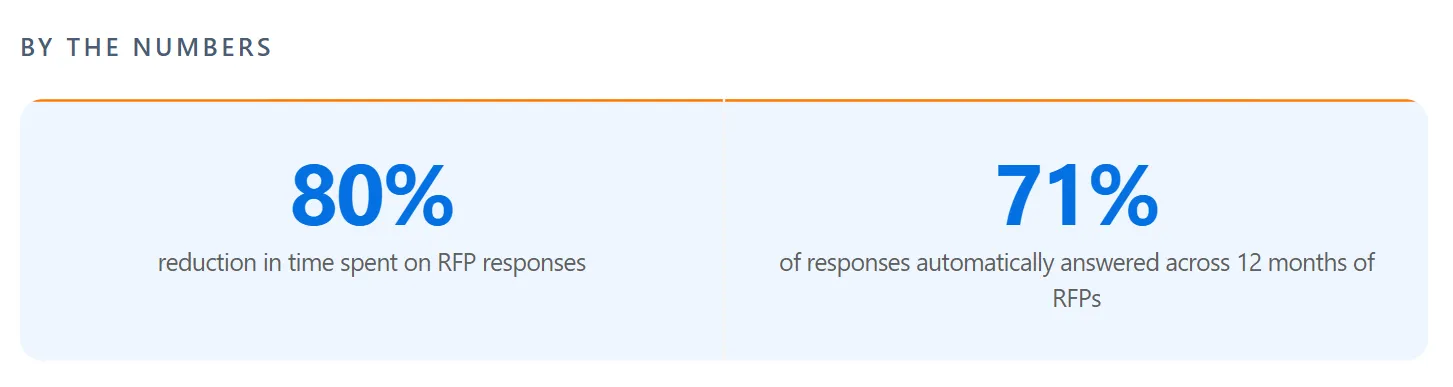
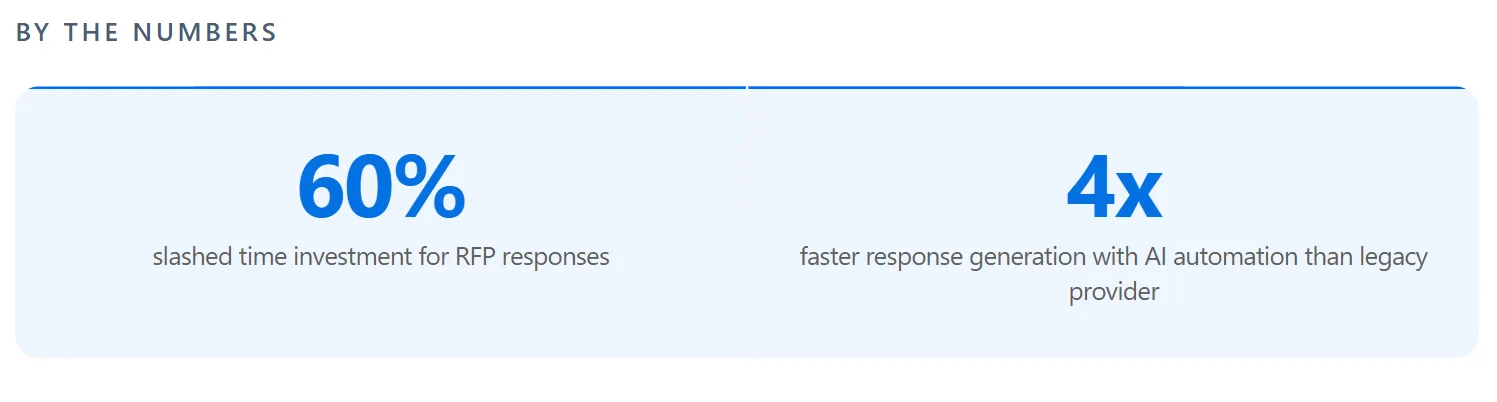
Mihai Popa, Bid Manager at FintechOS, said, “AutoRFP.ai is saving more than 60% of the time allocated before using the tool. The stakeholders involved can allocate this time to more strategic tasks.”
Who AutoRFP.ai Is Best For
- Enterprise-selling fintechs: Companies regularly responding to banks, insurers, payment networks, and large enterprise buyers.
- Security-heavy sales teams: Fintechs where deals routinely trigger detailed vendor security and compliance questionnaires.
- Cross-functional response teams: Organizations involving sales, solutions engineering, InfoSec, legal, compliance, and product specialists in the same response.
- Regulated fintechs: Businesses that need clear evidence, approvals, audit trails, and data controls around customer-facing statements.
- Teams replacing fragmented workflows: Fintechs using spreadsheets, shared documents, generic AI tools, and separate security-questionnaire systems today.


Video transcript
Did you know the average RFP can take thirty-two hours of manual grueling work? Now, in this video, in under ten minutes, I'm gonna show you how you can use AI RFP automation to drastically reduce the amount of time it takes to get to a first draft for your RFP, DDQ or security questionnaire using AutoRFP.ai. Sick. Let's jump into it. So at AutoRFP, we're an AI RFP software automation platform, across the globe with hundreds of customers using our software every day, battle-tested AI to help you automate RFPs. First, what's the problem? So an RFP or request for proposal or due diligence questionnaire or security questionnaire is a pain felt across all industries, whether it's construction, software, technology, finance, healthcare, anyone selling
to government or private businesses. And these glorified question and answers take hours and hours for people to complete, for them to win new business. It's a crucial part for your business to win enterprise and government contracts, which really help you grow sustainably and quickly. But when you go to bid on one, you are met with the RFP. Average response times are thirty to forty hours, usually involve five to eight people, seventy percent of content is reused but hard to find, and the average win rate across all industries is only forty-three percent. So you're spending hours with uncertainty that you may win, which is where efficiency and writing better responses, leveraging AI helps you win more faster. Now, looking into RFP automation, you have a number of options.
You can pick up a legacy RFP software. They've been around since the late nineties. They brought software to the RFP problem. Effectively, a glorified question and answer bank, like a database. You upload Q&A pairs, and then they try to use keyword matching to find the most relevant to then help you answer questions that you get in your new RFPs and tenders. You can also do AI builds yourself. So you might use ChatGPT or Claude, and you can see our other videos about how you can potentially use them. But effectively, you hit a ceiling where it's hallucinating, it's taking more time now to fix things than it should, and just doesn't have enough context to find the right answer most of the time. Or you can choose an actual AI native leader like AutoRFP.ai. Built from AI from the get go and have built the engine around zero
hallucination, multimodal architecture to leverage the latest models across all your major providers, library-less approach, so it doesn't take a lot of time to maintain the system, really high automation rates and enterprise security built in from day dot. So why do teams choose AutoRFP.ai? The reason is your knowledge is always current. We integrate with over twenty different systems, and we pull in from all your various file management and different software to make sure that your data is always up to date, and you don't have to maintain it across multiple different places. We're most accurate in the category because we leverage the different models, including specialized re-ranker models, embedding models, search models, and your large language models where they're best. And our team of over fifteen software engineers and AI engineers make sure that this is battle-tested, evals are correct, and it produces the correct answer based off your source context. And it's one platform for every stage of the RFP journey, from intake to new RFP
to AI-powered go/no-go to drafting to reviewing and using agents to review and update your RFP response, translation to collaboration across SMEs and different team members, ensuring that they can easily collaborate in an easy-to-use platform, and then exporting as well. Let's start with the AI native auto library. This is the core of the platform where your different content sources and past projects and up- and web scraping all live in the one place and- Any question that comes up, whether it's in an RFP or a team member asking the question, can be automatically answered with trust-based scores, specific semantic search, and ensures that the correct answer is found and used to then answer and generate an appropriate response. Then effectively, you upload a blank RFP.
The AI-powered response engine then automatically generates responses, translates it and everything to have the correct answers. Then your team can very easily edit, review, integrates with Slack and Teams, and everyone's notified on project deadlines. Now, I've spoken enough. Let's jump into the actual product, and you can see AI RFP automation from the start. We start by creating a project, which is a new RFP. We've got our portal agent that can scrape your requirements from web portals like SAP, Ariba and others, automatically ingesting those answers into your AutoRFP.ai instance, and then automatically drafting responses for you to easily enter back into the portal. Or you can upload a zip that contains a PDF, Excel, Word doc of your RFP and import that into the platform.
First we have our AI go, no-go. This ask different questions of your RFP based on your company context to ensure that should we actually bid on this RFP before we start it. It'll automatically grab out key details and link it to our CRM via our integration with Salesforce and so on. And here it's answered each question, and you can see it has confidence levels, it has trust built in, and you can then look back and see where the original source and what, for instance, table or other information. Our AI importer automatically selects every requirement, child requirements, dropdown pick lists response cells, everything else that's required for that RFP. We can manually change it if needed, but it automatically pulls that in. Then we can choose what content from our library or just choose every content, and our intelligent tagging and hierarchy system will make sure that the most relevant content is used for that response. And then I can create my project.
Next, the AI response engine then automatically starts sourcing the correct content from your auto library, re-ranking and finding the most relevant information, using that to then draft, redraft, and edit responses vi- with AI, and then provide those responses back to you in matter of seconds. And you can see here my thirty or so requirements automatically being filled out across the entire project. It's chosen the relevant pick lists, and each one of these have trust scores that I can understand further where this came from. It also has our AI-powered feedback score, and this is where AutoRFP is different to other systems. We don't wanna just help you source the correct answers. We wanna help you write better responses. And this goes into our feedback loop, where as you use the platform and write better responses, the AutoRFP system learns from those responses, and continually, your responses get better to help you win more faster.
Here we can do inline comments, so I can notify my team and so they can jump in, get notifications. I can submit, approve, add attachments, and everything else I can do in this platform. Finally, we have our project overview, which is our project management HQ for this particular RFP, making sure everyone understands deadlines. You can send reminders out to team members and just know when something needs to be completed by and when completed by and who is completing it, making sure that your RFP response is submitted on time and you're not faced with five PM Friday deadlines, calling someone to make sure you can get the correct answer to the correct question that's our short introduction to AutoRFP.ai. There's a lot more in RFP automation and AI RFP software that you can learn but feel free to reach out to our team. We'd love to provide a detailed demonstration to you so you can understand if this is a good fit for your business Already, AutoRFP.ai is in forty-four-plus countries across the globe with hundreds
of customers across different industries like technology, finance, and healthcare, and our customers are winning more faster. One of our customers like Shana Sweeney from SugarCRM won fifteen of their top twenty-five enterprise customers using AutoRFP.ai. They're using AI RFP automation to win more today, and it's a competitive advantage for their businesses. Our pricing is incredibly transparent. You can find more information on our website, to get in touch with our team, head over to our website, AutoRFP.ai. Book in a demo today and learn more and see if we can help you win more faster.
2. Responsive: Best for Large Fintech Proposal Operations
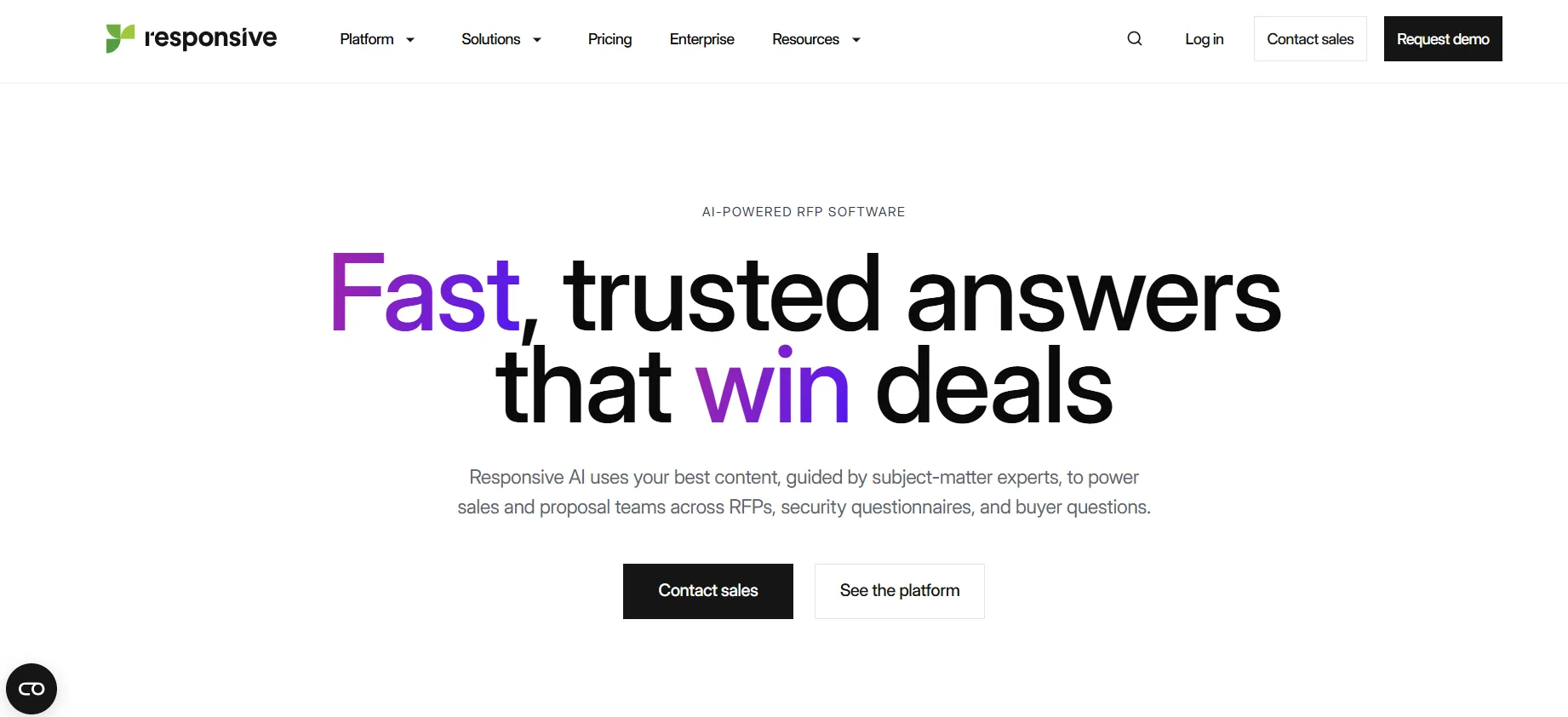
Responsive is best for larger fintech companies with staffed proposal functions that need deep project management, reporting, content governance, and coordination across a high volume of simultaneous responses.
Its breadth is a genuine advantage for complex organizations. Responsive can support proposal operations, security workflows, reporting, Trust Center requirements, and broader procurement use cases.
That breadth also means fintech teams should consider how much implementation and platform administration they actually need.
Key Features
- Enterprise project management: Coordinates owners, sections, deadlines, reviews, and approvals across active responses.
- Content management: Stores and reuses verified proposal and questionnaire content.
- AI-assisted drafting: Generates first-pass responses from available content and connected sources.
- Reporting and analytics: Gives proposal leaders visibility into projects, workload, activity, and performance.
- Trust Center capabilities: Supports sharing approved security and compliance information.
- Broader procurement workflows: Extends into RFQs, assessments, and adjacent enterprise-response processes.
Pricing
| Plan | Monthly Cost |
|---|---|
| Lite Edition | Contact sales |
| Emerging Edition | Contact sales |
| Growth Edition | Contact sales |
| Enterprise Edition | Contact sales |
Where Responsive Shines
- Complex-team coordination: Well suited to fintechs with dedicated proposal departments and many simultaneous contributors.
- Operational visibility: Detailed reporting can help leadership understand capacity and proposal performance across business units.
- Enterprise maturity: Large organizations can access deeper professional-services and implementation support.
- Broad workflow coverage: Useful when the organization’s response operations extend beyond standard RFPs and security questionnaires.
Where Responsive Falls Short
- Implementation weight: Its broad feature set can require more configuration, onboarding, and process design.
- Ongoing library management: Content still needs ownership, review, and maintenance as products and security controls evolve.
- Potential feature overload: Lean fintech bid teams may not need the full project-management, procurement, reporting, and Trust Center stack.
- Nuanced security responses: Fintechs should test first-draft quality on their most technical bank security questions rather than evaluating the platform only with standard RFP content.
- Pricing transparency: Enterprise buyers need a sales quote to understand the complete cost and package.
Customer Review
A Marketing Associate wrote on Gartner, “It’s a good product which is light in use though improvement is needed in the AI part.”
A Director of Product said, “Workflow is still not intuitive to me. More training may be required. However, the biggest challenge is the recommended answers which link to the questions in the RFP. There are too many answers linking to the RFP question to be useful. Time consuming to search.”
Who Responsive Is Best For
- Large fintech enterprises: Companies with multiple business units and substantial proposal volume.
- Staffed proposal desks: Teams with dedicated bid managers and established response operations.
- Reporting-heavy organizations: Leaders who need detailed workload and performance visibility.
- Broad response functions: Companies managing commercial RFPs alongside Trust Center, assessment, and adjacent procurement workflows.
3. Loopio: Best for Fintech Teams With Dedicated Content Managers
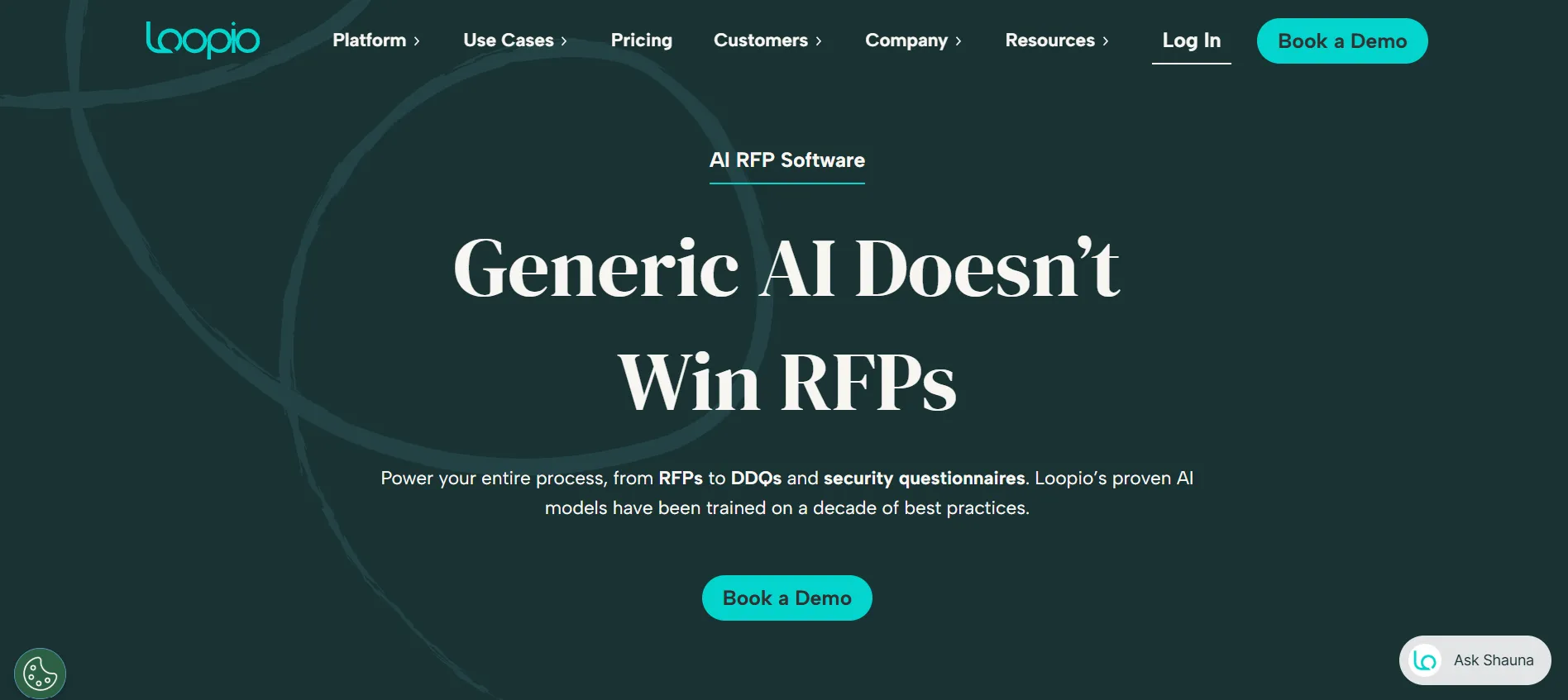
Loopio is a mature response platform built around a structured content library. It works particularly well for fintech companies that already have approved answers, defined content owners, and a team responsible for keeping that information organized.
Its strength is making a library-led operating model easier to manage. AutoRFP.ai takes a different approach by reducing the manual library-maintenance requirement itself. The distinction matters in fintech because security, privacy, product, and regulatory information can change frequently.
Key Features
- Centralized content library: Stores approved RFP, DDQ, and security-questionnaire material for reuse.
- AI-assisted recommendations: Helps teams locate and apply relevant existing answers.
- Content review cycles: Assigns owners and schedules recurring reviews.
- Collaboration workflows: Routes questions and review work to subject matter experts.
- Confidence and source signals: Helps reviewers determine which suggested content deserves closer examination.
Pricing
| Plan | Cost |
|---|---|
| Foundations | $20,000/year |
| Enhanced | Contact sales |
| Enterprise | Contact sales |
Where Loopio Shines
- Mature operating model: A strong fit for organizations that already have formal proposal processes.
- User experience: Its polished interface can make structured response management approachable for established teams.
- Consistency across teams: Centralized approved content helps different contributors work from the same response base.
- Community and market maturity: Long-standing adoption gives buyers access to an established customer ecosystem.
Where Loopio Falls Short
- Library upkeep: Teams still need to organize, review, tag, and refresh stored responses.
- Content decay risk: Security or product information can become stale when ownership and review schedules are not maintained.
- Dedicated ownership: Larger fintech libraries may justify a full-time content-management or proposal-operations role.
- Contributor costs: Teams involving many occasional security, product, and legal reviewers should examine how seat-based packaging affects participation.
- Modernization objective: Fintechs specifically looking to remove library maintenance rather than manage it more efficiently may prefer a self-updating approach.
Customer Review
Krunal P., Cybersecurity Analyst, said, “Loopio is an intuitive platform for content management and delegating responsibilities for various projects.”
Lisa S., Business Development, said, “The import function can be clunky at times. When uploading a PDF I sometimes see formatting issues.”
Who Loopio Is Best For
- Established fintech proposal teams: Companies with mature response processes and repeatable questionnaires.
- Dedicated content managers: Organizations with people responsible for library governance.
- Library-first buyers: Teams that want approved Q&A content to remain at the center of the workflow.
- Stable response environments: Fintechs whose products and approved answer sets change relatively predictably.
4. Iris: Best for Lean Fintech Teams Seeking Compliance-Focused AI Drafting
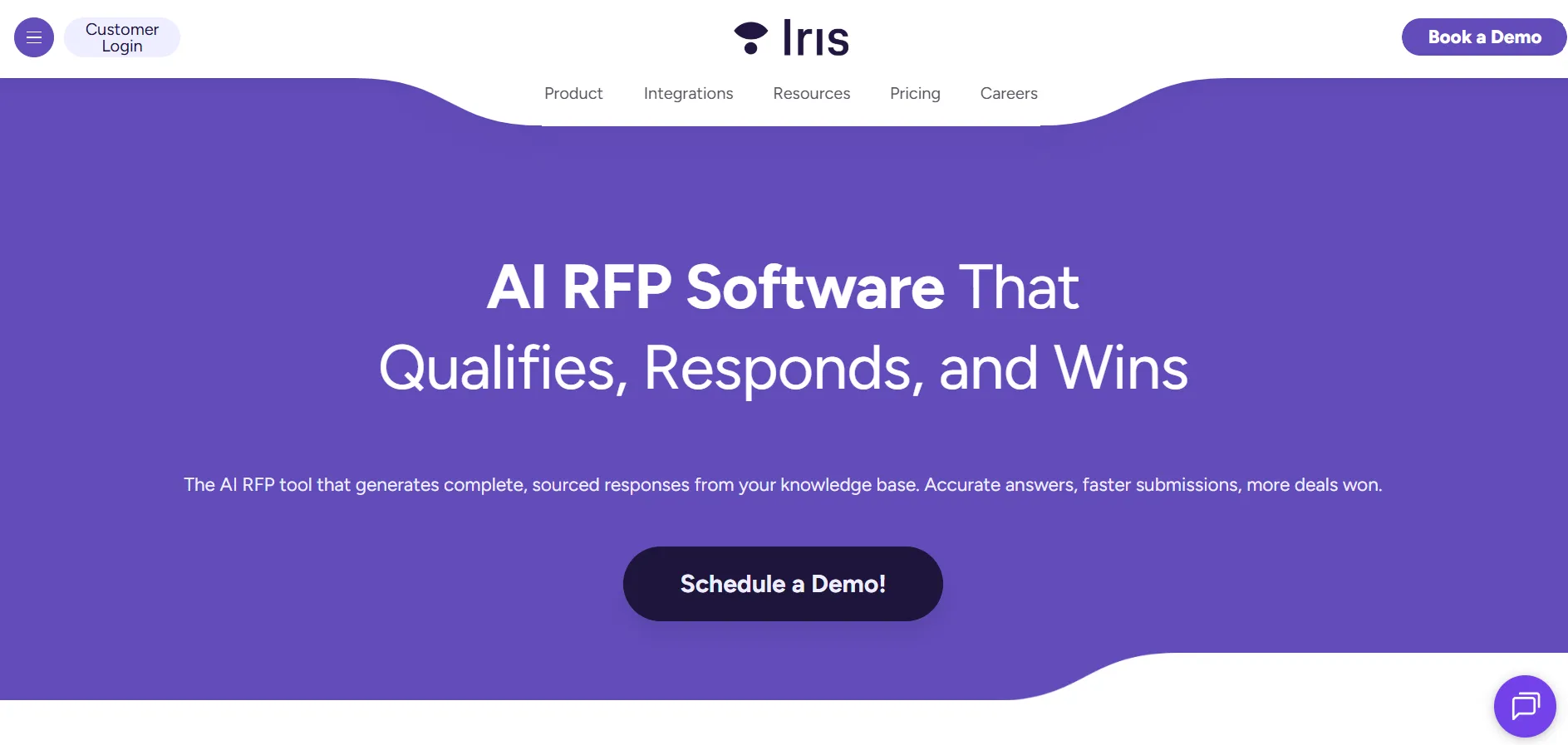
Iris, also known as heyiris, is a modern AI response platform for teams handling RFPs, DDQs, and security questionnaires.
Its compliance-focused workflows, content-freshness controls, and unlimited submission credits can appeal to lean fintech teams that need significant response capacity without building a large proposal department. Larger fintech companies should test Iris carefully for enterprise scale, unsupported-answer handling, financial-services depth, and governance controls.
Key Features
- AI response generation: Produces drafts from connected organizational knowledge.
- Unlimited submission credits: Paid plans are positioned around unlimited RFx, DDQ, and security-questionnaire usage.
- Content-freshness alerts: Identifies information that may require review.
- Compliance workflows: Supports governance and controlled response processes.
- Enterprise connections: Brings proposal work together with CRM, knowledge, and collaboration systems.
Pricing
- Iris does not publicly disclose a fixed price. It uses quote-based, per-active-user pricing.
| Plan | Price | Key features |
|---|---|---|
| User-Based Pricing | Custom; contact sales | Unlimited RFP/RFx, DDQ and security-questionnaire credits; unlimited collaborator users; full platform access; no per-submission fees or usage overages |
Where Iris Shines
- Lean-team efficiency: May suit fintech companies that want broad response automation without creating a large bid function.
- Compliance-led usability: Its governance-oriented interface aligns well with teams where compliance reviewers participate regularly.
- High questionnaire volume: Unlimited submission positioning can appeal to companies with unpredictable RFP and security-review demand.
- Modern buying experience: Newer teams may prefer its AI-led workflow over a traditional library-heavy proposal system.
Where Iris Falls Short
- Enterprise track record: Larger fintechs should validate proven deployment at their required scale.
- Portal automation: Teams answering questionnaires inside banking and security portals should test exact coverage.
- Integration depth: Buyers should verify whether their full sales, content, identity, and communication stack is supported.
- Unsupported-answer handling: Fintechs should confirm exactly what occurs when the available evidence cannot support a response.
- Security requirements: Certifications, hosting, data residency, and model-training commitments should be confirmed directly during procurement.
Customer Review
A Marketing Associate said, “Iris has made responding to security questionnaires significantly faster and easier. The upload and auto-analyze workflow is intuitive, and the team was exceptionally helpful during onboarding. There’s very little to complain about.. it just works.”
A VP of IT Security and Risk Management said, “The only thing that could make it better is if it processed customer contracts and could call out security, legal, or operational deviations from the accepted standards and build dashboards from those deviations to determine risk, but also to collect per-contract requirements like contacting customer’s SOC in x hours at y address.”
Who Iris Is Best For
- Lean fintech response teams: Companies wanting AI-assisted drafting without a large proposal department.
- High-volume questionnaire teams: Organizations managing frequent RFPs, DDQs, and security questionnaires.
- Compliance-involved workflows: Teams where governance and compliance reviewers are regular contributors.
- Modern-tool buyers: Fintechs willing to validate enterprise controls during evaluation rather than defaulting to an incumbent.
5. Arphie: Best for Modern Fintech Teams Wanting Citation-Forward Drafting
Arphie is a modern AI response platform with source references, confidence indicators, writing controls, competitive research, and broader narrative support.
It is one of the closer alternatives to AutoRFP.ai for teams that want transparent sourcing alongside AI drafting. Its clean interface and content velocity make it particularly appealing to smaller and mid-sized fintech companies that want to adopt automation without a heavy implementation.
Key Features
- Source-cited drafting: Displays the supporting information used to create responses.
- Confidence indicators: Helps reviewers identify answers that may require more attention.
- Writing controls: Adjusts tone, detail, structure, and response style.
- Connected knowledge: Uses approved organizational information during drafting.
- Competitive research: Helps teams incorporate relevant positioning and deal context.
- Narrative support: Extends beyond structured questionnaires into broader proposal content.
Pricing
Arphie AI does not publish fixed pricing tiers. Instead, it uses a quote-based “contact us” model, with pricing tailored to factors such as your team’s RFP volume, workflow complexity, and implementation needs.
Although complete pricing plans are not publicly available, Arphie has provided indicative price ranges for its services.
| Annual cost range | Pricing model | Key features | Implementation cost |
|---|---|---|---|
| $36,000–$60,000+ | Concurrent projects | Advanced AI, transparent sourcing, rapid implementation | White-glove included |
Where Arphie Shines
- Modern user experience: Clean workflows can lower the adoption barrier for growing fintech teams.
- Citation visibility: Helps users understand where generated material came from.
- Flexible writing: Useful when a fintech needs both questionnaire responses and more persuasive proposal sections.
- Fast-moving teams: Its lighter operating model can appeal to teams that do not want a lengthy enterprise deployment.
Where Arphie Falls Short
- Largest enterprise programs: Fintechs running very large security-questionnaire programs should test scale directly.
- Approval depth: Highly regulated teams should verify whether review, permissions, and audit controls match internal governance requirements.
- Portal coverage: Teams responding inside bank procurement and security portals should test exact workflow support.
- Regional requirements: Hosting and data-residency options should be evaluated against the fintech’s customer commitments.
- High-stakes abstention: Buyers should confirm exactly how the system handles questions when approved evidence is insufficient.
Customer Review
A Technical PM said, “Nice & easy to use product. Helps us saves time with payments questionnaires that often take up a lot of time for our team. We have to do many questionnaires that are repetitive, and need information from various stakeholders (sales, product & eng teams, and more).”
A Senior Associate mentioned on Gartner, “Sometimes there are minor interface bugs but the team fixes them in a matter of hours, if not minutes.”
Who Arphie Is Best For
- Small and mid-sized fintechs: Teams seeking a modern response platform without extensive setup.
- Citation-conscious reviewers: Organizations that want supporting evidence visible with AI drafts.
- Mixed proposal workloads: Teams producing structured answers plus longer narrative sections.
- Growing presales functions: Companies looking to introduce response automation before creating a large proposal-operations function.
6. 1up: Best for Fintech Revenue Teams That Need Answers Inside Their Existing Tools
1up is an AI-powered answer layer designed to surface company knowledge inside the tools revenue teams already use.
It can support RFPs, security questionnaires, and DDQs, and gives sales, presales, RevOps, and other GTM teams quick access to trusted company answers. That makes it useful when the main problem is finding information, rather than coordinating a complex formal submission from intake through approval.
Fintech reviewers can use the AutoRFP.ai vs 1up.ai evidence comparison to check source signals, approval controls, identity provisioning, and returned questionnaire files.
Key Features
- Connected knowledge: Generates answers from selected company sources.
- Questionnaire automation: Supports bulk responses to RFPs, DDQs, and security questionnaires.
- In-workflow answers: Surfaces knowledge through Slack, Teams, Google Chat, browser tools, and other workspaces.
- Salesforce access: Brings response knowledge closer to active sales workflows.
- Knowledge-gap reporting: Helps teams identify recurring questions where documentation is incomplete.
- Multilingual support: Extends answer access across international revenue teams.
Pricing
| Plan | Price |
|---|---|
| Free | Free |
| MCP | $50/month, plus automation usage |
| Starter | $300/month for 1 questionnaire |
| Plus | $900/month for 6 questionnaires |
| Enterprise | Custom pricing |
Where 1up Shines
- Low adoption barrier: Teams can introduce answer automation without implementing a large proposal-management program.
- GTM-wide usefulness: The same knowledge layer can support sales questions outside formal RFP projects.
- Accessible pricing: Public entry plans make early experimentation easier for smaller fintech functions.
- Workflow convenience: Employees can retrieve information from familiar communication and sales tools.
Where 1up Falls Short
- Formal proposal operations: It is more of an answer layer than a full enterprise response system of record.
- Approval depth: Fintechs with sequential security, legal, and executive reviews may require deeper governance.
- Auditability: Buyers should verify whether version history and approval evidence meet regulated response requirements.
- Submission workflows: Teams completing complex documents and portals may need another platform to manage the full response lifecycle.
- Approved-only sourcing: Financial-services buyers should confirm how external or broader GTM sources are governed before entering customer-facing answers.
Customer Review
A Business Development Associate said, “My overall experience with 1up has been excellent. The platform is easy to use, very reliable, and noticeably improves efficiency in day-to-day work. Getting started was simple, and the support team has been consistently responsive and helpful.”
A Global Bid Manager mentioned, “We need to keep the knowledge base up to date, however that’s on us and any system. Character limit in Ask1up; occasionally it’s useful for me to ask long questions with multiple requirements, my workaround is to break the question down into smaller pieces, which is reasonable for the work I have to do. Perhaps require more detailed reports on usage and who is using now that the user community has grown exponentially, this is in the near roadmap.”
Who 1up Is Best For
- Fintech presales teams: Groups that need quick product and security answers throughout the sales cycle.
- RevOps functions: Teams wanting company knowledge inside existing GTM tools.
- Department-level adoption: Smaller business units testing AI questionnaire automation.
- Lightweight workloads: Companies that do not yet require extensive proposal management, approval chains, and audit controls.
7. Conveyor: Best for Fintech Security Questionnaire and Trust Center Workflows
Conveyor is a security-review specialist built around security questionnaire automation and customer-facing trust workflows.
For fintech companies where security questionnaires are the dominant bottleneck, this specialization is a genuine advantage. Its Trust Center, document-sharing workflows, and browser-based questionnaire handling make it well suited to InfoSec and GRC teams. The tradeoff is narrower coverage when the organization also needs full commercial RFP and DDQ management.
Key Features
- Security questionnaire automation: Generates responses for recurring customer security assessments.
- Trust Center: Gives prospects controlled access to approved security and compliance information.
- Browser-based completion: Supports questionnaire work inside external portals.
- Document sharing: Manages controlled access to reports, policies, and other security evidence.
- Customer self-service: Allows buyers to retrieve common security information without creating another manual request.
- Salesforce workflows: Connects security-review activity with commercial opportunities.
Pricing
| Plan | Price | Key features |
|---|---|---|
| Free | Free | 10 Trust Center credits per month; no Questionnaire Automation; no integrations |
| Enterprise | Custom | Unlimited users and seats; full Conveyor Platform access; usage-based pricing with volume discounts; integrations, analytics and enterprise settings; dedicated support |
Where Conveyor Shines
- Security specialization: Its workflow is built around the needs of InfoSec, GRC, and customer-trust teams.
- Reduced repetitive requests: Trust Center self-service can prevent security teams from repeatedly sending the same documents.
- Strong fit for bank reviews: Fintechs facing frequent customer security assessments can keep security work separate from general proposal operations.
- Focused buying decision: Teams that only need to solve security-review friction may prefer a specialist over a broader RFP platform.
Where Conveyor Falls Short
- Narrative RFP coverage: Commercial proposals and strategic RFP responses are not its primary focus.
- DDQ depth: Financial and investor due-diligence questionnaires are outside its core specialization.
- Cross-functional proposal management: Fintechs may still need another system for sales, product, implementation, and commercial sections.
- Tool consolidation: Companies receiving both substantial RFP and security-questionnaire volume may end up maintaining two response systems.
- Broader response governance: Teams should assess whether specialist security workflows provide enough control for all customer-facing response types.
Customer Review
Reviewers often highlight Conveyor’s time savings, ease of use, and helpful support, while some report occasional AI inaccuracies, slower response times, and workflow or usability limitations.
Who Conveyor Is Best For
- Fintech security teams: Organizations whose biggest bottleneck is customer security reviews.
- GRC functions: Teams responsible for recurring compliance evidence and questionnaire completion.
- Trust Center buyers: Companies wanting customer self-service for security documentation.
- Security-heavy SaaS fintechs: Businesses selling into banks and enterprises that trigger lengthy InfoSec reviews but relatively few narrative RFPs.
How to Choose the Right RFP Tool for Fintech
Fintech companies should choose RFP software based on the buyer scrutiny they face, not simply how quickly a platform produces a draft. A bank security review, enterprise RFP, and DDQ can involve the same product but require different evidence, reviewers, controls, and submission workflows.
1. Start With the Buyer Review That Causes the Most Friction
Look at the work your team actually receives. Some fintechs struggle with large narrative RFPs, while others lose days to security questionnaires asking about encryption, SSO, data residency, subcontractors, business continuity, AI use, and incident management.
The right platform should remove the biggest recurring bottleneck first. A fintech with a staffed bid desk may value Responsive’s project-management depth, while a security-led organization may get more value from Conveyor’s specialist workflow.
2. Test How the Platform Handles High-Stakes AI Answers
For fintechs, AI-generated answers about security, privacy, compliance, and risk need to be verifiable, not simply convincing. Responsive and APMP’s 2026 State of Strategic Response Management Report highlights this challenge, with Vodafone Senior Bid Manager Ken Lebek cautioning that AI is “still hallucinating a lot” and stressing the importance of the knowledge foundation behind the LLM.
Test shortlisted platforms with your hardest bank or enterprise security questions, especially where approved information is incomplete or conflicting. Check whether reviewers can verify the source behind each answer and whether unsupported questions are clearly escalated instead of filled with plausible content.
AutoRFP.ai is designed around this approach, exposing sources and Trust Scores for each answer and routing questions for human review when sufficient approved evidence is unavailable.
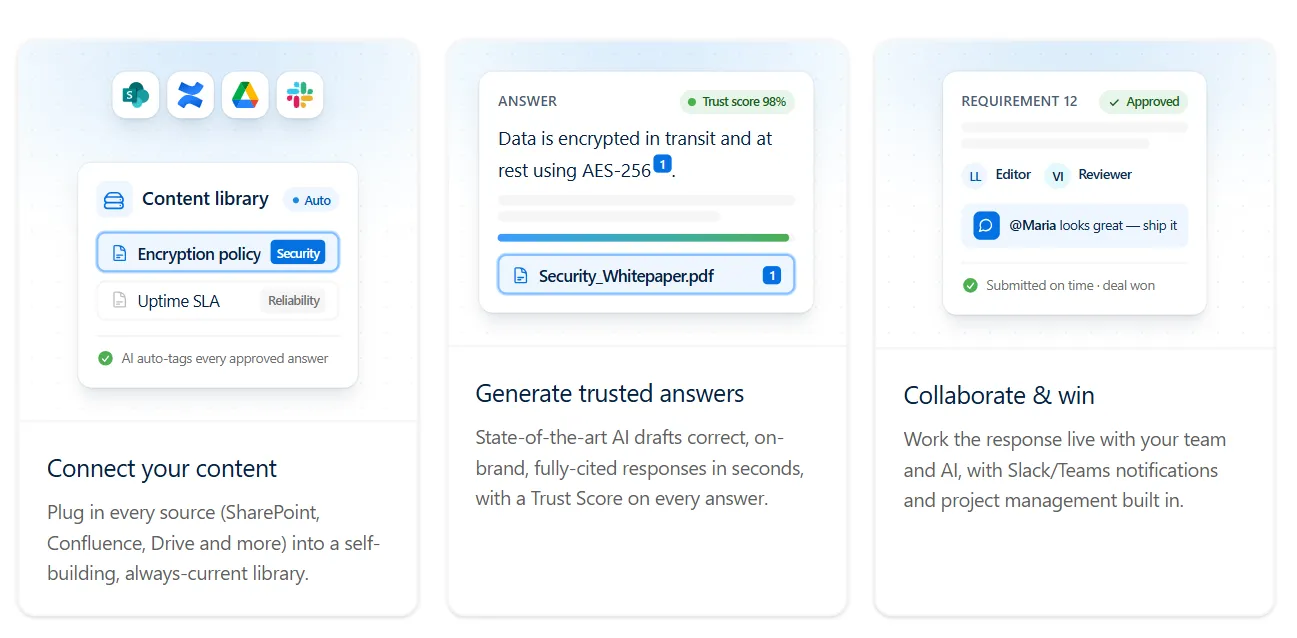
3. Decide Whether You Need a Response Platform or a Specialist Tool
A specialist can be the better choice when your workload is narrow. Conveyor makes sense when security reviews dominate, and 1up can work well when the main need is giving sales and presales teams quick access to trusted company answers.
The decision changes when the same fintech regularly handles commercial RFPs, detailed security questionnaires, DDQs, and cross-functional approvals. In that case, maintaining separate tools can create another source of fragmentation.
4. Check How the Platform Fits Your Knowledge and AI Stack
Fintech teams rarely work in a single system. RFP software should connect with the CRM, document repositories, collaboration tools, identity providers, and increasingly the AI assistants employees already use. Check whether those connections preserve permissions and approved-source controls instead of creating another disconnected copy of sensitive company knowledge.
1up is useful when teams primarily want answers surfaced inside existing sales and collaboration tools. AutoRFP.ai goes further with an MCP server that connects approved RFP knowledge to tools such as ChatGPT, Claude, Microsoft Copilot, and Google Gemini.
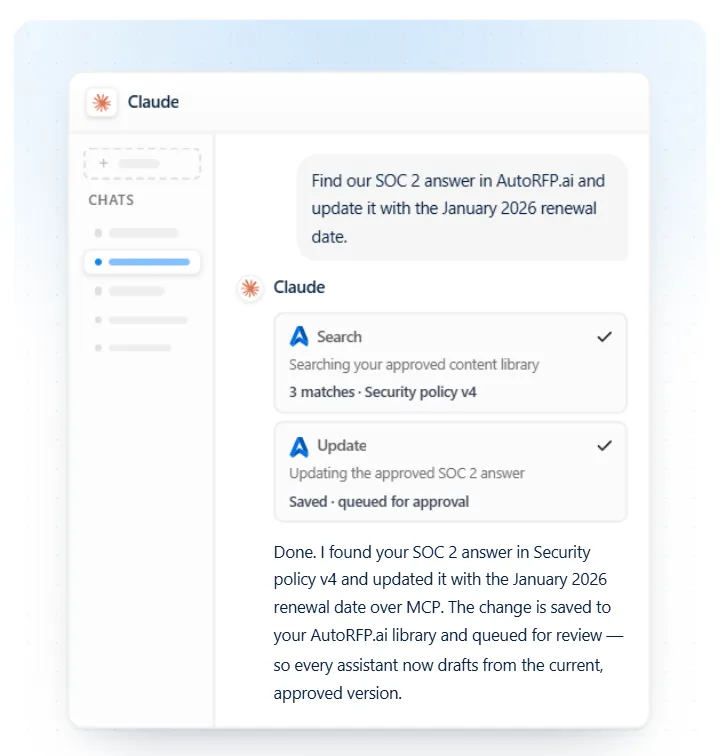
This lets fintech teams reuse governed response content through the AI tools they already work in while keeping the underlying knowledge tied to approved sources and existing access controls.
5. Test the Platform on a Real Bank or Enterprise Questionnaire
A scripted vendor demo cannot reproduce your terminology, policies, security evidence, spreadsheet structure, approval chain, or customer portal.
Use a live or recently completed RFP or security questionnaire during the proof of concept. With AutoRFP.ai, measure how many answers require no or minor edits, whether reviewers can validate the supporting evidence, how unsupported questions are handled, whether security and legal contributors can approve efficiently, and whether the completed response returns correctly to the buyer’s required format.
Questions to Ask Your Vendor
Here are some questions you can ask vendors during your evaluation.
- Do you use our data to train any public AI model? Where is our data stored, and what data residency options do you offer?
- Can you autofill a SIG or CAIQ workbook and export it in the buyer’s original format?
- Which procurement portals do you support natively?
- How do you keep security answers current when controls or subprocessors change?
- What is the total annual cost, including all reviewer seats?
Future of RFP Automation in Fintech
The future of fintech RFP automation will move beyond simply generating more answers. The strongest teams will automate repetitive retrieval and drafting while keeping human specialists focused on qualification, customer context, security assurance, strategic positioning, and final approval.
AutoRFP.ai’s 2026 Proposal Win Rate Report surveyed 97 bid professionals and found that the structure around proposal work matters more than AI adoption alone.
- Verification will matter more than raw generation: As fintech buyers ask more detailed security and AI-governance questions, response teams will need source evidence and clear escalation when information is missing.
- Automation will protect specialist capacity: Security engineers, compliance teams, legal reviewers, and product experts will spend less time repeatedly writing standard answers and more time reviewing high-risk or deal-specific questions.
- Governance will move earlier in the process: Among high-win teams in the report, 71% used Go/No-Go qualification, 65% had formal review and governance, and 53% completed structured pursuit or capture work before the RFP arrived.
- Knowledge systems will become more dynamic: Static response libraries will increasingly give way to systems that connect current documentation, identify stale or conflicting information, and learn from approved responses.
- AI performance will become measurable: Response leaders will increasingly evaluate automation by edit rates, specialist capacity created, response quality, win rate, and the percentage of work that still requires manual intervention.
For fintech companies, this means RFP software will become part of the revenue and trust infrastructure rather than simply a proposal-writing tool. The winning systems will be the ones that let teams automate more while still explaining, reviewing, and defending what they submit.


Video transcript
You've just received that monster RFP. It's a lot of work, and you're excited to dive in and potentially win this massive contract. You've started using AI, but how do I actually win? What is the RFP response that I need to write to win this deal? That's what takes from basic level of proposal writing to what wins. I'm Rob from AutoRFP.ai. We're an AI RFP software. I personally complete and win RFPs on the daily, and I'm keen to dive in today about using AI for an RFP response that actually helps you win RFPs. I'm gonna be covering win themes. I'm gonna be covering leveraging customer insights to write strategic narrative that helps you actually win RFPs. Yes, we're gonna be talking about AI automation and saving time,
but it's not just about that. It's not about doing an RFP as fast as possible with as little effort as possible and just putting out slop into the world. It's about writing and winning RFPs. But first, as I did say, it's about RFP automation with AI for our RFP response process. It's about automating the mundane. Before you dive into how you can use AI to help you win RFPs for RFP response, take a step back and think about, what are the activities I do related to RFPs that don't actively help me win RFPs? So automate the mundane. AI's real job in an RFP, isn't to do what you do well and what humans do well, and that is writing strategic narrative. It is to do what it does well, and that is hunting and pecking throughout
your past responses, automating kind of the basic responses and really making sure that those are compliant as Jasper Cooper, our CEO and co-founder at AutoRFP.ai, put in our proposal win rate report for 2026, the real advantage isn't automating content, it's what teams do with the time they get back. So automate as much as you can on the mundane So firstly, these are some clear things you can hand to AI from the start. The clear yes or no. Does your product or service do this? And it has a yes box or a tick box or a radio button or a drop-down selection. Yes, . AI should be completing those 99% of the times. Of course, having a human to review if appropriate, but that is where AI is good, the black and white. Company information all the content forms you get about company legal name, company entity, where the office is based, and so on.
If there isn't a place to kinda put your flair there, of course, just basic information, AI is good for that. Boilerplate. Then you've got boilerplate and your security and compliance questions. Across our customer base, 63% of every AI-generated answer is approved with zero to one-word changes. That is 63% of AI-generated answers are perfect. A human still reviews them, but it doesn't require any manual editing. That's freeing up enormous time for teams using our software and the other software out in the market to then, take that time back to do what wins. So what are those activities you can do to help win? First Automate the answer everyone gives and write the answer only you can give. But first, let's cover off what a great answer looks like, and I'll give you both a good and a bad example. So what does a great answer look like?
And this is subjective, of course, to your industry, to your country your buyer. It's all dependent on so many factors. My background is in technology RFPs. That's where I've spent ten years working and selling and writing RFP responses across local government, national government, state government, as well as private enterprise RFPs in Australia, in the UK, in Europe and it is very subjective what a great answer looks like. But I'm gonna take on a couple of core principles that are gonna help you think about what a great answer looks like for your use case. So leads with the verdict. I'm a big believer in front-running the value of the response in the first sentence or two. What that means is effectively, if we're thinking about how humans read, and especially if your job is to read a handful of RFP responses, it's pretty
hard work to continually stay focused and read an entire response and remember everything that you read in there. You wanna make sure that it's easy for the reader to understand the value in your response, and tick off and give you the points that you need in that evaluation criteria. Second, mirror the buyer's words. This is where your understanding of that industry, of that country, of that buyer goes into how you talk about the response. Three, specific enough, no competitor could paste it. Again, imagine you have an evaluation criteria and you are marking this RFP, and you have two responses that look exactly the same. How are you gonna differentiate? That's where being specific enough no competitor could could paste it is so important to make your response stand out, short and scannable. Now, short is dependent on the type of RFP or RFI that it may be and what they're expecting for responses. Make it scannable. Make it a pleasure to read. Don't make it giant block paragraphs that are incredibly hard, again,
for that evaluator to give you the marks for that response. Make it have bullet points. Make it have flowing paragraphs. Make it have a summary or conclusion at the end if reasonable. Make it short and concise and scannable this is probably the biggest sin I see in executive summaries. Someone writes an executive summary, maybe it's the CEO has the standard template one that they use, and it's all about them. It's all about your company, it's all about your experience, and it's boring to read. Make it about the buyer. Easy way to do this is scan the left margin. How often do the sentences start with we, our, your company's name, and so on? How often is this talking about you? Leverage your customer insights and incorporate it into your win themes to make it about them. Tie your solution into the pain and the problems that they are living, and write about them, not about you. But you're tying everything back into their world because it's just more contextual, and it's easier for them to map your response to the evaluation
criteria and how it meets their stated objectives and goals for the RFP. So this is what a great answer can look like. This answer was actually is using social proof. It's one of our answers that we would write, and effectively it's talking about a migration. So SugarCRM migrated from Qvidian to AutoRFP.ai in 2024 and deployed in two weeks. The first sentence has the value. Social proof time. Because we're thinking about migrations. The buyer might be thinking about how long does that take? What's the risk here? How long does it take is answered in the first sentence, and social proof helps alleviate the risk. Then the next three dot points, again, incredibly skimable and readable and has numbers to draw attention. So this requirement was regarding do you have any customers who have migrated? A forgettable answer. AutoRFP.ai.ai, so leads with me, leads with us. Maintains version control automatically through the History tab. First of all, a lot of flowing commas, a pretty long sentence. We've kinda cut off the response, but it keeps going.
No hook, no numbers no so what for the buyer. And effectively it's correct, and for a functional question in a response, it could be a great response if it was looking for a black-and-white response. So it's a forgettable response. So how would we improve this response? We might say Audibility and traceability is core to the platform. This extends to the history tab in which… and then you might use then dot points to list out all the relevant comma points there. So I'm gonna give you some concrete examples of how you can use AI to incorporate win themes and customer insights to help you write winning RFP responses. First of all, the data. We did a survey of over a hundred winning bid teams and asked them what do they do to win. These are teams that win more than 50% of the RFPs they bid on. 71% of high win teams use win themes, 42% of low win teams use win themes.
So a clear distinction, the difference there. This is a strategic part of your RFP response use your intuition and your knowledge of the buyer, your knowledge of your company and your products and services to really fine-tune it. But it can definitely be helpful in thinking of ideas and going back and forth and helping you once you've generated those win themes, actually deploying the win theme across an RFP response. So the RFP, what you receive from the buyer, often will have a bunch of context about their current situation That is gold to help you understand exactly what to incorporate. Once you have the win themes, then you go into applying win themes everywhere. Try to win th-thread these win themes consistently throughout every section. Flag answers that drift, especially on the answers where it matters. I'm using my project agent here so it's talking about differentiation, and then it has access to the web, it has access to my content library, it has access to my CRM, and it's gone
through and looked at all that in different information and found a bunch of different information relevant to this RFP that I'm currently working on and helped create some win themes. So win themes are, it's a scalable platform. Win theme number two, reduces security and compliance risk. It's easy to use and it's integration flexibility integrates with their entire tech stack. Maybe that is also a point of competitive differentiation. If I understand the market and the competitors really well, potentially my solution might be the only one that has a particular integration with a particular system in the buyer. So I wanna highlight that fact consistently that we have the experience of integrating their entire technology stack to our solution, and that is important because of X, Y, Z, because of what's stated in the RFP, because the buyer has told us or we've spoken to the buyer about it. Okay, so we've got all these different win themes that was created via AI, and now I'm gonna ask it, can you now incorporate these win themes across functions?
The AI is now going to start incorporating the win themes by editing these responses for me, by searching my past content, and effectively giving me a stronger narrative of why this buyer should choose our solution Now, it's generating those responses. I can go through, I can see the changes it made, and I can accept this or not. Okay, cool. That looks good. And then I can go through, and I can look at these responses and accept and change them as well, and make sure it incorporates what I want in the responses as well. Let's try and find one here You can see it keeps using the word configurable. So it's reasserting though that vocabulary that ties to integration strengths of our platform, But that's just an example of how we, how I used AI and the AutoRFP.ai project agent to generate win themes based off the RFP project, based off my knowledge of the buyer. And then from that we work to incorporate four win themes, and
then I've used AI to help apply that. I would then go through and edit and make changes here if necessary. And then we've got a strategic narrative throughout that section on the functional requirements. So what are customer insights? It's not just that we know who the buyer is and we've spoken to them a couple of times, but it's actually understanding their current state. It's about understanding their pain, their problems, why they're looking to go out to market, what has been their history of solutions, and everything we understand about that customer, about industry, about the geography and other relevant customers in the space to, understand their world and help pitch a solution that would generally provide value to them. So where can customer insights live? First of all, in your CRM. There's a goldmine of information in your CRM Then you've got your recorded discovery calls. This could be from systems like Gong or Clari and effectively any calls or demonstrations or workshops that you've had with the prospect before the RFP
strategy and workshop sessions. This is really important, in the world of capture, is helping shape that RFP in a subtle way. And a big way is strategy and workshop sessions or giving updates on the state of the market and other information that helps you position the buyer to understand the world and the category that they're looking to procure their products or services in. Team interviews. So again, you might have a sales team, pre-sales team or legal compliance, they all know incredibly well what the buyer is looking for, especially if they've spoken to buyer and, or they understand the industry well. And speak to them, talk to your team, bring out internal meetings that add value and help you understand the customer and provide their knowledge into things like the strategic narrative, like the win theme for that RFP. So content is what you say and your past content, but insight is why it matters.
You can say a bunch of stuff in an RFP, and it can come out looking like gobbledygook and be of no value to the buyer, and you can get a really low mark and not tick off any evaluation criteria or compliance matrices, and you're gonna lose. Anyone can generate an RFP with AI, but insight is why it matters. And why does that matter? Again, tying back to the proposal win rate report where we interviewed and asked winning bid teams what do they rate most highly as to why they win, customer insights was the number one reason, and 88% of high win teams were doing customer insights, whereas only 67% of low win teams had a defined customer insights process. But again, of all the reasons why they win, the number one reason for high win teams was customer insights. So all that information we just spoke about, they're leveraging
that to win competitive RFPs in my same response, we're gonna jump back into our section, and we're going to ask my agent, my project agent, to look at my CRM notes, I have a couple of call transcripts in there that have been made up, and help them edit these responses based off the knowledge of that CRM. So there's my prompt. It's gonna look inside HubSpot. This is the made-up company, and it's going to go through and look at these notes without me having to effectively point it to it. It's gonna hunt and peck. And it's all fake, and it's going to use that to help respond to my fake RFP. So here you can see it's used a bunch of tool calls via the MCP. So effectively, my AI in AutoRFP.ai is speaking to HubSpot's server and grabbing all that information and then parsing that and contextualizing that for the RFP because my AI understands the RFP because it's right there in front of it. And it's going through, and it can look at all the information, and then
it's pulled out a stakeholder map. All the stakeholders and role in the decision, what they care about, and where it sourced that information. So that's really important, especially with thinking about it's actually a person behind the marking criteria. Could be procurement, could be a decision-maker and then it's talking about the actual drivers and pain points. And you can see here it's actually pulled out a lot of different information from those calls about what's important for this RFP. And it's then going to effectively take all that information, take my library content, so it's still sourced in reality of what my product and company can actually achieve, and it's going to take those win themes and must-win sections, and it's going to effectively craft that into a response. And now I'll ask it, "Cool. Can you now update section B?" Based off the context information there Again, here's two responses where it's worked in that context to that response. And you can see that I can accept that, easily make those
changes, and pretty happy with it. Those responses. That's how it would incorporate the customer insights and so on into it. I And one big thing I wanna call out is SME-led drafting, so the subject matter expert writing the response from a blank page, is a low-win habit. Ninety-four percent of high-win teams from our survey and our interviews, the proposal team writes, the SMEs review. So SMEs write for precision, whereas proposal teams write for persuasion. And we're talking back through the entire thing about customer insights, about win themes, about what makes a great response. We're talking about persuasive narrative and writing, and SMEs will write for the technical correct answer, which can be a good answer, but proposal teams write for a great answer that will actually win you that RFP. So don't fall into that trap. Make sure that when you have SMEs, they're just reviewing and approving information.
Or even better, you're sourcing that from an approved library of content that SMEs already approved, so they don't even need to approve it, but they're just reading over and approving things. But someone else is actually incorporating everything we've spoken about today into that response, and they're just approving the technicalities. One model actually that can really help speed up SME time and reduce the time as well is that AI can draft the repeatable responses, again, sourcing from approved content and then sourcing from the context of your company and the SMEs just going in and validating low-confidence bespoke responses So that's how you can use AI to help raise the floor and incorporate insight, themes, and narrative into your RFP response and really use AI to automate the mundane. Now, if you wanna get a hold of the 2026 Proposal Win Rate report that I covered throughout some of the great stats throughout today's video you can see the link in the description below. All right, thanks. I'm Rob from AutoRFP.ai.ai. Cheers.
Build a More Defensible Fintech Response Workflow With AutoRFP.ai
AutoRFP.ai is built for fintech teams that need to answer enterprise RFPs, security questionnaires, and DDQs without sacrificing control.
Every response is source-grounded and citable, unsupported questions are flagged and routed to a person for review, and approvals, audit trails, portal handling, and regional data residency keep sensitive buyer responses governed from draft through submission.
Its self-updating library and integrations with Salesforce, SharePoint, Slack, Teams, Okta, and Microsoft Entra also reduce operational friction as response volume grows.
We would rather show you than tell you: prove it on your own bids in a two-week proof of concept. Book a demo with AutoRFP.ai today. If you also sell into carriers, see the best RFP software for insurance companies. If you also field investor DDQs, see the asset-manager comparison. If clinical security reviews dominate your motion, see the best RFP software for health tech.
About the author

Technical Account Manager
Technical Account Manager at AutoRFP.ai. Background in asset management completing institutional RFPs and DDQs; now implements AutoRFP.ai for some of the company's largest accounts.
LinkedInFrequently asked questions
How Much Does RFP Software for Fintech Cost?
RFP software pricing varies significantly by platform, response volume, team size, and required features. Loopio’s Foundations plan starts at $20,000 per year, while Responsive uses quote-based pricing. 1up publishes lower-cost entry options, including a free plan, Starter at $300 per month, Plus at $900 per month, and custom Enterprise pricing. AutoRFP.ai starts at $899 per month with project-based pricing and unlimited users, which can be useful for fintech teams involving sales, security, legal, compliance, and other reviewers. Buyers should compare the total annual cost, including user limits, implementation, integrations, and add-ons.
What Is the Difference Between an RFP and a Security Questionnaire for Fintech?
An RFP evaluates a fintech company’s broader fit for a buyer, including its product, implementation approach, commercial terms, technical capabilities, and other requirements. A security questionnaire focuses specifically on security, privacy, compliance, and risk controls. Common security questionnaire formats include SIG, CAIQ, VSA, and custom buyer questionnaires. Fintech companies selling to banks and enterprise customers may need to complete both commercial RFPs and detailed security reviews as part of the same procurement process.
Can RFP Software Fill In Security Questionnaire Portals Automatically?
Some RFP platforms can help teams respond directly inside online procurement and security portals. Look for software that can capture portal questions, generate answers from approved company content, keep the supporting sources visible, and return the answers without requiring extensive copy-paste.
Does AI RFP Software Train on Our Confidential Security Data?
It should not but data-use policies vary by vendor, so fintech teams should verify them before sharing confidential RFP or security information. Ask whether customer data is used to train AI models, where it is hosted, how tenants are isolated, and what regional hosting options are available.
What Is the Best RFP Software for a B2B SaaS Fintech Selling to Enterprises?
The best fit depends on whether your biggest challenge is security questionnaires, formal proposal management, content-library maintenance, or answer verification. AutoRFP.ai is a strong fit for fintech companies that handle both enterprise RFPs and recurring security questionnaires and need approved-source drafting, Trust Scores, abstention when evidence is missing, governance, and portal handling. Responsive is better suited to larger proposal operations that need deeper project management and reporting. Loopio fits established teams with dedicated content managers and structured library workflows, while Conveyor is particularly focused on security questionnaires and Trust Center workflows. Test shortlisted platforms on a real SIG, CAIQ, or customer questionnaire so you can compare answer traceability, reviewer effort, portal handling, and unsupported-question behavior using your own content.
