
15 Winning RFP Best Practices to Follow in 2026
RFP best practices for response teams: qualify hard, build win themes tied to scoring, answer evaluators with evidence, then run disciplined reviews.

Co-founder & CEO, AutoRFP.ai·Updated ·22 min read
You can put weeks into an RFP response and still lose because the proposal was unclear, too generic, or hard to evaluate. The strongest teams follow RFP best practices that keep the response focused, compliant, persuasive, and easy to review. In this article, we’ll cover the key practices to follow across planning, writing, collaboration, review, and submission so your team can build proposals with a better chance of winning.
What Separates Winning RFP Responses From Losing Ones
Winning RFP responses are not simply better written or completed faster. They are built on a stronger operating model. High-performing teams qualify opportunities carefully, start with clear customer insight, define win themes before drafting, and give one proposal owner control of the narrative.
That structure shows up in the results: strong teams reach the shortlist at a median rate of 63%, compared with 38% for low-performing teams. They make it easier for evaluators to see the fit, the value, and the evidence behind every claim.
Losing responses are often technically correct but strategically flat. They reuse generic content without enough context, rely on SMEs to write disconnected sections, and treat compliance as the finish line rather than the minimum requirement. Winning teams work differently.
Proposal professionals shape the persuasive story, SMEs validate accuracy, and automation handles repeatable content so more time can go into research, differentiation, and buyer-specific messaging. The difference is not more effort. It is knowing which work should be standardized and which parts deserve deeper strategic attention.
15 RFP Best Practices That Move Your Win Rate
The best RFP practices do more than help your team submit on time. They protect capacity, improve strategic focus, and make every response easier for evaluators to understand, score, and defend internally. The following practices cover the full journey from deciding whether to bid to producing a compliant, differentiated response.
1. Qualify the Opportunity Before Committing Resources
A strong RFP process starts with the willingness to reject opportunities your team is unlikely to win.
Assess strategic fit: Review solution fit, customer access, mandatory requirements, commercial value, competitive position, delivery risk, and available capacity.
Identify deal-breakers early: Surface product gaps, unacceptable terms, unrealistic deadlines, required certifications, and pricing constraints before involving the wider team.
Demand a credible win path: Do not approve the bid simply because your company can meet the requirements. Confirm why the buyer would choose you over the likely alternatives.
Around 71% of high-win teams use a formal Go/No-Go step, but the checkpoint only works when teams are prepared to act on the result rather than approve every visible opportunity.
Pro tip: Require the account owner to explain the customer problem, competitive angle, and reasons you can win before kickoff. “It is a large contract” is not a bid strategy.
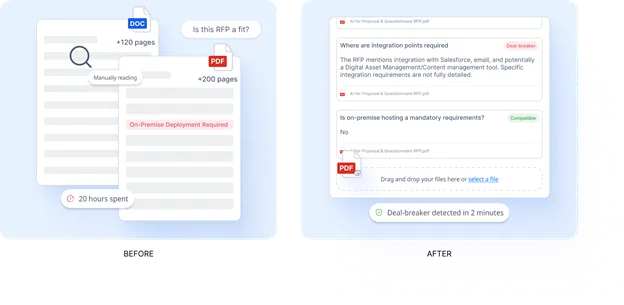
The webinar below walks through a tighter qualification checkpoint: reading the opportunity, weighing bid effort against realistic win probability, and calling the decision before anyone starts drafting.
Software can carry that checkpoint too. An RFP or DDQ platform with go/no-go scoring built in rates opportunity fit, delivery risk, and available capacity in one pass, which keeps the call consistent from bid to bid.
2. Start With Customer Insight, Not a Blank Document
Do not begin drafting until the team understands the buyer’s current state, desired outcomes, risks, and decision environment.
Gather internal intelligence: Pull relevant information from CRM notes, discovery calls, demonstrations, workshops, emails, account plans, and conversations with sales or pre-sales.
Research the wider business: Review annual reports, strategic priorities, leadership statements, industry pressures, regulatory obligations, and recent organizational changes.
Map the stakeholders: Identify likely evaluators, decision-makers, users, procurement leads, and economic buyers, including what each group may care about.
Create an insight brief: Document the buyer’s problems, priorities, constraints, success measures, competitive context, and unanswered questions in one shared place.
Defined customer-insight processes appear in 88% of high-win teams, compared with 67% of low-win teams. Content tells you what you can say; insight tells you why it matters to this buyer.
3. Define Win Themes Before Writing the Response
Win themes give the entire proposal one persuasive direction instead of allowing every contributor to tell a different story.
Connect three elements: Each theme should combine a buyer priority, a meaningful differentiator, and credible proof.
Keep the set focused: Three or four strong themes are usually more useful than a long list of generic strengths.
Thread them throughout: Reinforce the themes in the executive summary, technical approach, implementation plan, case studies, commercial narrative, and high-value answers.
Check for drift: Flag sections that are compliant but do not support the overall reason the buyer should choose you.
Defined win themes are used by 71% of high-win teams, compared with 42% of low-win teams.
Side note: “Experienced team,” “great service,” and “innovative solution” are not strong win themes unless they are connected to a specific buyer concern and supported by evidence.
4. Give One Person Clear Ownership of the Bid
Cross-functional participation is essential, but shared participation should never mean shared accountability.
Name one proposal owner: A bid manager or proposal lead should own the schedule, requirement coverage, narrative, assignments, review process, and submission readiness.
Define decision rights: Clarify who approves technical claims, pricing, contractual positions, security responses, and the final version.
Assign section-level accountability: Every section should have one named owner, one internal deadline, and one defined reviewer.
Control conflicting feedback: The proposal owner should decide which edits strengthen the response and which ones dilute its strategy.
Every high-win team in the analyzed cohort had at least one dedicated bid manager, while 14% of low-win teams reported having no dedicated bid role.
5. Match Bid Volume to Real Team Capacity
Capacity should be judged by the work required to protect response quality and not simply by the number of employees available.
Measure the complete workload: Consider bid volume, document complexity, bespoke content, review burden, SME availability, submission formats, and concurrent deadlines.
Set practical limits: Define how many active opportunities the team can manage without weakening research, strategy, compliance, or review quality.
Escalate overload early: Make the revenue risk visible before the team reaches the deadline, not after quality has already declined.
Do not confuse size with coherence: Adding more contributors can create slower decisions, duplicated work, and unclear ownership when the underlying process is weak.
According to AutoRFP.ai‘s Proposal Win Rate Report 2026, in the 151-500-bid volume band, teams with 2-10 people achieved a 46% normalized win rate, while teams with 11-20 people recorded 12%. The lesson is not to keep teams small at all costs; it is to keep capacity, ownership, qualification, and process aligned.
6. Let Proposal Teams Draft and SMEs Validate
Subject matter experts should protect accuracy without being forced to build the complete persuasive response from scratch.
Use SMEs for specialist input: Ask them to confirm facts, explain technical approaches, identify risks, and validate new or low-confidence claims.
Let proposal professionals shape the answer: The proposal team should translate expert knowledge into clear, buyer-focused, evaluator-ready language.
Give SMEs something to react to: Provide the exact requirement, a draft response, required proof, and a clear deadline instead of sending the entire RFP.
Use interviews for complex topics: Record a focused discussion when the SME must solve the answer, then turn that discussion into structured content for validation.
Around 94% of high-win teams use joint collaboration or a model where the proposal team writes and SMEs review. Only 6% rely on SMEs to draft before the proposal team reviews.
Pro tip: For highly technical responses, use a “proposal-SME-proposal” workflow: the proposal lead creates the structure, the SME supplies or validates the substance, and the proposal lead restores clarity and persuasion.
7. Reuse Commodity Content and Customize What Can Win
The goal is not to make every answer bespoke. It is to direct bespoke effort toward the sections that can change the evaluator’s decision.
Reuse low-differentiation content: Company details, standard security controls, certifications, policy information, yes-or-no capabilities, and established processes can often come from approved sources.
Customize high-value content: Focus human attention on the executive summary, implementation approach, business outcomes, competitive differentiation, risk reduction, pricing narrative, and partnership model.
Adapt rather than paste: Even reusable answers should reflect the question, terminology, response limit, and relevant buyer context.
Separate content by importance: Mark questions as standard, tailored, strategic, or must-win so the team knows where to spend its time.
About 51% of teams without content automation fall into the low-win cohort, compared with 29% of teams using content automation.
Side note: Reused content can still be tailored. Bespoke content is written from scratch; tailored content starts with an approved foundation and adapts it to the opportunity.
8. Govern the Sources Behind Your Answers
A large content library is not useful when contributors cannot tell which answer is current, approved, or relevant to the opportunity.
Start with high-dependence content: Prioritize the product, security, legal, implementation, company, and compliance information used most frequently.
Assign content owners: Give each important content area a responsible expert or team that confirms changes and approves the source.
Control context: Categorize information by product, region, legal entity, industry, solution, or version wherever multiple correct answers may exist.
Retire weak material: Remove duplicates, outdated claims, unsupported statements, and rarely reused answers that cost more to maintain than to recreate.
Connect to living sources: Where possible, retrieve information from maintained technical documentation, policies, product records, and approved company systems rather than relying on copied fragments.
Pro tip: Ask one simple governance question: “Could this requirement have two different correct answers in our organization?” When the answer is yes, categorization and context controls become essential.
9. Use AI to Automate the Mundane Work
AI creates the most value when it removes repetitive work and gives the team more time for customer insight, differentiation, and judgment.
Automate appropriate tasks: Use AI for requirement extraction, answer retrieval, compliance mapping, boilerplate drafting, company information, gap identification, question routing, and first-draft assembly.
Ground outputs in approved material: Responses should come from trusted sources, with traceability back to the content used.
Apply confidence-based review: Direct human attention toward new, bespoke, high-risk, or low-confidence answers rather than reviewing every answer with equal intensity.
Keep strategic decisions human-led: People should still own win themes, positioning, competitive judgment, pricing, exceptions, evidence, and final narrative quality.
AI proposal technology is used by 65% of high-win teams, but AI adoption by itself showed no independent predictive relationship with win rate. It amplifies the process into which it is introduced, whether that process is strong or weak.
10. Write Every Answer for the Evaluator’s Scorecard
A strong answer makes it easy for evaluators to identify compliance, relevance, evidence, and value without searching through unnecessary text.
Lead with the verdict: Answer the question directly in the opening sentence before adding qualifications or supporting detail.
Address every component: When a requirement contains three separate questions, make all three answers explicit.
Mirror the buyer’s terminology: Use the language found in the RFP, evaluation criteria, strategic documents, and stakeholder conversations.
Connect capability to impact: Explain not only what your solution does, but how it supports the buyer’s stated objective or reduces a named risk.
Make it scannable: Use concise paragraphs, descriptive subheadings, bullets, tables, and visible proof points where the response format permits them.
A useful response structure is: direct answer → explanation → evidence → buyer impact.
11. Make the Response Specific Enough That a Competitor Could Not Reuse It
Generic claims disappear when evaluators compare several qualified vendors offering similar capabilities.
Name the buyer’s situation: Refer to its environment, objectives, constraints, stakeholders, timelines, systems, or operational risks where appropriate.
Quantify the value: Use relevant timelines, percentages, savings, service levels, adoption figures, implementation milestones, or performance outcomes.
Match proof to the concern: A buyer worried about migration risk needs migration evidence, not a general company award.
Explain the “so what”: Translate features into the result they produce for the buyer.
Use relationships as an insight source: Convert account knowledge into a stronger response rather than assuming familiarity will carry the decision.
A relationship may help your team gain access and uncover context. The proposal still needs enough evidence and specificity to persuade evaluators who have never met your company.
12. Use Clarification Questions Strategically
The clarification period is an opportunity to improve your understanding of the requirement and not an administrative step to complete because the buyer offered it.
Ask only useful questions: Avoid requesting information already stated clearly in the RFP.
Resolve strategic ambiguity: Clarify current systems, implementation expectations, requirement priorities, scope boundaries, response assumptions, evaluation methods, and mandatory conditions.
Test potential risks: Raise unclear legal, security, delivery, commercial, or integration requirements before your team builds its response around the wrong assumption.
Update the response strategy: Feed useful answers back into the compliance matrix, customer insight brief, solution approach, and win themes.
The best clarification questions help the team make a better bid decision or produce a materially stronger answer.
13. Structure Reviews Around Different Quality Risks
A review process should test the proposal from several angles without turning the document into a collection of conflicting personal preferences.
Compliance review: Confirm that every requirement, attachment, instruction, and mandatory condition has been addressed.
Strategy review: Test whether the response reflects customer insight, reinforces win themes, and differentiates the solution.
Technical review: Ask SMEs to validate accuracy, assumptions, feasibility, risks, and supporting evidence.
Commercial and legal review: Confirm pricing, commitments, exceptions, terms, and delivery obligations.
Final editorial review: Check consistency, readability, terminology, formatting, cross-references, and submission readiness.
Formal review or governance appears in 65% of high-win teams, compared with 42% of low-win teams.
Side note: More reviewers do not automatically produce a stronger proposal. Give each reviewer a defined lens, and let one editor resolve feedback while protecting the central narrative.
14. Run a Ruthless Pre-Submission Audit
The final review should verify the complete submission package, not merely search the main document for spelling mistakes.
Confirm requirement coverage: Check every question, clause, form, appendix, attachment, and supporting document against a live compliance matrix.
Verify response instructions: Recheck page limits, word limits, templates, file formats, naming rules, signatures, portal fields, and submission deadlines.
Audit consistency: Ensure that pricing, timelines, service levels, implementation claims, company details, and contractual positions agree across all files.
Test the submission process: Confirm portal access, upload limits, document rendering, macros, links, passwords, and final permissions in advance.
Create a submission buffer: Set an internal deadline early enough to resolve upload or approval problems without relying on deadline-day heroics.
Assign one person to confirm that every final check is complete and recorded. “Everyone reviewed it” is not the same as accountable sign-off.
15. Capture the Learning From Every Outcome
Each completed RFP should leave your team with better judgment, stronger content, and fewer avoidable problems on the next opportunity.
Request buyer feedback: Seek scoring details, evaluator comments, debriefs, or publicly available award information for both wins and losses.
Separate outcome from process: A win does not prove the process was flawless, and a loss does not automatically mean the proposal was poor.
Identify the real cause: Examine qualification, customer insight, solution fit, pricing, differentiation, compliance, capacity, reviews, and competitive position.
Update approved knowledge: Add strong new answers, remove outdated material, record objections, and capture evidence that can support future bids.
Turn lessons into actions: Give each agreed improvement an owner and deadline rather than storing the debrief in a folder that no one revisits.
A post-bid review is valuable only when the learning changes what the team does next.


Video transcript
So you've just received an RFP. Maybe it's the first time you're doing it. Potentially you're an experienced bid manager, and you wanna understand what is the RFP management process, like process, challenges, and how do you win these highly competitive and challenging bids? In this video I'm gonna show you through the exact RFP management process, challenges, share with you some data in relation to winning bid teams and how they win these complex bids that can really elevate your business. Let's jump into it So why does RFP management matter? An RFP or request for proposal is when a large organization, let's say an enterprise with 10,000 staff, or federal government body wants to procure products or services. Where RFP management matters is we surveyed with between AutoRFP.ai and Stargazy over ninety-seven bid professionals in our twenty
twenty-six proposal win rate report. You can find the link below if you wanna have a look yourself of the proposal win rate report. In this report, we found that fifty-one percent of teams without content automation sit in the low win cohort. So in our RFP management video today, we're gonna go into content automation. We're gonna talk about how ninety-four percent of high win teams use joint collaboration with their subject matter experts, not having the subject matter expert drafting. And where this all matters is the median shortlist rate. So the rate of which your RFP makes it to the next stage and isn't disqualified is sixty-three percent for high win teams versus thirty-eight percent for low win teams. So the teams that have very strong RFP management processes and structure, not only are they winning more, but they're making it through the RFP process to the next step almost double or triple the rate of other teams with content automation, joint collaboration with SMEs, and a lot of other things.
So let's jump into it. But before that, I wanted to leave you with this quote: " Most teams lose RFPs because their system is perfectly designed to produce the results they currently achieve." That was in the Proposal Win Rate report from Christina, the founder of the Stargazy community, a bid manager community, and that really stuck with me, is that if you have a poor system for your RFP management and response, you are setting yourself up to fail, which is why RFP management and systems and processes matter a lot more than heroic efforts one-off bid that you spent, hours and hours fine-tuning. But actual process and repeatable ways to win will get you and your business more revenue than just the one-off effort of trying to win a random bid. And finally, sixty-five percent of the bid teams that win the most
use AI proposal tech, which is what Audirfp.ai is and where I'm from. So what is RFP management? RFP management is how you organize everything that happens between receiving an RFP and submitting your response. Think about it could be everything from when you first discover an RFP on a public tender notice board. Let's say it was for a public tender notice board. Receiving an RFP and submitting your response. It involves people, content, and process. So what is the RFP management process? It starts off with a kickoff meeting. When you see it or you receive that private or public RFP, think about who needs to be involved. Get executive stakeholders on board quickly, especially if it's a very highly competitive and commercial bid. What is the response strategy? How are we going to make our response best fit for the evaluation criteria to win the RFP? Draft and assign. Who is doing what section?
How are we going to complete those sections? And overall, what does a great first draft look like? That is where AI can help the most. Review and submit. Who gets final say on the pricing and commercial? Who gets final say on legal? Who gets final say privacy, security, and compliance measures? Make sure that's clear from the start, and be ready when you have your first draft and everything is ready to be reviewed, that it can be submit cleanly to the right people at the right time. Audit and analyze. Something we don't do often enough in bid management is think about how could we do better with this bid? What feedback can we do, and how can we improve for next time? Which leads into that next one, continuous improvement, and that is the difference between a one-off effort and a systematic approach to RFP management and bid response that will get you to win bid after bid versus just that random one bid that you were lucky to get. An effective kickoff meeting does not just rehash to everyone
exactly what the RFP is saying. It is about establishing clear deadlines, where we talked about who is going to submit each answer each section, who's gonna draft each section, who's going to review each section. That's where you wanna have all those people there to establish clear deadlines for each of those contributors. Then you should already have somewhat of an understanding here, but this is where you can kinda lean on the people in this meeting to develop win themes. A win theme is what is your clear competitive advantage or way that you are going to structure your response with persuasive writing, with clear customer stories, that will get you the win in this RFP. For instance it could be an enterprise that cares a lot about security and privacy, and it could be based in the EU, is looking for a vendor who meets certain requirements. And you could be the only vendor, and you may know that you're the only vendor who meets the high-level requirements in relation to security and privacy, and you believe that's a competitive advantage for your company and for this bid.
Overall make sure that you plan all your supporting documents, so everything that the final submission should include. And you can use like an RFP checklist. We've got a pre-submission checklist in the links below. But you can use a pre-submission checklist to make sure, again, all of that is taken care of when you go to submit. And then assign a single project owner who drives accountability. This would often be a bid manager or at least, or a project manager, someone who is keeping an eye on all the deadlines. Clarification questions is an often overlooked part of the RFP process that can really help you understand that buyer and should be used every time. What you don't wanna be doing is submitting a question for the sake of submitting a question. Don't ask something that is very clear in the RFP. That could reflect negatively. But do think of some useful questions, that you can submit back to the buyer that will, help understand their current solution better and what they're currently doing. Map requirements to identify capabilities.
You could look at, for instance, there could be Moscow ratings, there could be mandatory nice to have, must-have, and so on. But each of those requirements you can compare to, evaluation criteria, and you can look at where do you stack up. But every single one of those requirements, where do you stack up just at a first glance? Even better is that step is in your AI go, no go or your go, no-go process before you even start to bid on, start contributing resources. You've already seen if you're actually a good fit for this bid before jumping headfirst. Build a response plan with section owners, deadlines, and review cycles. We discussed that just before. And decide your competitive angle before writing a single word Now, drafting response and assigning owners.
So this is where we actually start to write. So each of the reviewers and writers they begin to work. Use real-time collaboration so multiple people can work simultaneously. You never wanna have a bid that only one person can access at a time. That's not very conducive to strong teamwork. Pull from your your content library for common questions instead of writing from scratch. So at the start of the video, I mentioned how a strong content library often underpins a winning bid team, and here is the time that you can use that. So if you have pre-filled answers or approved answers in regulatory environments that you can pull from readily to answer common requirements, then this is where you use that. Make sure, though, you're not just mindlessly copy and pasting. Make sure that where appropriate, you're weaving in that win theme throughout the RFP and bid response. AI tools, and this is where a company like and product like ours, AutoRFP.ai, really shines, is generating that first draft.
AutoRFP will demonstrate a first draft in a matter of seconds from a blank RFP document and it'll leverage your content library for that, really speeding up the RFP response time, increasing participation rate, and giving you more time to write even stronger and better responses. So it goes into kind of like an AI feedback loop to continuously improve your responses. That can be one part tooling, and tooling can be one part of your RFP management process and response process that can really underpin a winning strategy. Some larger bids and structured processing involve a different colored reviews, where it goes through multiple and sequential reviews of different sections for relevant people. One trap around reviewing is making sure that the value of the bid and that win theme isn't lost through people's opinion. If you have ten different people review a section, you're gonna have ten lots
of different feedback and potentially some of them are contradictory or some of them are the same. But you wanna make sure that, of course, you're applying feedback if they're experts in that space. But you as the editor or project owner of that section should ensure that the win theme and what makes that a winning bid isn't lost. That's the review trap And finally, just before you go to that final review, run your pre-submission checklist, spelling, grammar, compliance, consistency and so on. And again, in the description below, we've got our pre-submission checklist that you can download for free, and that can be part of your winning process. Finally, we've now submitted that RFP. So some kinda top-level metrics that you should track is your stages the bid goes through. How many do you not bid for because it wasn't a good fit? That's a good thing to measure. Make sure there's endless opportunities, but you wanna bid what actually makes sense. The ones that you bid for, what were the outcomes of those b-
The ones that you bid for, what are the outcomes for those bids? Was it won? Was it lost? Did you withdraw? Did you stop the bid because of resourcing issues and never submitted it? Next level, once you have that data in terms of the status of your bids , is what were the size of the bids and what was the cost of the bid? That's a really tricky thing to measure. There's some great resources out there around cost of bid, but effectively you wanna make sure that these bids are profitable. So if there's a ten percent chance on a ten million dollar bid, but it costs two hundred grand to bid, that's a really tough one to make. And then also make sure that, you wanna make sure, in a good system or a good AI RFP software like AutoRFP or other software out there in the RFP software market, should automatically be using your responses that you're working on and add them into your library and intelligently store that and categorize that content so it can be used for next time. That's where it's really important to consistently write better and
better, and your content library kind of builds over time, and your systems are set up to produce better results as your company gets, makes bid management and RFP response and the management, RFP management process a competitive advantage of the company And finally, continuous improvement. So it's really not out there to ask for feedback, whether that's a private enterprise bid or if it's government bid. Often this may even be posted publicly. But you wanna make sure you get feedback on the bid, and not just on the bids that you win, but the bids that you lose are sometimes more important. You may unearth that you shouldn't have bid on that in the first place, that it wasn't a good fit from the start. You may realize a flaw in your RFP management process and where something needs to be sharpened up for next time. And continuous improvement in your RFP management process implementing that will just kinda make it better and better every time, and that's what really helps companies go from winning the occasional RFP worth a million dollars
to consistently winning million-dollar RFPs and substantially growing the business's footprint in the enterprise so what are some of the common RFP management challenges? Outdated systems and bottlenecks. Thinking about that process is where is the most amount of friction? That could be following up people to review. So you're always having to message them and be like, "Hey, can you review a section? This was due yesterday." It could be that your content lives in ten different systems. You can never find the right answer. It could be technical docs. It could be SharePoint. It could be Google Drive or whatever. And then and then content library paralysis. So if forty percent of saved references may reference outdated information, no one has the full data to update them. Now, here's some best practices to help you win RFPs consistently and land those million-dollar contracts. Automate the repetitive work. AI has come so far and can help out in particular places of the RFP management process.
Whether it be automating the repetitive work of a first draft and finding the relevant information out of your content library, AI is incredibly strong in that. AutoRFP.ai customers consistently get eighty percent plus AI first draft rate off their existing content, and you wanna make sure that standardized templates. Centralize everything, so it's easy to find the right and source the right information. Cross-functional collaboration, multiple people can edit at once. Reviewers it's easy for someone to review. It's an easy-to-use system. You don't want some clunky software that they have to log in, and an SME can never use it, and therefore, they hate having to help you on an RFP. And track performance metrics automatically. Every time you are moving through your CRM or your relevant software, these opportunities that the bid software is also updating, or at least your bid process data is there. Automating routing questions to the right SMEs, so you don't have to think about who should this go to. Real-time progress tracking so nothing falls through the cracks, and automatic importing of different documents to get a really high level of AI first
draft, and trust scores telling you which answers need human review. So the AI is doing a lot of heavy lifting. That's kinda what AI RFP management looks like is the AI is taking care of that manual work, and the human is coming in to ensure that the win themes are strong, that the pricing is competitive, and that evaluation criteria are met, and they're going to win that bid. All right. What I wanted to leave you with today was a live demo of just the project management capabilities with an AutoRFP.ai and how that can help your RFP management process. So looking in here, we have an RFP project. You can see here that already forty-five of my responses have been submitted and reviewed, nine have been, nine have been submitted but not reviewed, and there's still fourteen left drafted. So I can quickly click into my Drafted, see what ones are left left need to be edited, and then I can look after those as needed. So I can click into my fourteen draft and see, okay, we're still waiting for someone here to to submit those, and I can go in, submit, and make changes. So it's a very easy kinda multiplayer capability, seeing where everything's at.
Can go to my Project Overview and see that the project is due in five days. This is everyone who worked on that project, when it's due. My first draft was highly AI automated, ninety-seven point one percent draft. And overall we have sixty-two percent exceed compliance, thirty-five percent fully compliant, and I can quickly see what response is partially compliant and understand why that's partially compliant and kinda review that. By just having one look and a couple of clicks, I can see, against the evaluation criteria, what responses need to be improved or where we're potentially weak on this competitive bid before having to really do a lot of work. I can see project attachments and everything else going into this bid. And so that's what a project overview dashboard for a competitive bid looks like. If you wanted to have a look at AutoRFP and give it a try, you can go to our website autorfp.ai. Here, you can have a look and learn more about our product and everything else that kind of goes into it and what kind of automation rates our customers are achieving with autorfp.ai. And you can also book a demo to spend time with our team, and in this demo, they'll
provide a really guided walkthrough of the platform, help understand your business, and see really if it's a good fit or not. Thanks. I'm Rob from autorfp.ai. Hopefully, that was helpful in relation to your RFP management process. See ya.
The “Best Practices” That No Longer Work
Some RFP practices sound sensible because they reward effort, speed, or experience. But they can also lock teams into inefficient ways of working that do not improve the final outcome.
More bespoke writing always creates a stronger response: Writing every answer from scratch does not automatically make a proposal more relevant. It often forces teams to spend valuable time rewriting standard information instead of strengthening the sections that truly influence the buyer’s decision.
Relationships are the main reason companies win RFPs: A strong relationship may help you access the opportunity, but it cannot persuade every evaluator involved in the decision. Formal buying committees still need clear evidence, relevant answers, and a solution they can justify internally.
SMEs should write the response because they know the subject best: Technical knowledge does not always translate into persuasive proposal writing. SMEs often produce accurate but disconnected answers, while the proposal team is better positioned to maintain a clear voice and consistent narrative.
Strong execution matters more than a defined process: Teams cannot rely on individual effort to rescue every bid. When the operating model is weak, even highly capable people spend their time chasing inputs, fixing inconsistencies, and managing last-minute problems instead of improving the strategy.
AI allows proposal teams to do more with fewer people: AI can increase drafting speed, but it does not remove the need for research, judgment, governance, review, and strategic direction. Used without a strong process, it simply helps teams produce more generic responses at a faster rate.
The issue with these practices is not that they are completely useless. It is that teams often treat them as shortcuts to winning when they only solve one small part of the proposal challenge.
How to Turn Best Practices Into a Repeatable Engine
Best practices only improve performance when they become the default way work moves through the team. A repeatable RFP engine needs defined inputs, clear ownership, automated workflows, quality controls, and a feedback loop that makes each completed response improve the next one.
1. Convert Every Best Practice Into a Workflow Rule
Broad advice such as “research the customer” or “review for compliance” leaves too much room for interpretation. Turn each practice into a required step with a clear trigger, owner, deadline, and output.
For example:
Customer research: Produce and approve an insight brief before drafting begins.
Win-theme development: Finalize the core themes during kickoff and store them inside the project.
Compliance review: Check every answer against the requirement and evaluation criteria before final approval.
Post-bid learning: Complete a debrief and assign follow-up actions after every outcome.
Organize these rules around consistent stages such as intake, qualification, kickoff, drafting, review, submission, and debrief.
Side note: When a practice depends on one experienced employee remembering to do it, it is still a habit, not a repeatable system.
2. Standardize the Inputs That Shape Every Response
Teams should not reinvent the structure of the process for every new opportunity. Create standard templates for the information that contributors need before they can work effectively.
Useful inputs include:
Opportunity brief: Deal value, deadline, scope, strategic fit, and major risks.
Customer insight brief: Priorities, pain points, stakeholders, current environment, and desired outcomes.
Win-theme framework: Buyer need, differentiator, supporting evidence, and expected value.
Compliance matrix: Requirements, response owners, review status, and supporting documents.
Response plan: Internal deadlines, section owners, reviewers, and approval paths.
Review brief: The exact lens each reviewer should apply.
Standardizing the inputs does not mean making every response identical. It gives the team a reliable foundation for producing opportunity-specific work.
3. Automate Work That Does Not Require Strategic Judgment
The team should not spend hours cleaning documents, transferring questions, finding boilerplate, or rebuilding the buyer’s template. Automate those tasks so proposal professionals can spend more time on strategy, evidence, and differentiation.
AutoRFP.ai can support this part of the engine by:
Importing Word, PDF, Excel, and ZIP-based RFP packages.
Extracting requirements, sections, tables, and supporting context.
Preserving complex structures such as macros, nested tables, and compliance matrices.
Creating first drafts from approved responses and internal company sources.
Routing questions and review requests to the appropriate contributors.
Exporting completed responses into the buyer’s original Word, Excel, or PDF format.
Preserving dropdowns, conditional formatting, and other template requirements during export.
The purpose is not to automate the entire proposal. It is to remove work that does not require human judgment. AI amplifies the operating model it is placed into, so weak processes simply become faster, while mature processes gain more capacity for strategic work.
4. Build Trust Controls Into AI-Assisted Drafting
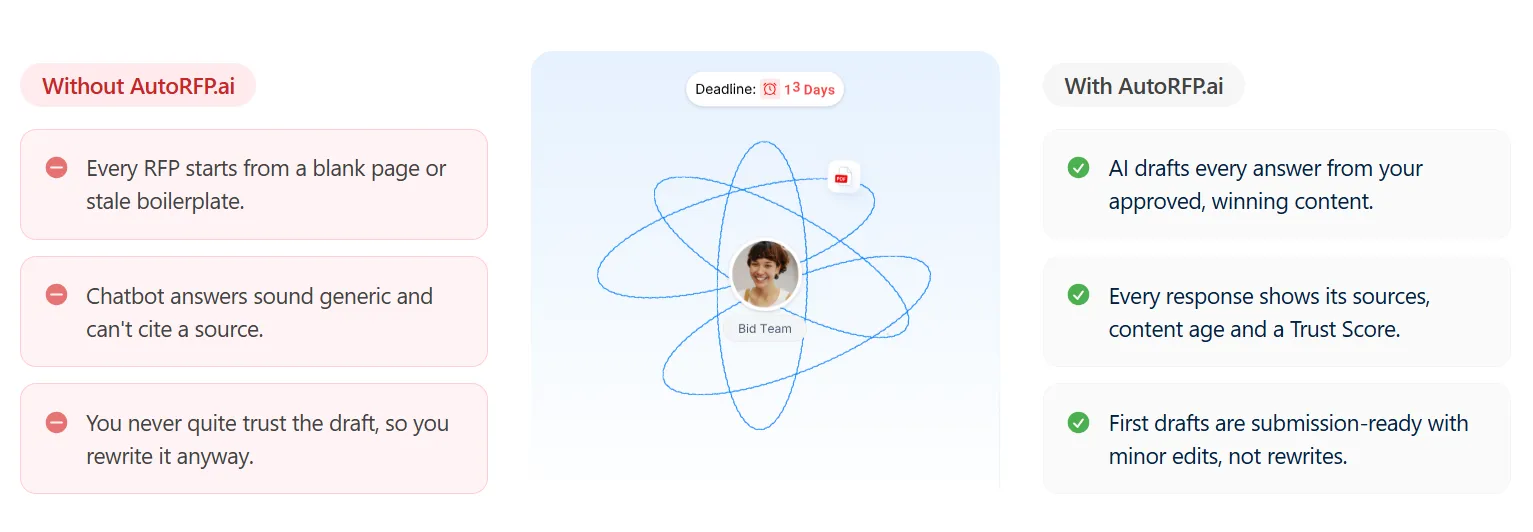
A repeatable engine must produce answers that reviewers can verify, not drafts they have to investigate from scratch.
Set clear rules for how AI-generated responses should be handled:
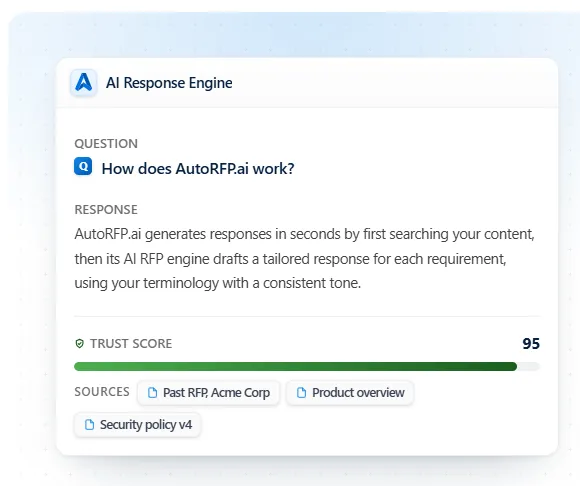
Use approved sources: Generate answers from verified company content, not unsupported general knowledge.
Show the evidence: Link every answer to the document or response that supports it.
Display content age: Let reviewers see when the source was last updated.
Use trust scores: Direct attention toward low-confidence or high-risk answers.
Leave unsupported answers blank: When no approved evidence exists, the system should not make up a response.
Apply risk-based review: Give new, strategic, contractual, technical, and low-confidence answers deeper human review.
AutoRFP.ai follows this source-backed approach by showing the sources and trust rating behind each generated answer. When supporting evidence cannot be found, it can leave the answer blank rather than hide uncertainty inside convincing language.
Pro tip: Do not measure AI success only by how much it writes. Measure how much of its output can be approved quickly and defended confidently.
5. Make Every Approved Answer Improve the Next Bid
A completed RFP should strengthen the organization’s knowledge base automatically. Otherwise, teams continue solving the same questions and rebuilding the same responses.
Create a closed content loop:
Add approved responses back into the reusable knowledge base.
Capture the final version rather than the unreviewed first draft.
Organize content by product, market, region, entity, industry, and use case where necessary.
Remove duplicate or outdated answers.
Connect to maintain sources such as product documentation, policies, and security records.
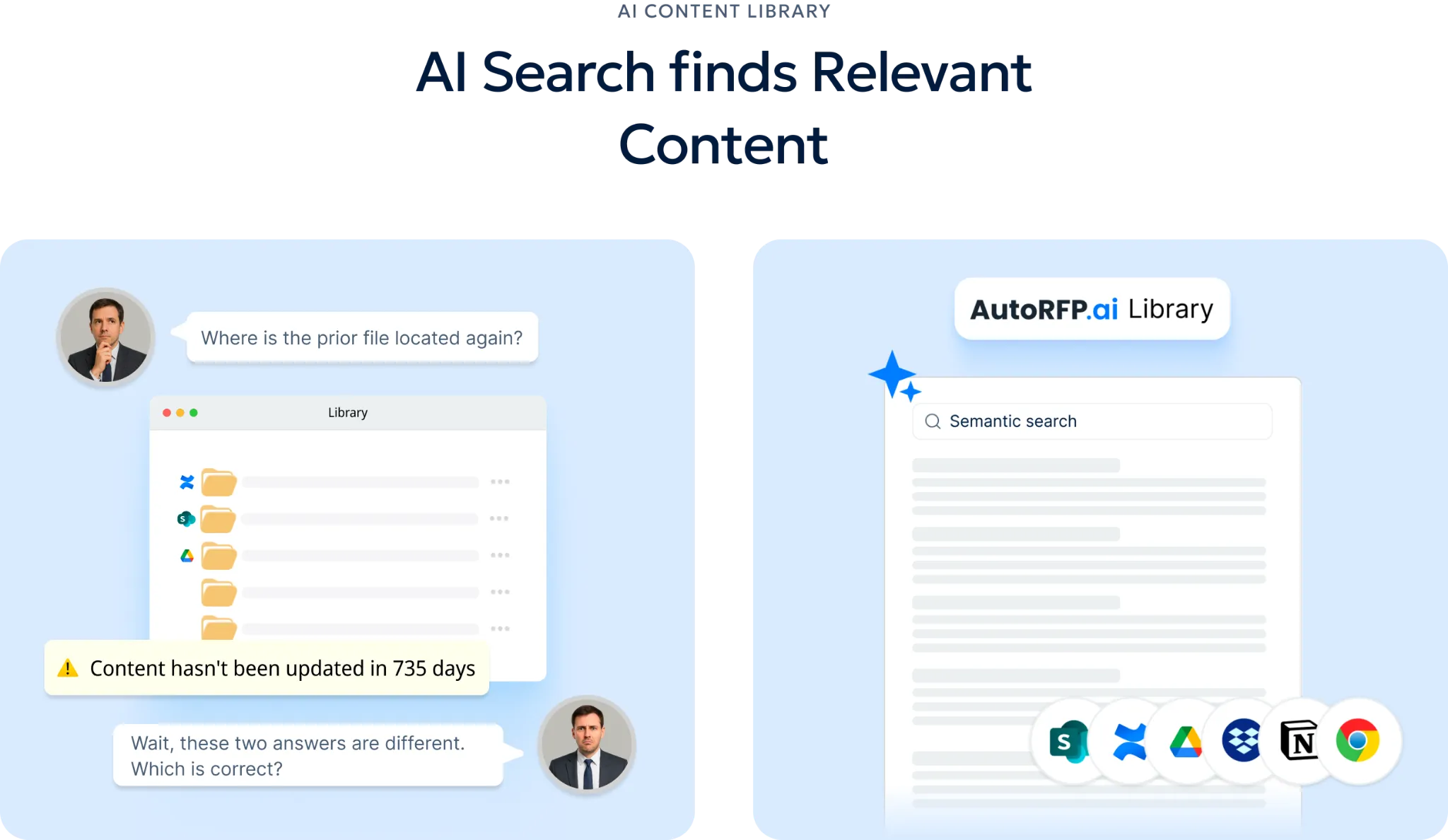
Use semantic search so contributors can find relevant material even when the wording differs.
AutoRFP.ai can add approved answers into a self-updating content library, then use AI to categorize and retrieve them in future projects. That reduces the manual tagging and maintenance that often causes traditional libraries to become outdated.
The goal is not to save every answer ever written. It is to retain reliable content that genuinely reduces effort or improves quality in future responses.
6. Manage Every Bid Through One Operational View
Repeatability breaks down when assignments live in spreadsheets, comments sit in email threads, and project status depends on meetings.
Use one workspace to track:
Section ownership and internal deadlines.
Drafted, submitted, reviewed, and approved answers.
Blocked requirements and unanswered questions.
Open comments and pending decisions.
SME and reviewer workloads.
Changes made throughout the response cycle.
Overall completion and submission readiness.
AutoRFP.ai brings these activities into one project dashboard for RFPs, security questionnaires, and DDQs. Proposal managers can see where work is delayed, which answers need review, and who needs to act without manually checking multiple systems.
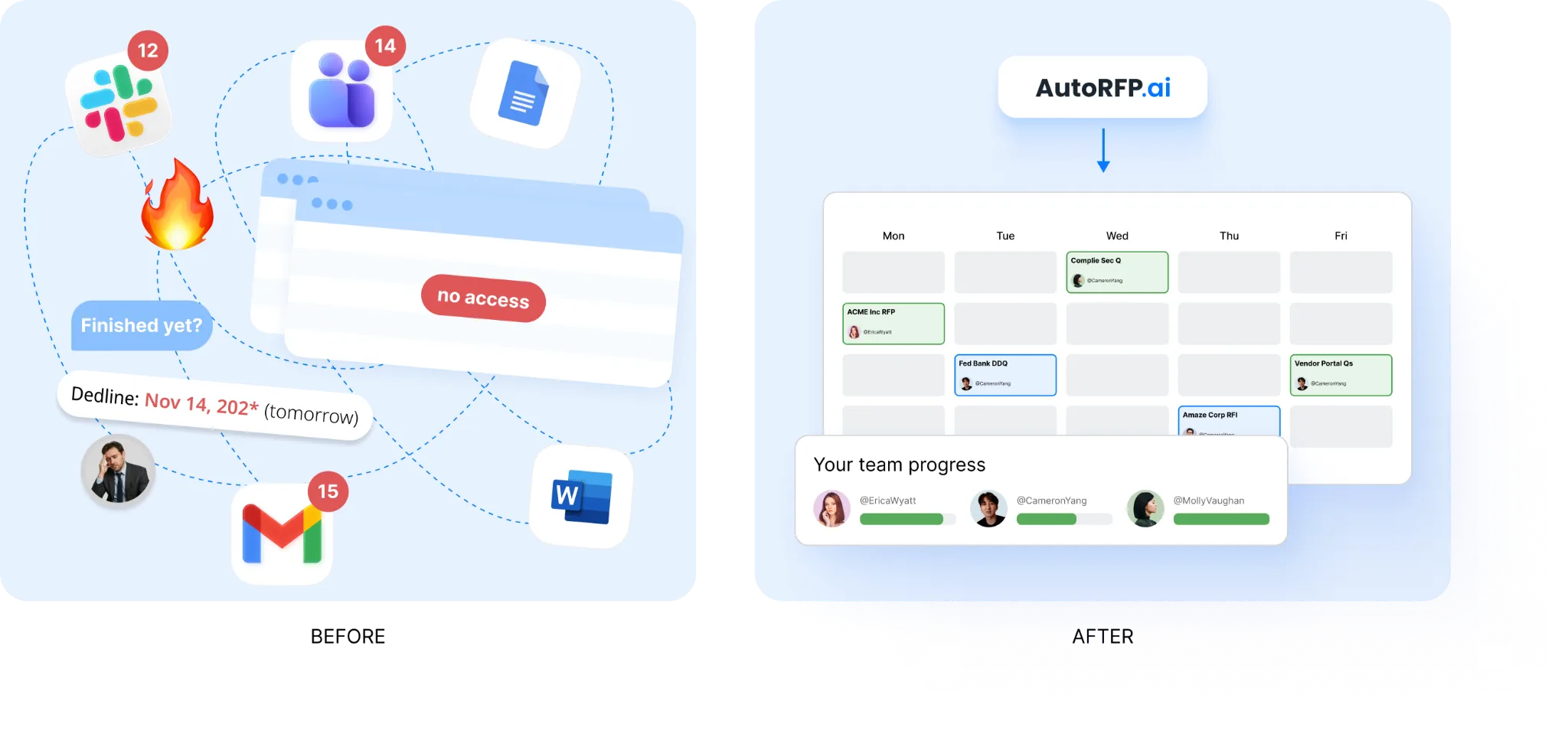
Central visibility also makes accountability more consistent. Contributors can see exactly what they own, while proposal leaders can intervene before a small delay becomes a deadline problem.
7. Measure the Engine, Not Just the Final Result
Win rate matters, but it does not explain why performance changed. Track the operational signals that show whether the system is becoming more efficient, controlled, and competitive.
Useful measurements include:
Automation rate: How much repeatable work was completed automatically?
Edit rate: Which answers required no changes, minor edits, major rewrites, or manual drafting?
Response cycle time: How long did the project take from import to submission?
Review delays: Which functions or stages repeatedly created bottlenecks?
Content reuse: How much approved material was reused successfully?
Compliance gaps: Which requirements repeatedly received partial or non-compliant responses?
Cost of bid: How much internal time and expense went into each pursuit?
Commercial impact: Which gaps, delays, or requirements affected the greatest pipeline value?
AutoRFP.ai’s ROI reporting can track automation, editing effort, cost savings, and freed capacity across projects. Its gap analysis can also show recurring product, security, hosting, or compliance weaknesses and connect them to the deals they affect.
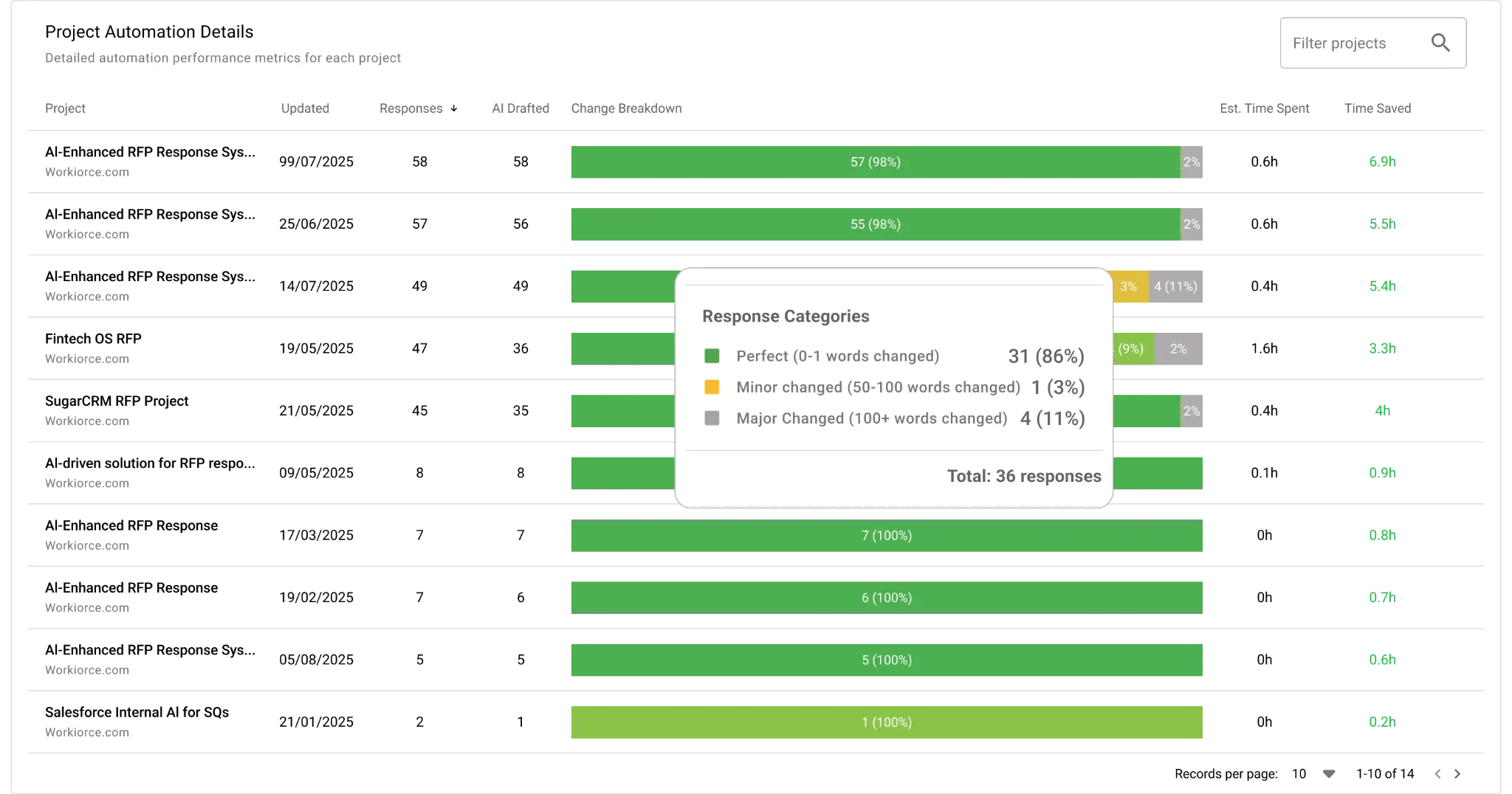
For example, proposal leaders can move beyond saying that buyers frequently request a missing capability. They can show that it appeared in 18 of 40 recent RFPs and affected $1.8 million in pipeline. That turns proposal data into evidence that product, security, finance, and revenue leaders can act on.
A repeatable engine is complete only when its results feed back into qualification, staffing, content, product decisions, and future response strategy.


Video transcript
Transcript is auto-generated and may contain minor errors.
Have you ever wanted to know how AI can answer RFPs? That's what I'm going to show you today using the power of AutoRFP.AI and how you can use AI to automate up to 80% of your RFPs. My name is Rob from AutoRFP.AI. Let's jump into it. AutoRFP.AI, we're a software product leveraging the latest models from OpenAI, Anthropic, and Google to automate our customers, whether that's technology companies, finance companies, healthcare businesses in 44 plus countries across the globe automating their RFPs. But, our goal is not just to automate, but to help them win. So, let's look at the RFP response market in 2025. We have our legacy RFP software players.
That's your Responsive.AIs, your Loopios, Qvidians, have been around for, you know, 10 plus years and really brought software to the RFP process in managing your subject matter experts and team members, project management, in having a question and answer bank, and using keyword search to automatically copy and paste answers from your content. Then, you have a lot of really new Silicon Valley based AI RFP software. It seems like every week there's a new AI RFP software. Probably no surprise to you watching this video. AI is a great use case for RFPs. There's a lot of new startups in the space. AutoRFP, we're actually in a nice position having launched 3 years ago before chat GPT released and building
our product since then with hundreds of customers all across the globe from Fortune 500 companies to Silicon Valley tech unicorns using our software every day to automate the mundane. That is what an RFP is, isn't it? It's a bit mundane. What kind of challenges do businesses and team members have when they search for an RFP software? You might be spending like Amanda here, who is one of our customers before she picked up Order RFP, spending a lot of time just answering RFPs. That raw horsepower needed to complete thousands of questions across these large documents, whether it's Word documents, PDFs, Excel spreadsheets, supplier portals like SAP Ariba. Amanda, actually their COO at that company, would spend an entire weekend
just answering an RFP. We've all been there. I have as well. Or you might be like one of our customers, Jason, before he picked up Order RFP, using a lot of time to maintain his legacy RFP software. He had this big content library of questions and answers and constantly was having to spend time just maintaining that, where he was now spending more time stuck in content nightmare land than actually answering RFPs. It was really challenging. Or you might be like one of our customers, Katie, before she picked up Order RFP, was spending a lot of time just trying to version control, wrangle subject matter experts to answer questions, and just the speed of collaboration and project management deadlines was really tough.
So, what AI workflow then automates this entire RFP process? First, people would upload their requirements, those RFP tender documents that you receive from your prospects in any format they come, whether that's PDF, Word, Excel, zip file. Upload all that relevant information into the system, and then it'll begin answering with AI those different responses in 40 plus different languages, whether you receive an RFP in German but write answers in English and have it translate back. It uses your data lake of content and AI to find the relevant information to then automate an RFP response to every single requirement and every single question. Then, once that's done, you have that
highly automated AI first draft, you get your team in there, project manage deadlines, ensure that there's proper oversight on responses from legal, security, pricing, commercials, whoever it is, they're engaging in the product and using it to collaborate and get that winning RFP response. You don't want to just automate, you want to win. And that's where Auto RFP really shines, because as you're writing those winning responses, it just gets better and better over time, constantly learning from your work. Awesome. Let's jump into the product. This is AutoRFP.ai. You can see I have all my different projects. I'm going to create a project. And here is my blank RFP documents. I've got a zip folder that contains three different documents in here. Really interesting what's happening right now is we're using Gemini Flash
2.5 to automatically answer any questions in relation to that document. So for instance, I want to know if data needs to be stored in specific geography and provided my answer there. So it's doing an AI go no go analysis. Then here we have our document. It's got multiple tabs in Excel spreadsheet. Automatically the AI has scanned the entire document and picked up every functional and non-functional requirement, everything that's relevant for my cover letter that I'm going to produce in my PDF. And then this appendix B has some information as well. Then we have our data lake of content in AutoRFP.ai. That might be your web pages, your integrations, 15 plus integrations that AutoRFP can pull in and sync automatically. And the AI is going to use specialized re-ranker models to then ensure that there's the
most relevant answer for that specific question. It's much better than just creating something in ChatGPT. I'm not going to do a translation today, but here I would translate if needed and I create my project. This is where we see the magic really happen. So we have our data lake of information, which is all our content from our business, the context, past RFP responses, and then we have the AI sourcing the relevant information, then the AI from that information drafts relevant answers, and we have multiple LLMs that then ensure that answer is the best it can be for that response in the entire context of our business and the entire context of the RFP. You can see that it's quickly answering those different RFPs. We can jump to different sections and see cool, RFP workflow, it's answered. Oh, there's a
few questions there that have a lower trust score. Let's jump into to understand why. So, that content there is relevant to the search query, but it's 7 months old. I want to make sure that a person reviews and actually submits a new answer for that. So, everything in my RFP workflow, I'm going to then assign George to be the editor for that response. George will be at receive a notification in Slack, in Microsoft Teams, or via email. George will be able to jump in, answer those, and then submit them for my review. So, that's how I collaborate seamlessly across OrderRFP.ai. Then, across my trust scores, I want to look down and find those that are still generating and any that are at lower trust scores, and again, further answer those questions and assign to different team members as relevant. We've got our drop-downs that are in the RFP were automatically assigned by the AI depending on the answer. Our
responses automatically generate and bring across tables, so I have my service level agreement, my SLA here, answered in a table and generated into the response. Images that you might have in your RFP response will also come through automatically with your content with the AI generating as well. I want to jump over to my project overview. I understand when this project is due, what the AI draft rate was, what my compliance levels are, who is involved in this RFP process, how many do they have to review, do I need to send any reminders? If I want to add any attachments to include in my submission. So, I'm going to uh include my ROI report, my integrating with Notion doc, and all the different information that I want to include in that submission, I can do so. Then I have my AI assistant. So, in
answering these responses, I can prompt and write custom prompts to improve that response. I can use my quick writing actions to fix up any spelling or grammar, check for inconsistencies, and so on. I can find and search with my AI semantic search to find any relevant content and use those answers as well. Then I can improve that response. Then in my comments, I can discuss with my team. Please review this specific part. So, then I can comment and collaborate with my team. Once I have my edited response from the AI, I can accept and see where those revisions are, and quickly accept that new response. I have a full audit trail of any AI actions as well as people actions over my responses. I can restore to previous versions. So, you never have a collaboration and versioning issue.
Everyone, multiple people at once, are working in OrderRFP. And then what I think's one of the coolest things is the AI assistant. With the relevant content and context, I can just chat to the AI regarding my business, regarding this RFP, regarding these requirements, and it can provide answers to help me improve my responses as I work through the RFP. Next, I'm going to approve all my responses because this one is ready to submit. So, now all I have to do is export that RFP. Now, all I have to do is export that RFP. So, I click export all and the power of AutoRFP and the AI involved here, I'm not fiddling around with those original source documents, inserting or copy and pasting answers. Instead, it is
automatically populating those answers in there. We've downloaded our files in those original format with AI having answered and automated our RFP process. I'm going to jump into We have two things here. We've got our customer files, which are the original documents that required answers, and we can jump in here and see all those answers and where they've gone. So, across my multiple tabs, we have all of my responses and the drop-down that's come through for every one of those responses with me not having to do a single thing, and then I'm ready to submit that Excel spreadsheet with those requirements. I've got my docx as well with the relevant information filled out, and one of the coolest thing is I have my cover letter or my proposal that I can include in that pro- process, and this includes all
relevant information and additional information on my RFP response. So, my export template that I created in Word doc and uploaded to AutoRFP as a template, the AI has then automatically generated answers and responses for my executive summary, for my transmittal letter, and for everything that I want to upload additionally, whether it's a solution overview, whether it's more information about our AI security and privacy, and all that information has come through, and the AI has filled this out. For instance, there's my SLA table that we saw the AI generate earlier, and it's filled that information out ready for me to then submit and add, includes any images like reviews across Gartner, and all that information has come through ready to export to the customer. And that's the end-to-end workflow of
AutoRFP.ai, from uploading my blank RFP, leveraging my data lake of organizational context and past RFP answers, for the AI then to automatically generate and respond to and automate the RFP process, to collaborating with team members across the entire RFP process, and then exporting to the original customer format and submitting my RFP. There's one really important thing I want to make sure to convey when you're thinking about AI and RFP software. And that is what might be the boring, but incredibly important security, privacy, and transparency. At AutoRFP.ai, we pride ourselves on getting security, privacy, and transparency right from day one.
Our customers, as I mentioned, in over 44 plus countries, hundreds of businesses from Fortune 500 to Silicon Valley unicorns using AutoRFP daily, have global hosting options across the US, across Europe in Germany, and in Australia for APAC. Everywhere we have global offices, an office in Vancouver, in Stockholm in Sweden, in Brisbane, Australia, providing 24 six support across the globe. There is zero training, and I want to make sure this is absolutely clear, zero training on customer data for models. We are not sending any customer data back to the OpenAIs, the Anthropic's, or the Google's of the world. Your data, customer data, is your data. The outputs that the AI generates is clearly stated
in our service agreement that those are your outputs. You control this data. It's not AutoRFP. We're not secretly building some sort of AI model ourselves for based off customer data. We're not secretly trying to hurt our customers in the long term. We build for our customers. AutoRFP is a bootstrap company, profitable, growing 15% month-on-month, headcount doubling every six months across the demand we have for our solution, and we build it for you, for our for our customers. We don't build it for venture capital to one day uh try to sell the company. We don't build it for private equity that are trying to lay off and you know, squeeze every penny from the business. We do it for our customers. That's why we built. And you can find out all that
information in our trust center and our legal center as well. If you're interested in jumping on long and learning more about AutoRFP.ai, head over to our website. We've got a lot of information there about the business, uh the product, about our pricing as well. Uh you've got our annual plans across scale, accelerate, and enterprise. We have customers with as little as 24 projects a year, so 24 RFPs a year, to as much as over 1,000 RFPs done every year. The scale uh all the way in between. You can book a demo and spend time with our team, and they can provide a much more uh You can spend time with our team, and they can provide You can spend with time with our team, and they can provide a much more detailed breakdown and a customized demo for you and your business about AutoRFP. So, head over to AutoRFP.ai today and learn more about it. Thanks. See you.
So, head over to AutoRFP today. That I'm Rob from AutoRFP.ai, and we just covered off AI and how to automate your RFP process with AutoRFP.ai.
How to Measure Whether Your RFP Process Is Improving
Do not judge improvement only by whether the latest bid was won or lost. Track a balanced set of outcome, efficiency, quality, and capacity metrics across multiple submissions to see whether the process is becoming more selective, repeatable, and competitive.
| Metric | What improvement looks like |
|---|---|
| Win rate | A higher percentage of submitted RFPs results in signed contracts, measured over a consistent period and separated by sector, deal size, or opportunity type. |
| Shortlist rate | More submitted responses progress to demonstrations, interviews, negotiations, or the next evaluation stage. A falling shortlist rate may reveal compliance failures or weak messaging before it affects final wins. |
| Go/No-Go effectiveness | The team rejects more low-fit opportunities early and concentrates resources on bids with stronger solution fit, customer access, commercial value, and win potential. |
| Response cycle time | The time between receiving the RFP and completing a review-ready draft decreases without increasing errors, rushed approvals, or late submissions. |
| Automation rate | More standard questions, document-import tasks, requirement mapping, and first-draft work are completed automatically, leaving more time for strategic sections. |
| First-draft acceptance rate | More AI-generated or reused answers require no changes or only minor edits, while the number of major rewrites declines. |
| Content reuse rate | The team successfully reuses more approved content for repeatable requirements without introducing outdated, irrelevant, or inconsistent claims. |
| Compliance performance | Fewer answers are marked partially compliant or non-compliant, and fewer mandatory requirements, attachments, or submission instructions are missed. |
| Review and SME turnaround time | Contributors complete reviews faster, fewer sections become blocked, and proposal managers spend less time manually chasing overdue input. |
| Cost and effort per bid | The team reduces the hours and internal cost required for each response while protecting quality, strategic depth, and deal value. |
Review these metrics together. A faster response process is not improving if shortlist rates, compliance, or answer quality are falling, just as a higher win rate may be misleading if the team is pursuing only a small number of unusually favorable opportunities.
Build a Higher-Win RFP Engine With AutoRFP.ai
Winning more RFPs should not depend on longer hours, scattered workflows, or constant SME chasing.
AutoRFP.ai helps teams turn proven best practices into a repeatable process by structuring complex bid documents, generating source-backed first drafts, tracking ownership and review progress, and reusing approved content across future responses.
Its trust scores and source links help reviewers focus on higher-risk answers, while reporting reveals where automation, compliance gaps, and team effort affect performance.
Book a demo to see how AutoRFP.ai can help your team respond with more speed, control, and confidence
About the author

Co-founder & CEO
Co-founder and CEO of AutoRFP.ai. Spent 7 years in enterprise sales and personally completed 500+ RFPs before founding the company.
LinkedInFrequently asked questions
What Is a Good RFP Win Rate?
A good RFP win rate is generally around 40% or higher, although the right benchmark depends on your industry, deal type, company size, and whether you are bidding for new or existing business.
Should You Respond to Every RFP You Receive?
No. Responding to every RFP can overload your team and take resources away from opportunities you are more likely to win. Use a formal Go/No-Go process to assess solution fit, customer access, competitive position, commercial value, mandatory requirements, delivery risk, and available capacity. Proceed only when there is a credible reason the buyer may choose your company, not simply because your solution can technically meet the requirements.
Who Should Be Involved in Responding to an RFP?
The response should have one bid or proposal manager who controls the schedule, assignments, narrative, reviews, and final submission. Sales should provide customer and competitive insight, while subject matter experts from product, security, legal, finance, implementation, and compliance validate specialist answers. Senior leaders may also review strategic or high-value bids. Each contributor should have a defined responsibility rather than being invited to review the entire proposal without a clear purpose.
How Do You Calculate an RFP Win Rate?
Divide the number of RFPs won by the total number of completed RFP outcomes, then multiply the result by 100. For example, winning 12 out of 30 decided opportunities produces a 40% win rate. Exclude bids that remain open, were cancelled by the buyer, or have no confirmed result. You can also calculate separate rates for new customers, renewals, industries, regions, deal sizes, and opportunity sources to understand performance more accurately.
What Is the Difference Between Win Rate and Shortlist Rate?
Win rate measures how many submitted RFPs ultimately result in contracts. Shortlist rate measures how many responses progress to the next stage, such as a presentation, demonstration, interview, or negotiation. Tracking both helps reveal where problems occur. A low shortlist rate may indicate compliance, relevance, or proposal-quality issues, while a strong shortlist rate combined with a low win rate may point to pricing, demonstrations, negotiations, or competitive positioning.
How Should You Handle an RFP Requirement You Cannot Fully Meet?
Do not hide the gap or claim compliance without evidence. State the current level of compliance clearly, explain any available alternative or workaround, and outline whether the requirement can be delivered through configuration, integration, a product roadmap, or an agreed implementation plan. Any future commitment should be approved by the relevant product, legal, security, and delivery owners before it is included in the response.
Is It Safe to Use AI With Confidential RFP Information?
It depends on the platform’s security and data-handling controls. Before uploading confidential information, confirm whether customer data is used to train AI models, where the data is hosted, how access is controlled, and whether audit trails, retention policies, SSO, and private deployment options are available. Enterprise teams should also assess relevant certifications, contractual protections, regional hosting requirements, and the platform’s use of third-party AI providers.
