Proposal Compliance Matrix: How to Build One That Wins in 2026
A proposal compliance matrix is a table that maps every RFP requirement to where your proposal answers it, so no requirement gets missed before submission.

Co-founder & CEO, AutoRFP.ai··16 min read
You can have strong win themes, great subject matter experts, and a polished proposal, but if the response misses a requirement, none of that may matter. That is why a proposal compliance matrix needs to be more than a checklist.
It should guide how your team plans, writes, reviews, and validates the response. In this article, we’ll walk through how to build one, what to include, and how to use it to create a more compliant and competitive proposal.
What Is a Proposal Compliance Matrix: Core Concepts
A proposal compliance matrix is a working document that maps every RFP requirement to the exact place it will be answered in the proposal.
It is how proposal teams stop requirements from getting missed, buried, duplicated, or answered in the wrong section.
The core idea is simple: every buyer requirement needs an owner, a response location, a compliance status, and proof that it has been addressed.
A strong proposal compliance matrix usually tracks:
- Requirement number: The exact RFP section, question, clause, or attachment reference.
- Buyer requirement: What the RFP is asking for, copied or summarized clearly.
- Response section: Where the requirement will be answered in the proposal.
- Owner: The writer, SME, sales lead, legal reviewer, pricing owner, or technical lead responsible for the answer.
- Compliance status: Whether the team is compliant, partially compliant, non-compliant, or needs clarification.
- Evidence needed: The documents, certifications, case studies, policies, pricing details, or technical proof required to support the answer.
- Review status: Whether the answer is drafted, reviewed, approved, or still unresolved.
- Submission risk: Any issue that could weaken the response, such as missing attachments, unclear wording, unsupported claims, or unresolved exceptions.
The matrix becomes the control center for the proposal.
Without it, teams rely on memory, comments, spreadsheets, and last-minute checks. That is how mandatory requirements get missed and reviewers end up finding basic compliance issues too late.
With it, the team can see what has been answered, what still needs work, who owns each gap, and whether the final proposal actually matches the buyer’s instructions.
For high-volume RFP teams, this is also where automation starts to matter.
Why a Proposal Compliance Matrix Can Make or Break Your Bid
A proposal compliance matrix can make or break your bid because it turns the RFP from a long document into a controlled response plan. Without it, teams miss requirements, duplicate answers, assign work badly and discover compliance gaps too late.
| Area | Why it matters |
|---|---|
| Compliance control | It helps the team confirm that every mandatory requirement is addressed before the proposal reaches final review. |
| Scoring alignment | It keeps the response focused on what the buyer will evaluate, not just what the team wants to say. |
| Risk visibility | It shows early where the team is non-compliant, partially compliant, missing evidence or waiting on clarification. |
| Review efficiency | It gives reviewers a clear map of what each section is supposed to prove, so they are not checking the proposal blind. |
| Team accountability | It makes ownership clear, so requirements do not disappear between sales, SMEs, legal, pricing and proposal teams. |
| Evidence discipline | It forces the team to connect claims to proof, such as certifications, case studies, policies, technical documents or implementation examples. |
| Proposal structure | It helps the team build the response around the buyer’s instructions instead of forcing the RFP into a generic template. |
| Deadline protection | It reduces last-minute surprises because gaps, missing documents and unresolved questions are visible earlier. |
| Win theme placement | It helps the team place key messages where they support actual buyer requirements, instead of dropping them randomly into the proposal. |
| Submission confidence | It gives the team a final check that the bid is complete, compliant and ready to submit. |
Download our examples that actually won RFPs.
What to Include in a Proposal Compliance Matrix
A proposal compliance matrix should capture three things clearly: what the buyer asked for, where your team answers it, and who owns the work. Keep it practical enough for writers, SMEs, reviewers, and leadership to use during the bid.
| Field | What it captures | Why it matters |
|---|---|---|
| Requirement reference | The RFP section, question number, page, paragraph, clause, or attachment where the requirement appears. | Keeps every requirement traceable back to the original buyer document. |
| Requirement ID | A unique number for each requirement, such as 1.1, 1.2, or A-03. | Makes it easier to track, assign, review, and discuss requirements without confusion. |
| Requirement description | A clear summary of what the buyer is asking for. | Helps SMEs and reviewers understand the ask quickly without rereading the full RFP. |
| Exact requirement text | The buyer’s original wording, especially terms like “shall,” “must,” “required,” or “provide.” | Protects the team from softening or misreading mandatory instructions. |
| Evaluation criteria | The scoring rule, priority, or standard the buyer will use to judge the response. | Helps writers focus on what will actually be evaluated, not just what is easy to answer. |
| Proposal response location | The proposal volume, section, page, table, or answer where the requirement will be addressed. | Shows reviewers exactly where to check whether the requirement has been answered. |
| Compliance status | Whether the team is fully compliant, partially compliant, non-compliant, pending, or needs clarification. | Gives the team an early view of risk before final review. |
| Assigned owner | The writer, SME, sales lead, legal reviewer, pricing owner, or technical owner responsible for the response. | Prevents requirements from getting lost between teams. |
| Supporting evidence | Links to case studies, certifications, policies, screenshots, technical documents, attachments, or proof points. | Makes the response stronger and easier to defend. |
| Risk level | Whether the requirement creates legal, technical, pricing, security, delivery, or commercial risk. | Helps reviewers prioritize the requirements that could weaken the bid. |
| Response notes | Internal comments, assumptions, clarification needs, buyer context, or SME instructions. | Keeps important context in one place instead of scattered across email and Slack. |
| Deadline tracking | The internal due date for drafting, SME input, review, approval, or final update. | Keeps the team moving, especially when several departments need to contribute. |
| Review status | Whether the response is not started, drafted, reviewed, revised, approved, or blocked. | Shows proposal leaders what is ready and what still needs attention. |
| Strategic alignment | The win theme, differentiator, value proposition, or customer pain point connected to the requirement. | Keeps the matrix from becoming a compliance-only checklist and ties the response back to why you should win. |
How to Build a Proposal Compliance Matrix Step by Step
Here’s how to build a proposal compliance matrix that keeps the bid compliant, reviewable, and tied to the strategy instead of turning into another spreadsheet nobody trusts:
Step 1: Break Down the RFP Requirements
Start by extracting every requirement from the RFP, including the obvious instructions and the buried ones.
Look at the main document, attachments, pricing forms, terms, appendices, portal instructions, and evaluation criteria.
Track:
- Requirement reference: Capture the section, page, paragraph, clause, or attachment where the requirement appears.
- Exact requirement text: Keep the buyer’s original wording, especially “shall,” “must,” “required,” and “provide.”
- Requirement ID: Give every requirement a clear number so the team can track it without confusion.
- Requirement type: Label whether it is technical, commercial, legal, security, pricing, delivery, or submission-related.
Pro tip: Do not rely on manual skim-reading alone for complex RFPs. AI RFP tools can extract requirements from Word, Excel, and PDF files so the team starts with a cleaner requirement set.
Step 2: Group Requirements by Section and Workstream
Once requirements are captured, organize them into the proposal sections or workstreams they belong to.
This makes the matrix easier to use during drafting and review.
Group by:
- Proposal section: Executive summary, solution, implementation, pricing, security, legal, support, or compliance.
- Internal owner: Sales, proposal, product, legal, finance, security, operations, or SMEs.
- Response type: New answer, reusable answer, attachment, certification, pricing input, or clarification.
- Priority: Mandatory, scored, optional, informational, or high-risk.
Pro tip: If one requirement touches multiple teams, assign one primary owner and list secondary reviewers. Shared ownership usually turns into no ownership.
Step 3: Add Compliance Status and Risk Level
The matrix should show whether the team can meet each requirement before the proposal is close to final.
This is where the team separates easy answers from real bid risks.
Use simple tags:
- Fully compliant: The team can meet the requirement without exceptions.
- Partially compliant: The team can meet part of the requirement, but needs clarification, positioning, or an exception.
- Non-compliant: The team cannot meet the requirement.
- Pending review: The team needs input from an SME, legal, pricing, security, or leadership.
- High risk: The requirement could affect scoring, pricing, delivery, legal exposure, or buyer confidence.
Pro tip: Do not hide non-compliance. Flag it early so the team can decide whether to clarify, qualify, escalate, or adjust the proposal strategy.
Step 4: Assign Owners, Deadlines, and Review Status
A compliance matrix is only useful if it drives action.
Every requirement needs someone responsible for moving it forward, especially when several teams are involved.
Track:
- Assigned owner: The person responsible for drafting or coordinating the response.
- Reviewer: The SME, legal, pricing, security, or leadership reviewer who must validate it.
- Internal deadline: The date the answer or input is due.
- Review status: Not started, drafted, in review, revised, approved, blocked, or submitted.
- Blockers: Missing data, unclear requirement, pricing issue, SME delay, or buyer clarification needed.
Pro tip: Set internal deadlines earlier than the actual submission deadline. Final review is not the time to discover that legal, pricing, or security has not seen the answer.
Ownership and due dates belong in the matrix before drafting starts. AutoRFP.ai CEO and Co-Founder Jasper Cooper has described missing an RFP by 26 seconds, which is why the compliance tracker should make every blocker visible early enough to recover.
Step 5: Map Each Requirement to the Proposal Response
The matrix should show exactly where each requirement is answered in the proposal.
This helps writers stay aligned and makes review faster.
Include:
- Response location: The proposal volume, section, page, table, or answer field where the requirement is addressed.
- Draft response note: A short summary of how the team plans to answer.
- Attachment reference: Any certification, policy, case study, screenshot, financial document, or technical appendix required.
- Source material: The approved content, past response, product documentation, security policy, or implementation proof supporting the answer.
Pro tip: Do not mark a requirement as complete just because it is mentioned somewhere. Mark it complete only when the answer is clear, compliant, and easy for the evaluator to find.
Step 6: Connect Compliance to Win Themes
A strong compliance matrix does more than prove the team answered the RFP. It also shows where the proposal should reinforce the reasons your company should win.
Tag each requirement with the win theme it should carry. The RFP statistics breakdown shows 71% of high-win teams already operate with defined win themes.
Add a strategic layer to the matrix:
- Win theme: Which key message supports this requirement.
- Differentiator: What makes your response stronger than a standard compliant answer.
- Proof point: The customer story, outcome, certification, benchmark, or technical evidence that supports the claim.
- Evaluator value: Why the buyer should care about this answer.
- Risk reduction: How the answer reduces buyer concern around delivery, security, adoption, cost, or performance.
Pro tip: If a win theme cannot be tied to real requirements, buyer priorities, or proof, it is probably not a win theme. It is just a marketing language.
Step 7: Use the Matrix During Reviews and Final QA
The matrix should stay active through Pink Team, Red Team, final review, and submission.
It is not just a kickoff document.
Use it to check:
- Pink Team readiness: Are the requirements, gaps, win themes, and section plans clear before drafting?
- Red Team review: Does the full draft answer every requirement clearly and persuasively?
- Evidence quality: Are claims supported by approved sources?
- Final compliance: Are all mandatory requirements, attachments, forms, signatures, pricing files, and portal instructions complete?
- Submission confidence: Can the team prove the proposal is compliant before it goes out?
Pro tip: Keep the matrix updated until submission. A stale compliance matrix creates false confidence, which is worse than having no matrix at all.
Common Compliance Matrix Mistakes That Get Proposals Disqualified
Even a strong compliance matrix can fail if it is vague, outdated, or disconnected from the actual proposal response. Avoid these mistakes before they turn into missed requirements, review delays, or disqualification risk:
| Common mistake | How to avoid it |
|---|---|
| Missing hidden requirements | Look beyond the main questions. Capture instructions from appendices, submission guidelines, pricing notes, legal terms, attachments, and evaluation criteria. |
| Using vague compliance labels | Avoid unclear statuses like “done” or “okay.” Use specific labels such as compliant, partially compliant, non-compliant, pending, blocked, or needs review. |
| Not linking answers back to the proposal | Include the exact response section, page, file, or answer location so reviewers can quickly verify where each requirement is addressed. |
| Ignoring buyer terminology | Use the buyer’s original wording where possible, especially terms like “shall,” “must,” “required,” and “provide.” This reduces misinterpretation. |
| Letting outdated answers stay in use | Check that reused content reflects the latest product capabilities, security policies, pricing, integrations, certifications, and compliance updates. |
| Failing to track exceptions clearly | Mark any deviations, assumptions, alternative approaches, or partial compliance notes so they can be reviewed before submission. |
| Leaving evidence until final review | Add proof points, certifications, policy links, case studies, screenshots, or technical documents while drafting so final QA is faster and cleaner. |
| Assigning unclear ownership | Name the exact writer, SME, reviewer, or approver responsible for each requirement instead of leaving ownership with a team or department. |
| Treating the matrix as a one-time document | Keep the matrix updated through drafting, Pink Team, Red Team, final review, and submission. A stale matrix gives false confidence. |
How to Automate a Proposal Compliance Matrix With AI RFP Software
AI RFP software should not replace your proposal compliance matrix. It should help your team build it faster, keep it updated, and make every response easier to verify.
To make this practical, let’s look at how the process works using AutoRFP.ai as an example: from uploading the RFP and extracting requirements to drafting source-backed answers, scoring response confidence, tracking gaps, and managing review workflows.
1. Upload the RFP and Extract Requirements Automatically
The first step is to upload the RFP documents into the platform. This can include Word documents, PDFs, Excel matrices, attachments, appendices, pricing sheets, security questionnaires, DDQs, and submission instructions.
AutoRFP.ai scans these files and breaks them down into structured requirements instead of relying on the team to manually copy every clause into a spreadsheet.
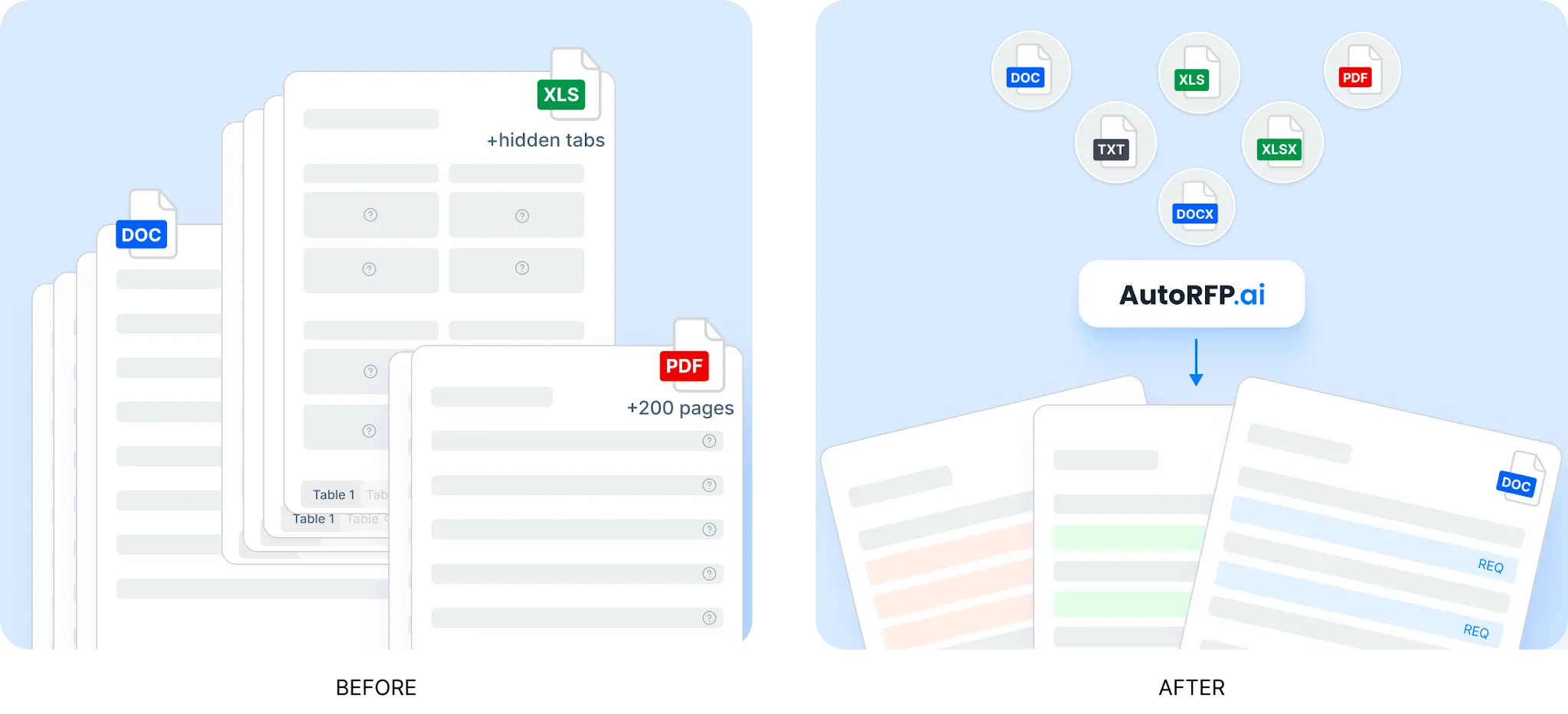
It can help identify:
- Mandatory requirements: Terms like “shall,” “must,” “required,” and “provide.”
- Hidden requirements: Instructions buried in appendices, attachments, pricing notes, legal terms, or portal guidance.
- Evaluation criteria: The standards the buyer will use to score the proposal.
- Submission constraints: File formats, deadlines, page limits, signatures, attachments, and response rules.
This gives the team a cleaner starting point for the compliance matrix, especially when the RFP is long, fragmented, or spread across multiple files.
2. Turn Extracted Requirements Into a Working Matrix
Once the requirements are extracted, AI RFP software can help structure them into a usable compliance matrix.
Instead of starting from a blank spreadsheet, teams can begin with the core fields already organized: requirement reference, requirement text, response location, owner, status, evidence, risk level, and review notes.
With AutoRFP.ai, the matrix becomes more than a static tracker. It gives the team a live view of what the buyer asked for, what needs to be answered, and where the response still needs work.
This helps teams track:
- Requirement reference: Where the requirement appears in the RFP.
- Compliance status: Whether the response is compliant, partially compliant, non-compliant, pending, or blocked.
- Response ownership: Who needs to draft, review, or approve the answer.
- Response location: Where the answer appears in the proposal.
- Evidence needs: Which documents, policies, certifications, or case studies support the answer.
The value here is control. The team can see the full bid picture earlier, instead of discovering gaps during final review.
3. Use Semantic Search to Match Requirements With Approved Content
A common problem with manual compliance matrices is that teams know the answer exists somewhere, but they cannot find the right source fast enough.
AutoRFP.ai uses Content Library Agentic Search to connect extracted requirements with approved company materials. Instead of only matching exact keywords, semantic search understands the meaning behind the buyer’s question.
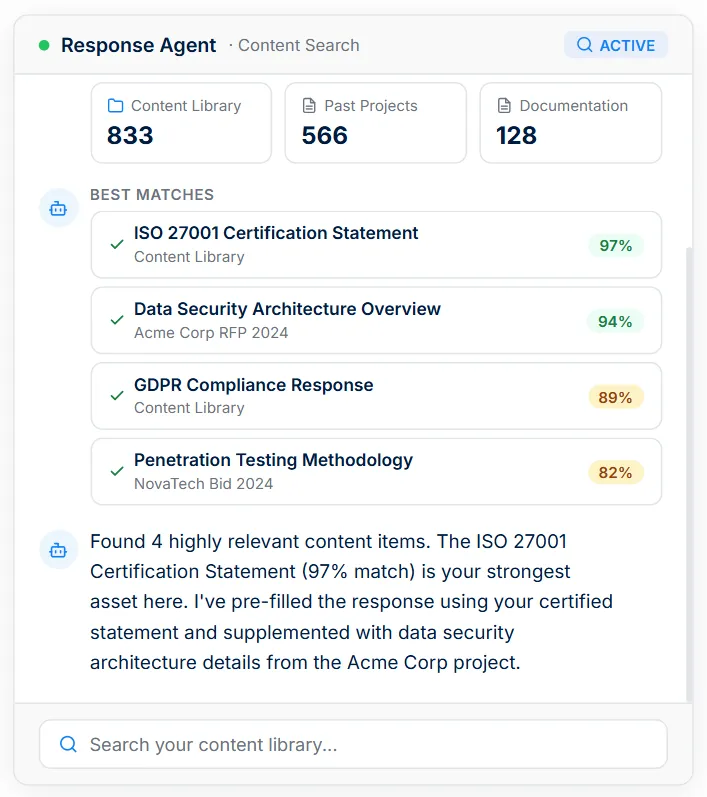
For example, if the RFP asks about “data residency,” the system can still find relevant content even if the approved source uses terms like “regional hosting,” “EU data storage,” or “cloud infrastructure location.”
This helps teams find:
- Past approved responses: Reusable answers from previous RFPs, DDQs, or questionnaires.
- Policy documents: Security, privacy, compliance, implementation, and support documentation.
- Proof points: Case studies, certifications, technical screenshots, and integration details.
- Product information: Approved details on capabilities, limitations, workflows, and roadmap-sensitive areas.
This keeps the matrix grounded in approved content instead of forcing writers to rebuild answers from memory.
4. Generate Source-Backed First Drafts
Once requirements are connected to approved content, AutoRFP.ai can create first-draft responses directly from the company’s approved knowledge base.
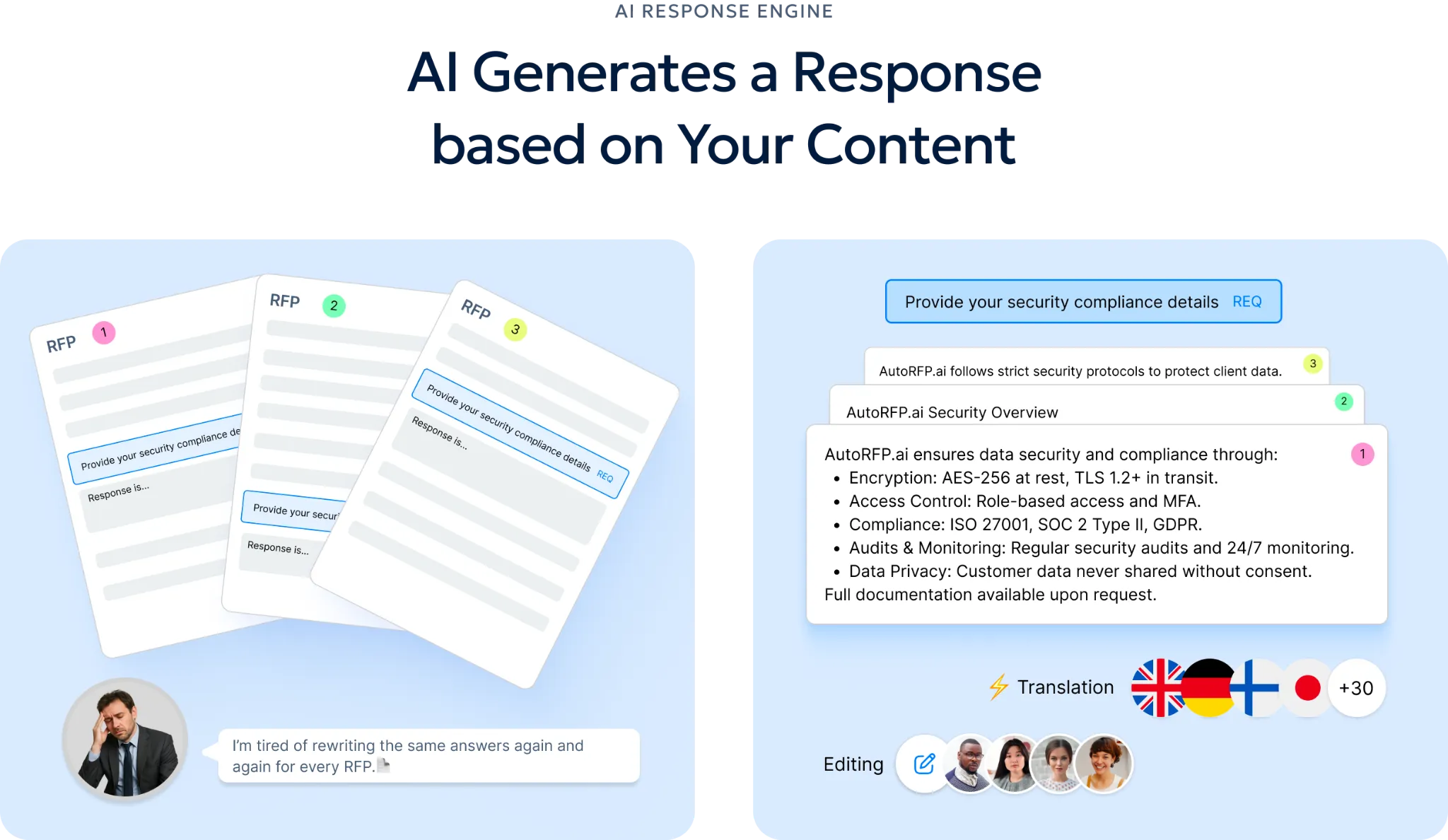
This is where AI helps the compliance matrix move from tracking to execution. The system does not just show that a requirement exists. It helps the team start answering it.
The important part is that AutoRFP.ai only writes from approved content. If it cannot find a reliable approved source, it does not force an answer. It leaves the response blank so the team knows the requirement needs SME input, clarification, or new source material.
This helps teams avoid:
- Unsupported claims: Answers that sound good but cannot be defended.
- Outdated content: Old responses that no longer match current products, policies, pricing, or certifications.
- Hallucinated answers: AI-generated claims with no approved source behind them.
- Reviewer confusion: Answers that cannot be traced back to the original evidence.
For high-stakes RFPs, this matters because speed only helps if the answer is accurate, traceable, and defensible.
5. Score Answers for Trust and Fit
A strong AI RFP tool should not just draft answers. It should help the team understand how much they can trust each answer.
AutoRFP.ai does this through scoring, so reviewers know where to focus first.
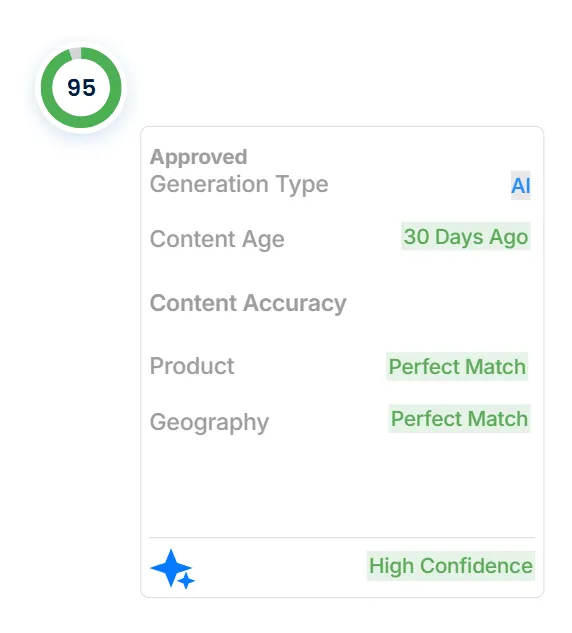
Two useful scores are:
- Trust Score: Shows which approved source, past content, file, or integration was used to draft the answer. This helps the team verify the facts before submission.
- Feedback Score: Gives suggestions to improve the draft so it better aligns with the buyer’s needs, win themes, and response expectations.
This makes the compliance matrix more useful during review. Instead of checking every answer from scratch, reviewers can focus on responses with low trust, missing evidence, partial compliance, or weak buyer alignment.
The result is a better review workflow: less time spent hunting for source documents, more time spent improving the quality of the response.
6. Track Collaboration, Ownership, and Risk in One Place
After the AI-first draft is created, the compliance matrix becomes the central project dashboard for the bid.
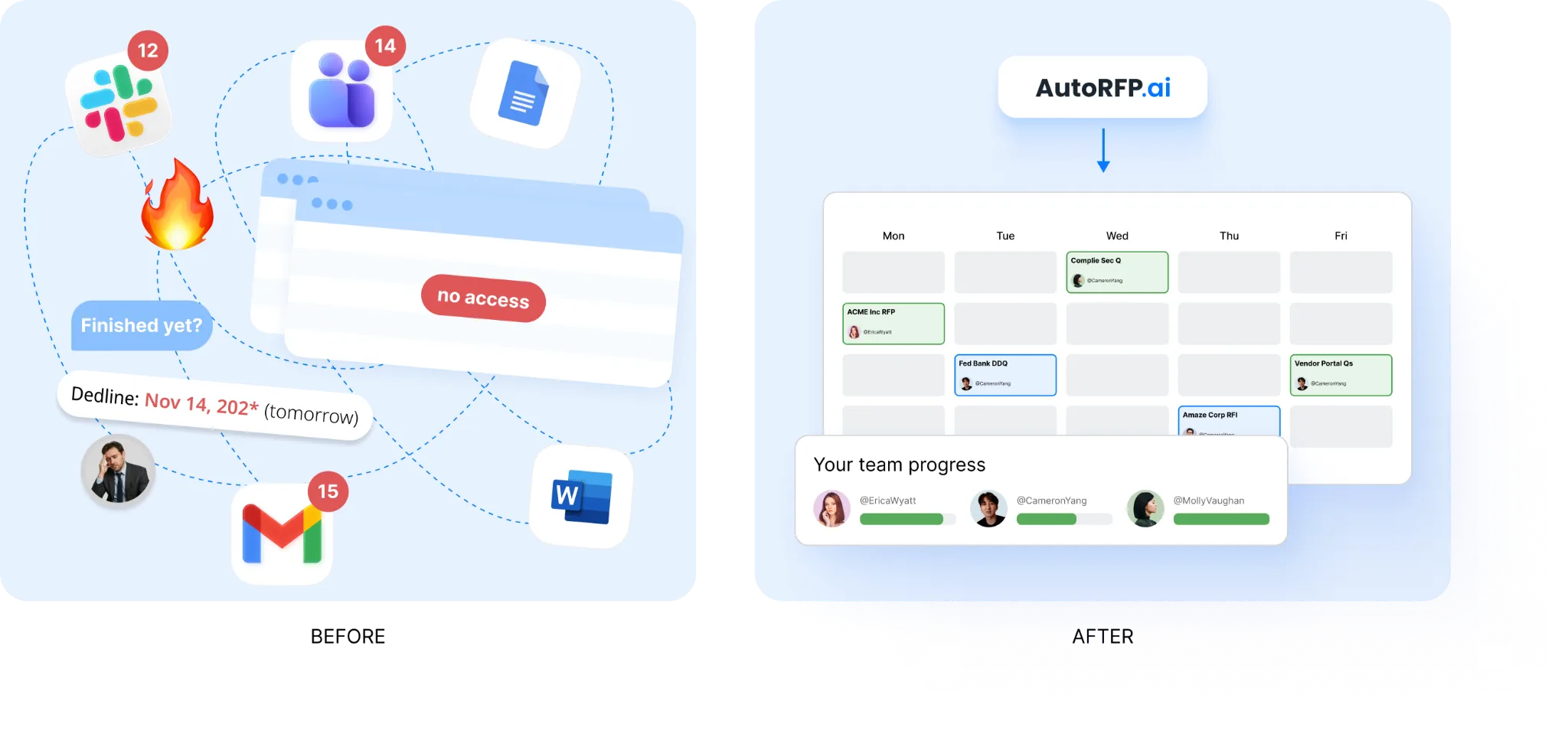
Teams can use it to see which requirements are compliant, which ones are still assigned, which ones need SME input, and which ones are at risk.
This is especially useful when multiple teams are involved, such as sales, proposal management, product, legal, security, finance, and implementation.
AutoRFP.ai helps teams manage:
- Assignments: Who owns each requirement or response.
- Status updates: Whether the answer is drafted, reviewed, approved, blocked, or needs revision.
- SME collaboration: Where experts need to add details, verify facts, or resolve gaps.
- Internal notes: Assumptions, clarifications, buyer context, and reviewer comments.
- Risk visibility: Requirements that are non-compliant, partially compliant, unsupported, or strategically sensitive.
This keeps the compliance matrix active throughout the proposal process instead of becoming a kickoff document that nobody updates.
7. Use Gap Analysis to Find Patterns Across RFPs
AI can also help beyond a single proposal. Over time, AutoRFP.ai’s RFP Gap Analysis Report can aggregate compliance data across every RFP and show which requirements your team consistently struggles to meet.
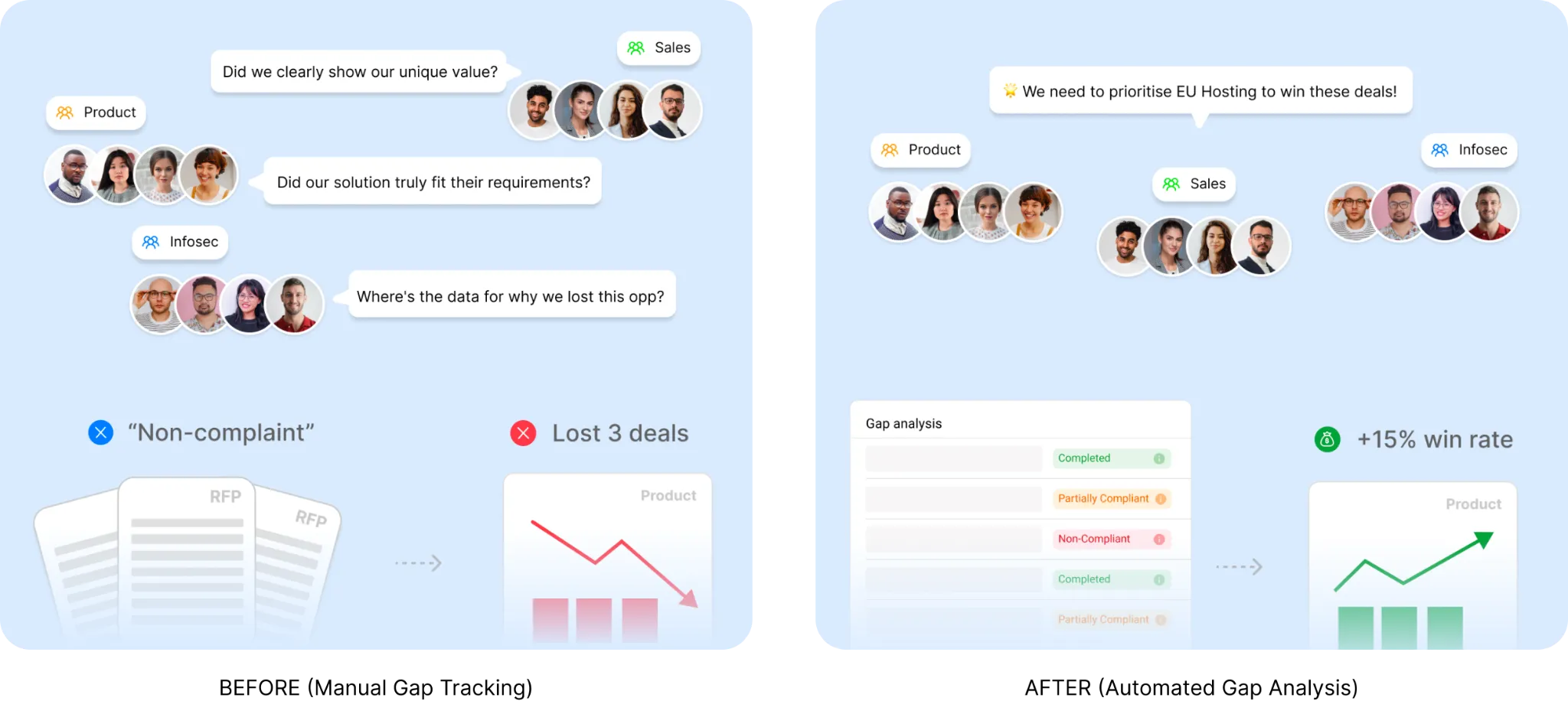
That turns compliance tracking into business intelligence.
For example, if your team marks “non-compliant” on EU data hosting three times in one quarter, that is not just a proposal issue. It may be a product gap affecting revenue.
The gap analysis can help teams track:
- Repeated non-compliance: Requirements the company fails across multiple RFPs.
- Partial compliance patterns: Areas where answers need exceptions or extra explanation.
- High-value risk areas: Gaps connected to large opportunities or strategic accounts.
- Requirement categories: Security, hosting, compliance, integrations, accessibility, features, pricing, or support.
- Trend data: How often the issue appears and how much pipeline it affects.
This helps proposal teams give product, security, legal, and leadership a clearer view of what buyers keep asking for and where the company may be losing points.


Video transcript
Did you know the average RFP can take thirty-two hours of manual grueling work? Now, in this video, in under ten minutes, I'm gonna show you how you can use AI RFP automation to drastically reduce the amount of time it takes to get to a first draft for your RFP, DDQ or security questionnaire using AutoRFP.ai. Sick. Let's jump into it. So at AutoRFP, we're an AI RFP software automation platform, across the globe with hundreds of customers using our software every day, battle-tested AI to help you automate RFPs. First, what's the problem? So an RFP or request for proposal or due diligence questionnaire or security questionnaire is a pain felt across all industries, whether it's construction, software, technology, finance, healthcare, anyone selling
to government or private businesses. And these glorified question and answers take hours and hours for people to complete, for them to win new business. It's a crucial part for your business to win enterprise and government contracts, which really help you grow sustainably and quickly. But when you go to bid on one, you are met with the RFP. Average response times are thirty to forty hours, usually involve five to eight people, seventy percent of content is reused but hard to find, and the average win rate across all industries is only forty-three percent. So you're spending hours with uncertainty that you may win, which is where efficiency and writing better responses, leveraging AI helps you win more faster. Now, looking into RFP automation, you have a number of options.
You can pick up a legacy RFP software. They've been around since the late nineties. They brought software to the RFP problem. Effectively, a glorified question and answer bank, like a database. You upload Q&A pairs, and then they try to use keyword matching to find the most relevant to then help you answer questions that you get in your new RFPs and tenders. You can also do AI builds yourself. So you might use ChatGPT or Claude, and you can see our other videos about how you can potentially use them. But effectively, you hit a ceiling where it's hallucinating, it's taking more time now to fix things than it should, and just doesn't have enough context to find the right answer most of the time. Or you can choose an actual AI native leader like AutoRFP.ai. Built from AI from the get go and have built the engine around zero
hallucination, multimodal architecture to leverage the latest models across all your major providers, library-less approach, so it doesn't take a lot of time to maintain the system, really high automation rates and enterprise security built in from day dot. So why do teams choose AutoRFP.ai? The reason is your knowledge is always current. We integrate with over twenty different systems, and we pull in from all your various file management and different software to make sure that your data is always up to date, and you don't have to maintain it across multiple different places. We're most accurate in the category because we leverage the different models, including specialized re-ranker models, embedding models, search models, and your large language models where they're best. And our team of over fifteen software engineers and AI engineers make sure that this is battle-tested, evals are correct, and it produces the correct answer based off your source context. And it's one platform for every stage of the RFP journey, from intake to new RFP
to AI-powered go/no-go to drafting to reviewing and using agents to review and update your RFP response, translation to collaboration across SMEs and different team members, ensuring that they can easily collaborate in an easy-to-use platform, and then exporting as well. Let's start with the AI native auto library. This is the core of the platform where your different content sources and past projects and up- and web scraping all live in the one place and- Any question that comes up, whether it's in an RFP or a team member asking the question, can be automatically answered with trust-based scores, specific semantic search, and ensures that the correct answer is found and used to then answer and generate an appropriate response. Then effectively, you upload a blank RFP.
The AI-powered response engine then automatically generates responses, translates it and everything to have the correct answers. Then your team can very easily edit, review, integrates with Slack and Teams, and everyone's notified on project deadlines. Now, I've spoken enough. Let's jump into the actual product, and you can see AI RFP automation from the start. We start by creating a project, which is a new RFP. We've got our portal agent that can scrape your requirements from web portals like SAP, Ariba and others, automatically ingesting those answers into your AutoRFP.ai instance, and then automatically drafting responses for you to easily enter back into the portal. Or you can upload a zip that contains a PDF, Excel, Word doc of your RFP and import that into the platform.
First we have our AI go, no-go. This ask different questions of your RFP based on your company context to ensure that should we actually bid on this RFP before we start it. It'll automatically grab out key details and link it to our CRM via our integration with Salesforce and so on. And here it's answered each question, and you can see it has confidence levels, it has trust built in, and you can then look back and see where the original source and what, for instance, table or other information. Our AI importer automatically selects every requirement, child requirements, dropdown pick lists response cells, everything else that's required for that RFP. We can manually change it if needed, but it automatically pulls that in. Then we can choose what content from our library or just choose every content, and our intelligent tagging and hierarchy system will make sure that the most relevant content is used for that response. And then I can create my project.
Next, the AI response engine then automatically starts sourcing the correct content from your auto library, re-ranking and finding the most relevant information, using that to then draft, redraft, and edit responses vi- with AI, and then provide those responses back to you in matter of seconds. And you can see here my thirty or so requirements automatically being filled out across the entire project. It's chosen the relevant pick lists, and each one of these have trust scores that I can understand further where this came from. It also has our AI-powered feedback score, and this is where AutoRFP is different to other systems. We don't wanna just help you source the correct answers. We wanna help you write better responses. And this goes into our feedback loop, where as you use the platform and write better responses, the AutoRFP system learns from those responses, and continually, your responses get better to help you win more faster.
Here we can do inline comments, so I can notify my team and so they can jump in, get notifications. I can submit, approve, add attachments, and everything else I can do in this platform. Finally, we have our project overview, which is our project management HQ for this particular RFP, making sure everyone understands deadlines. You can send reminders out to team members and just know when something needs to be completed by and when completed by and who is completing it, making sure that your RFP response is submitted on time and you're not faced with five PM Friday deadlines, calling someone to make sure you can get the correct answer to the correct question that's our short introduction to AutoRFP.ai. There's a lot more in RFP automation and AI RFP software that you can learn but feel free to reach out to our team. We'd love to provide a detailed demonstration to you so you can understand if this is a good fit for your business Already, AutoRFP.ai is in forty-four-plus countries across the globe with hundreds
of customers across different industries like technology, finance, and healthcare, and our customers are winning more faster. One of our customers like Shana Sweeney from SugarCRM won fifteen of their top twenty-five enterprise customers using AutoRFP.ai. They're using AI RFP automation to win more today, and it's a competitive advantage for their businesses. Our pricing is incredibly transparent. You can find more information on our website, to get in touch with our team, head over to our website, AutoRFP.ai. Book in a demo today and learn more and see if we can help you win more faster.
Automate Your RFP Responses & Win More With AutoRFP.ai
Compliance matrices help teams control the bid, but building and updating them manually slows every response. AutoRFP.ai helps you extract requirements, identify gaps, draft from approved content, score answer trust, and keep reviewers focused on the responses that need attention most.
Instead of chasing owners, evidence, and status updates across spreadsheets, your team gets a clearer path from RFP upload to submission-ready response.
Book a demo to see how AutoRFP.ai helps you automate RFP responses and win more today.
About the author

Co-founder & CEO
Co-founder and CEO of AutoRFP.ai. Spent 7 years in enterprise sales and personally completed 500+ RFPs before founding the company.
LinkedInFrequently asked questions
How Is a Compliance Matrix Different From a Requirements Matrix?
A requirements matrix mainly tracks what the buyer is asking for. It captures the RFP requirements, references, clauses, and instructions. A proposal compliance matrix goes further. It shows whether each requirement is addressed, where it is answered in the proposal, who owns it, what evidence supports it, and whether the response is compliant, partially compliant, or still at risk. So, the requirements matrix captures the ask. The compliance matrix helps prove your proposal answers the ask.
Who Creates the Compliance Matrix?
The proposal manager, bid manager, or capture lead usually creates the compliance matrix. But they should not build it alone. Sales, SMEs, legal, security, pricing, product, and implementation teams may all need to contribute, depending on the RFP. The proposal lead owns the matrix, but each team is responsible for confirming the requirements that fall under their area. AI RFP software can help extract and structure the requirements, but the team still needs to validate the matrix before drafting and submission.
When Should You Build a Compliance Matrix?
Build the compliance matrix as soon as the RFP is reviewed and the team decides to pursue the opportunity. It should come before full proposal drafting, not after. That gives the team enough time to identify mandatory requirements, assign owners, flag risks, collect evidence, and connect the response to the right win themes. The matrix should also stay active through drafting, Pink Team review, Red Team review, final QA, and submission.
How Does AutoRFP.ai Generate More Accurate RFP Responses?
AutoRFP.ai uses a multi-model pipeline to improve response accuracy across different stages of the workflow. That pipeline includes retrieval, re-ranking, drafting, redrafting, and checking across multiple frontier models chosen for their strengths. This helps the platform find the right approved content, draft stronger responses, verify the output, and reduce the risk of weak or unsupported answers.
Is AutoRFP.ai Secure Enough for Enterprise RFP Teams?
Yes. AutoRFP.ai supports enterprise trust requirements such as SOC 2 Type II, ISO 27001, no training on customer data, regional hosting, single-tenant or private options, sequential approval workflows, version history, and audit trails. That makes it suitable for teams handling high-stakes RFPs, security questionnaires, DDQs, and other responses where accuracy, governance, and source control matter.
